


Traditional Leather Saddle
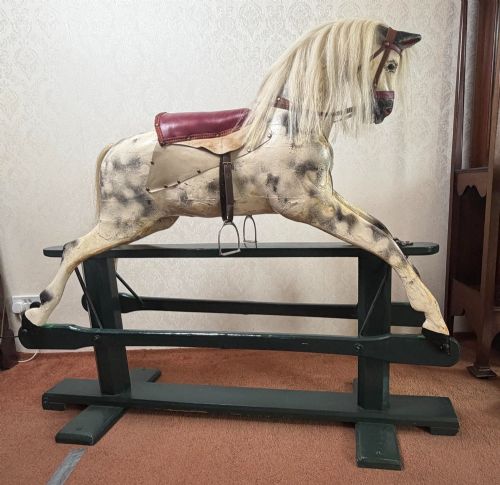
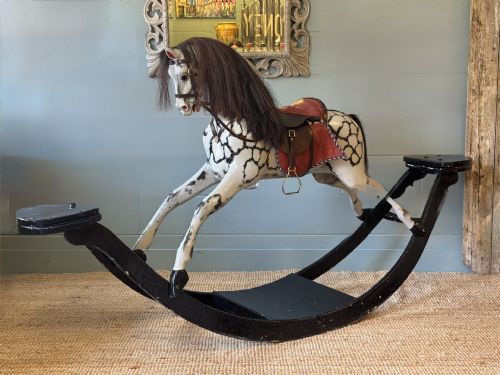
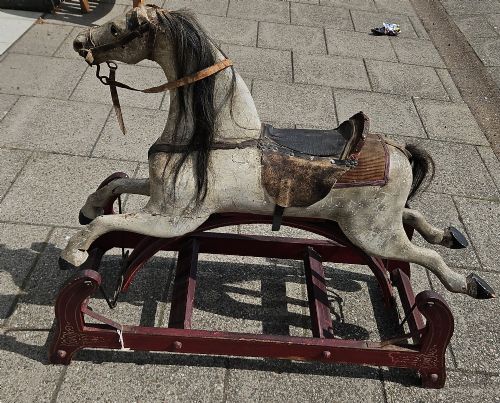
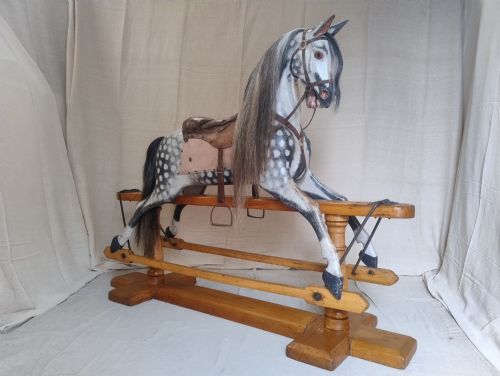
These pieces known as a traditional leather saddle serve the equestrian world and equip antique rocking horses from the Victorian period through to the mid twentieth century.
Traditional Leather Saddle
A traditional leather saddle represents the hardware used in equestrian pursuits and fitted to antique rocking horses across the nineteenth and twentieth centuries. Buyers searching for a traditional leather saddle encounter items originating from the Victorian era, Edwardian period, and the interwar years.
The objects span actual antique riding gear and the tack belonging to carved wooden rocking horses made by makers such as F.H. Ayres and G & J Lines. These pieces embody the traditional craftsmanship of British toy makers and saddlers working in pine, wood, and leather.
Most examples found on this page connect directly to antique toys rather than working horses, reflecting the survival of rocking horses over centuries. Each item carries the marks of its period, from late nineteenth century traditional styles to vintage British designs.
How they were made
Makers constructed these items using natural materials including leather, horsehair, wood, and metal components. Saddlers and toy makers shaped carved pine and other woods to form the bases or mounted animals, then stitched leather and stuffed them with horsehair.
Iron and steel parts provided structural support and mechanical connection points for both riding equipment and rocking horse assemblies. Artisans applied painted finishes to wooden surfaces, often creating dappled effects on toy horses that carried the leather tack.
Many of these sturdy wooden steeds survived generations of childhood gallops, still wearing their original leather tack with quiet dignity.
What varies in quality
The standard of an item depends upon the depth of the carver's detail in the wooden components and the grade of the leather used for the saddle itself. Pieces originating from established workshops display superior joinery and more refined sculptural work on the horse bodies that support the tack.
Preservation of original materials, such as the survival of initial horsehair stuffing and early painted surfaces, distinguishes finer examples. The integrity of the metal stirrups, iron framing, and glass eye details further separates standard production items from masterworks.
G & J Lines of London·F.H. Ayres·Collinson
The Traditional Leather Saddle Glossary
- Rocking horse
- A carved wooden toy mounted on curved wooden rockers or a safety stand, designed for children to ride. These toys frequently feature mounted leather saddles and horsehair manes.
- Tack
- The equipment used in horse riding, including saddles, bridles, and stirrups. In this context, the term applies to the miniature leather gear fitted onto antique toy horses.
- Dappled
- A coat pattern on a horse featuring spots or patches of a darker colour over a lighter base. Makers achieved this finish on wooden rocking horses using specialised painting techniques.
- Carved pine
- A method of shaping softwood timber using chisels and gouges to create three dimensional forms. Many nineteenth century toy horses and rocking horse bodies relied on this material before being covered in gesso and painted.
Traditional Leather Saddle: Frequently Asked Questions
How do I date an antique rocking horse saddle?
Dating relies on examining the stitching methods, the type of leather, and the accompanying rocking horse construction. Victorian and Edwardian examples show distinct tanning methods and iron hardware.
Comparing the saddle to documented pieces by makers like F.H. Ayres or G & J Lines helps narrow the production decade between eighteen eighty and nineteen forty.
Are these saddles meant for real horses?
The inventory on this page includes both full sized antique riding saddles and miniature saddles made specifically for rocking horses. Reviewing the dimensions and attachment points clarifies the intended use.
Miniature versions are proportioned for carved wooden toys rather than live equines, reflecting nineteenth century toy manufacturing standards.
What materials make up these pieces?
Traditional construction relies on genuine leather, horsehair stuffing, and wood reinforced with iron or steel hardware. Glass components occasionally appear as eyes on the associated animals.
Pine and other carved woods form the underlying structures of the toys that carry the leather work.
How should I clean antique leather?
Preserving antique leather requires minimal intervention to maintain the original surface and prevent degradation. Dusting with a soft cloth removes surface particles safely.
Avoid modern chemical cleaners that might strip the historic finish or soften the aged material beyond its natural state.