
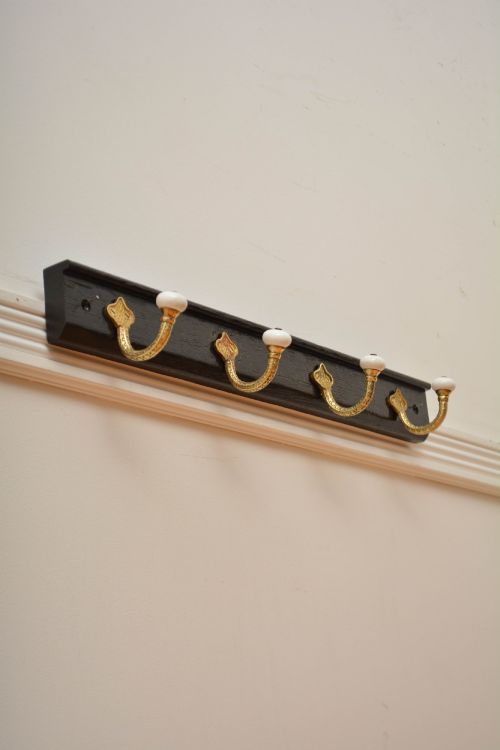
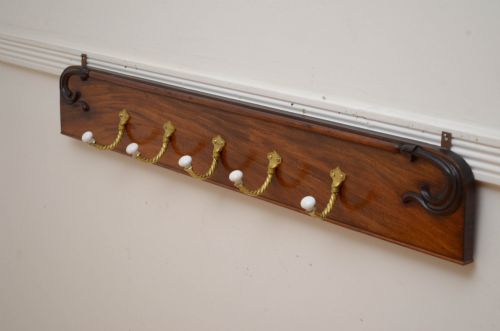
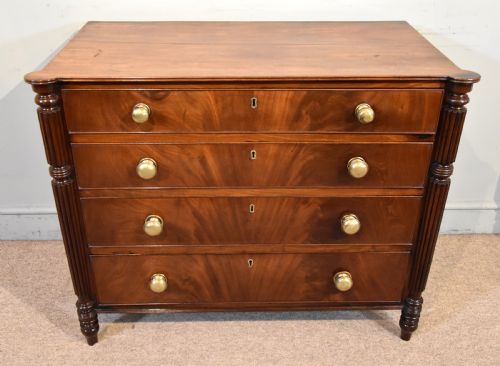


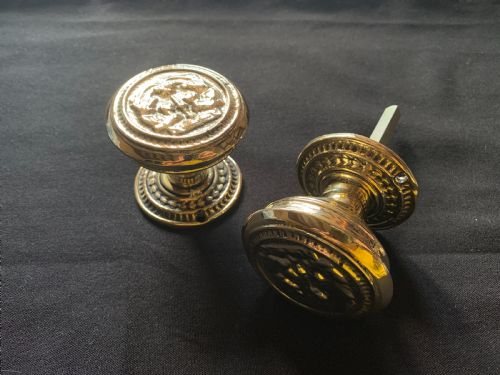

Traditional Brass Knobs
Traditional brass knobs offer solid weight and reliable function, bringing period character to doors throughout the house.
Traditional Brass Knobs
Traditional brass knobs encompass centre door furniture and pairs designed for interior doors, featuring prominently across Victorian, Georgian, and Regency periods. Buyers searching for traditional brass knobs will encounter single centre pieces alongside matched pairs in various turnings.
The selections span architectural ironmongery ranging from plain ovals to beehive turnings and octagonal forms. Pieces appear in solid brass as well as combined with ceramic or wooden elements, reflecting the distinct aesthetic preferences of each era.
Materials and construction methods
Metalworking techniques utilise cast brass and bronze to form the primary hardware bodies, often paired with contrasting materials such as mahogany, ebonised oak, and ceramic components. Component parts are assembled with integrated steel and iron fixings to ensure structural durability.
Surface finishing relies on period-appropriate polishing and natural oxidation, allowing the metal to develop an authentic patina over decades of handling.
Listings span the Georgian, Regency, William IV, Victorian, and Edwardian periods, utilising brass, bronze, mahogany, ceramic, and ebonised oak.
Assessing quality and craftsmanship
Quality rests in the crispness of the casting and the precision of the turning, particularly evident in the execution of intricate profiles like beehive rings or octagonal facets. Heavier metal gauge indicates superior substance and longevity.
The integrity of the connection between the metal collar and any inserted ceramic or wooden elements determines the structural soundness of the piece.
The Traditional Brass Knobs Glossary
- Beehive
- A decorative turning characterised by concentric raised rings resembling a traditional skep. This profile provides both tactile grip and distinct visual rhythm.
- Centre door knob
- A stationary handle mounted in the middle of an exterior or principal door rather than at the edge. These pieces often serve a decorative and pulling function.
- Ovular
- Having an egg-like or oval shape that fits comfortably within the hand. This form appears frequently across Georgian and Victorian hardware designs.
- Arts and Crafts
- A design movement prioritising honest construction and visible material qualities over excessive machine ornamentation. Hardware from this tradition displays straightforward, robust forms.
- Ebonised
- Wood treated with a chemical stain or finish to imitate ebony. This dark surface creates a sharp contrast against bright brass metalwork.
Traditional Brass Knobs: Frequently Asked Questions
How do I clean brass knobs?
Maintenance requires gentle wiping with a soft cloth to remove dust and preserve the existing surface layer. Avoid harsh abrasives that strip away the historical oxidation.
Leaving the natural patina intact generally preserves the character and visual depth expected from period architectural hardware.
Are these knobs suitable for modern doors?
Many historical door fixtures fit standard modern spindle sizes and latch mechanisms with minimal adjustment. Checking the spindle dimensions ensures straightforward installation on existing doors.
Careful measurement of the backplate and rose prevents interference with modern lock cases.
What is the difference between pairs and centre knobs?
Matched pairs connect through a spindle to operate a latch from both sides of a door. Centre knobs fix rigidly to one side only and do not turn a latch.
Centre pieces function primarily as pulls or knockers rather than operational door handles.
How can I tell a Victorian knob from a Georgian one?
Georgian examples often lean towards smooth, ovular profiles and restrained geometric proportions. Victorian pieces frequently introduce more ornate patterns, including beehive turnings and multi-faceted octagonal shapes.
Material combinations also shift, with Victorians frequently incorporating ceramic inserts alongside the cast metal.