


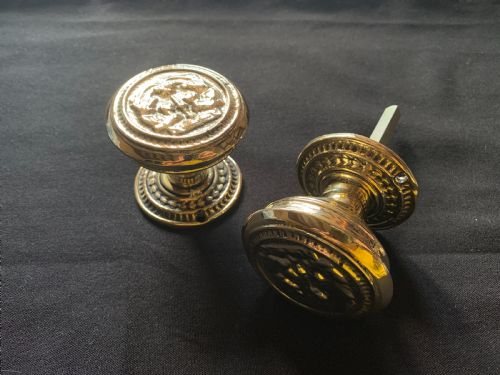


Traditional Brass Door Knobs
Traditional brass door knobs bring weight and tactile presence to a room, offering the distinct character of Victorian, Georgian, Regency, Edwardian, Arts and Crafts, and Art Nouveau periods.
Traditional Brass Door Knobs
Traditional brass door knobs form a solid group of architectural hardware spanning the Victorian, Georgian, Regency, Edwardian, Arts and Crafts, and Art Nouveau eras. The items listed now consist predominantly of single centre door knobs and matched pairs designed for period interior doors.
Most examples found here are cast in solid brass, sometimes paired with bronze, iron, steel, or oak components. Formats range from simple round profiles to distinct beehive, octagonal, ovular, and oval shapes, alongside complete door lock sets.
How they were made
Makers of traditional brass door knobs relied on metal casting techniques to form the main bodies in brass and bronze. These metals were often turned or shaped on lathes to achieve precise profiles such as the popular beehive and octagonal patterns.
Assembly frequently combined brass components with wooden elements like oak, or internal iron and steel mechanisms to ensure durability. Surface finishing was achieved through polishing or natural patination over time.
Listings feature items spanning Victorian, Georgian, Regency, Edwardian, Arts and Crafts, and Art Nouveau styles.
What varies in quality
The distinction between ordinary and superior examples lies in the weight of the metal and the crispness of the cast detail. Heavier solid brass castings maintain a more substantial feel in the hand compared to lighter alternatives.
Complexity of design also separates standard hardware from finer pieces, particularly where specialised shapes like beehive turnings, geometric octagonal facets, or integrated locks are executed with precision.
The Traditional Brass Door Knobs Glossary
- Centre door knob
- A large stationary knob mounted in the middle of a main entrance door rather than at the edge. These are typically used for pulling heavy doors shut.
- Beehive
- A decorative turning style featuring concentric raised ridges resembling a traditional beehive. This pattern provides a secure and tactile grip.
- Octagonal
- A shape possessing eight distinct sides formed during the manufacturing process. It offers both visual geometry and a comfortable grip in the hand.
- Spindle
- The central metal rod that connects a pair of door knobs through the door latch. It transmits the turning motion to retract the latch bolt.
Traditional Brass Door Knobs: Frequently Asked Questions
Are these door knobs suitable for daily use?
These period pieces were built for everyday architectural service and function reliably on interior doors today.
Their robust construction in solid brass and bronze ensures they withstand regular handling in modern homes.
What is a centre door knob?
A centre door knob is a stationary handle fixed to the middle of a front or heavy interior door.
Unlike latching pairs, it serves as a pull handle rather than a mechanism to open a latch.
How do I identify a Victorian door knob?
Victorian examples often display distinct decorative forms such as beehive turnings or octagonal facets in solid brass.
They frequently appear as single centre knobs or matched pairs designed for heavy timber doors.
Can I install these on modern doors?
Most traditional knobs fit standard architectural preparations, though older spindle sizes may require slight adjustment.
Checking the spindle and fixing dimensions ensures smooth integration with existing latches.