




Tooled Leather Writing Table
A tooled leather writing table brings a distinct surface of gold-tooled hide set into timber frames of mahogany, walnut, or rosewood.

Tooled Leather Writing Table
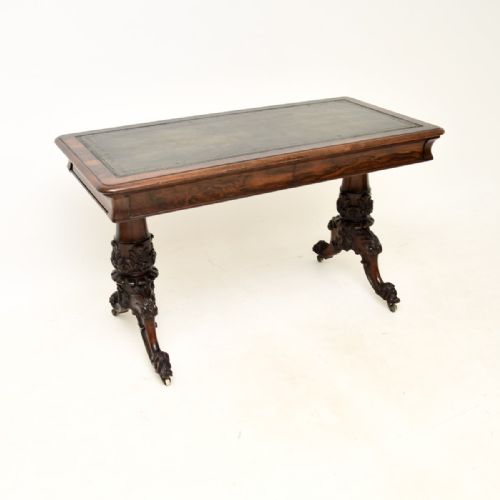
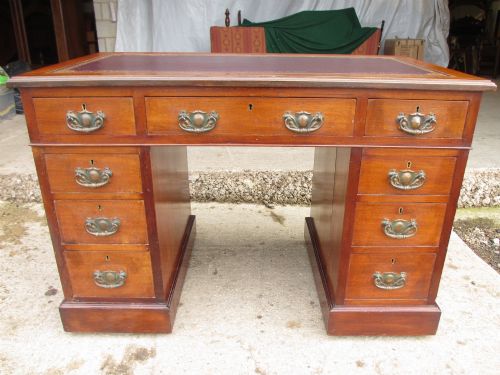
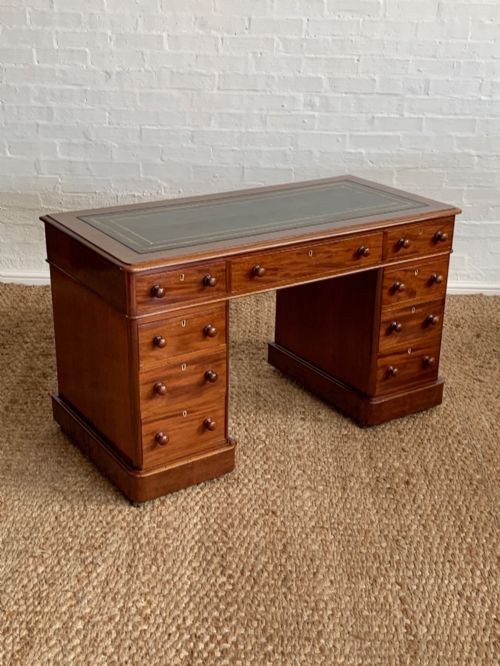
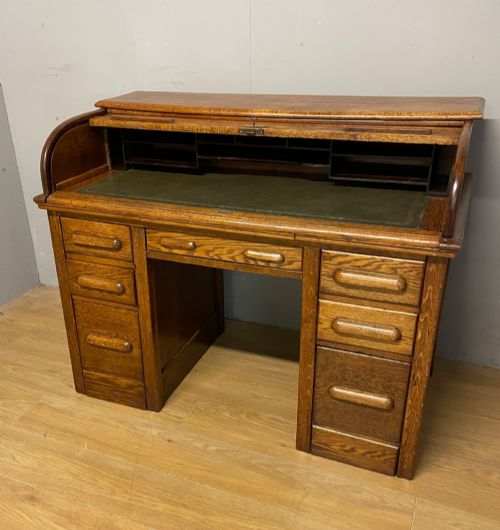
A tooled leather writing table combines a functional workspace with period cabinetry, spanning forms from pedestal desks to kneehole writing tables and freestanding centre tables. You will most commonly encounter Victorian and nineteenth-century examples executed in mahogany, walnut, or oak, often finished with inset leather surfaces decorated in gilt toolwork.
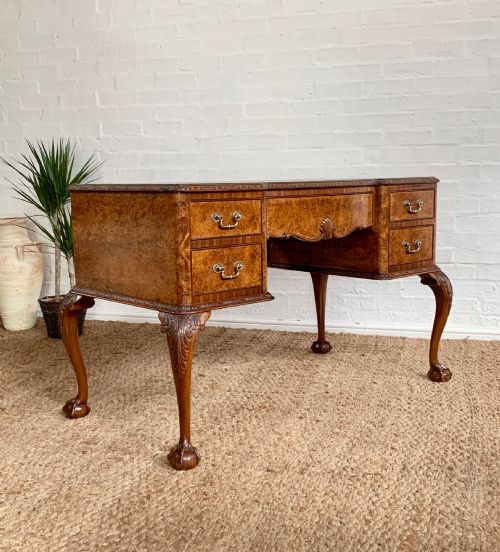
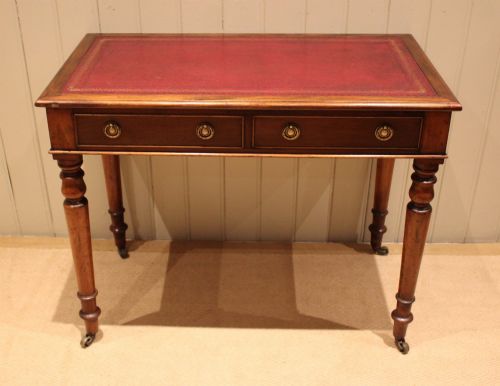
The architectural layout ranges from twin-pedestal partner desks and compact ladies writing tables to kidney-shaped side tables and library tables. These pieces originated to serve correspondence and administrative tasks in domestic studies, drawing rooms, and institutional libraries.
Makers adapted regional stylistic shifts over the decades, moving from William IV and early Victorian proportions through Arts and Crafts oak iterations to Edwardian refinements. The unifying element remains the inset leather skiver, bordered by blind or gilt-tooled patterns that define the writing surface.
Materials and Construction
Cabinetmakers constructed the structural carcasses primarily from dense hardwoods like mahogany, walnut, and rosewood, frequently incorporating burr veneers or inlaid details on drawer fronts and top frames. Oak and ebonised timbers also appear across specific revival and Arts and Crafts pieces.
The inset writing surfaces utilise leather hides, often dyed in tones of green, olive, or Moroccan shades, which are secured into recessed wooden channels. Artisans applied gold leaf tooling or blind stamping around the perimeter of the leather to frame the central writing area.
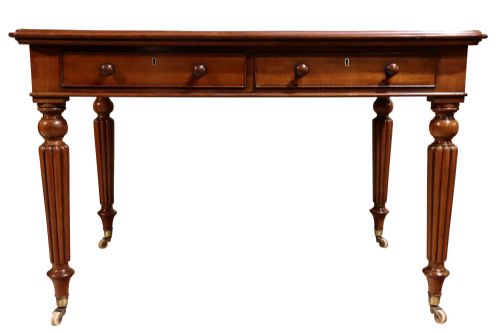
Secondary structural elements include brass handles, drawer pulls, and occasionally gilt ormolu mounts on French-influenced bureau plat designs. Drawer boxes typically employ traditional dovetail joinery, while legs range from reeded and turned supports to cabriole configurations.
Tooled Leather Writing Table Retail Price Guide 2026
Typical asking prices for tooled leather writing table among the pieces listed under this phrase on Sellingantiques today, from the lower quarter to the upper quarter. They describe what is for sale here now, not the wider market.
Some nineteenth-century models feature royal commemorative leather tooling, turning an ordinary spot for writing into a miniature historical archive.
Quality Variations
The grade of the timber and the precision of the cabinet work dictate the primary distinction between standard utility desks and superior examples. Finer pieces employ carefully selected burr walnut, figured mahogany, or rosewood veneers matched across drawer banks and top surfaces.
The execution of the leather tooling and the quality of the hide separate workshop tiers. Crisp, deep gold leaf impressions demonstrate a higher standard of craftsmanship than shallow or worn blind stamping on simpler secondary surfaces.
Structural integrity, including the weight of the timber, the thickness of the solid secondary woods inside drawers, and the integration of original brass hardware or mounts, determines the overall calibre of the piece.
Maple and Co
The Tooled Leather Writing Table Glossary
- Skiver
- The leather panel inset into the top of a desk or table to provide a smooth writing surface. This insert is frequently bordered with gold leaf tooling.
- Pedestal desk
- A heavy freestanding desk comprising two supporting banks of drawers beneath the main writing top. These pieces often feature leather inserts across the upper surface.
- Ormolu
- Gilt-bronze mounts applied for decorative effect on the framework or drawers of specific continental-style tables. This technique appears on French-influenced bureau plat designs.
- Kneehole desk
- A compact desk configuration featuring a central recess for the user's legs, flanked by single or double columns of drawers. This form suits smaller studies and writing rooms.
- Reeded legs
- Cylindrical furniture supports carved with parallel convex mouldings running vertically down the shaft. This decorative turning style occurs frequently on nineteenth-century mahogany tables.
Tooled Leather Writing Table: Frequently Asked Questions
What is a pedestal desk?
A pedestal desk is a heavy freestanding writing table supported by two vertical banks of drawers that rest directly on the floor. The top surface typically incorporates a tooled leather writing insert.
These pieces were designed to stand proudly in the centre of a room rather than against a wall, offering storage and workspace on both sides in partner configurations.
How do I care for leather desk tops?
Leather writing surfaces require gentle cleaning with a slightly damp cloth followed by appropriate leather balms to prevent the hide from drying out. Avoid harsh chemical cleaners that can lift the gold leaf tooling.
Keeping the surface protected from direct sunlight and excessive moisture preserves both the suppleness of the leather and the clarity of the gilt borders.
Where were these tables used?
These tables served as functional writing surfaces in domestic libraries, private studies, drawing rooms, and commercial offices throughout the nineteenth and early twentieth centuries. They accommodated correspondence, accounting, and reading.
Smaller ladies writing tables were typically placed in private boudoirs or reception rooms, while larger partner desks anchored professional offices and estate libraries.
How do I identify Victorian examples?
Victorian writing tables display characteristic dense hardwoods like mahogany and walnut, often paired with hand-tooled leather skivers in green, olive, or Moroccan shades. Structural markers include dovetailed drawer construction and turned or reeded legs.
Stylistic cues range from heavy, carved proportions typical of mid-century pieces to lighter aesthetic movement or ebonised designs from the late nineteenth century.