

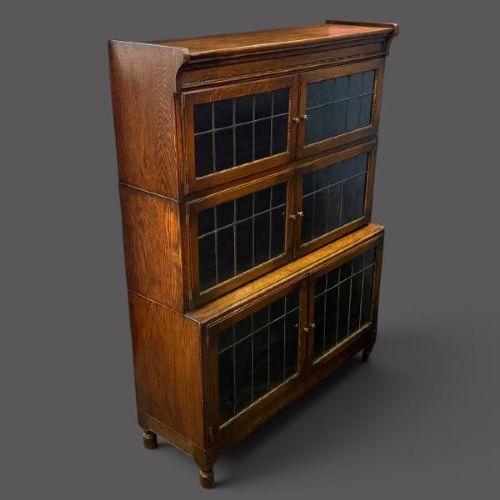
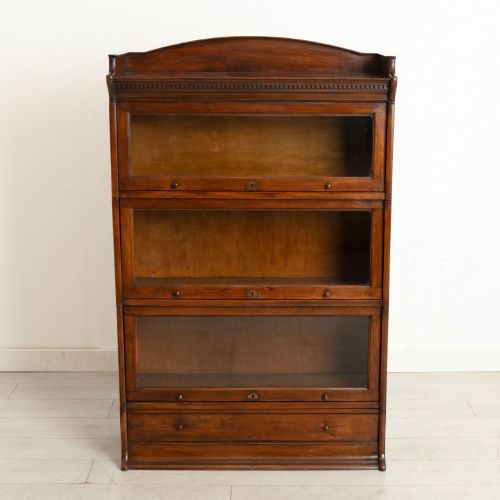
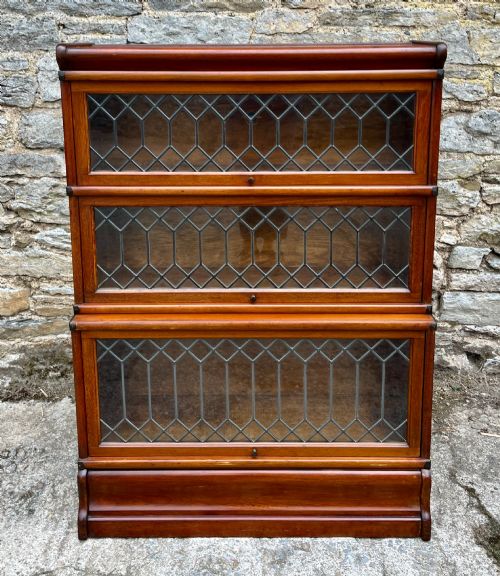
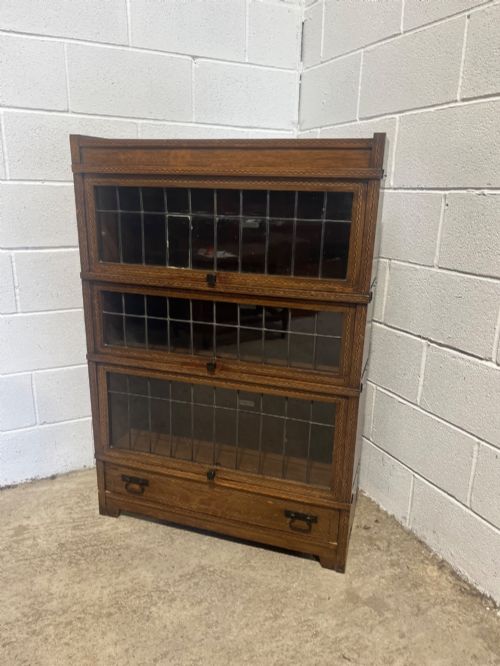




Three Tier Stacking Bookcase
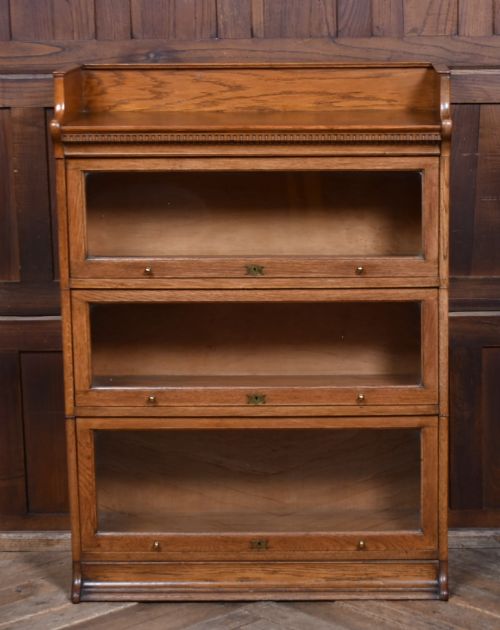
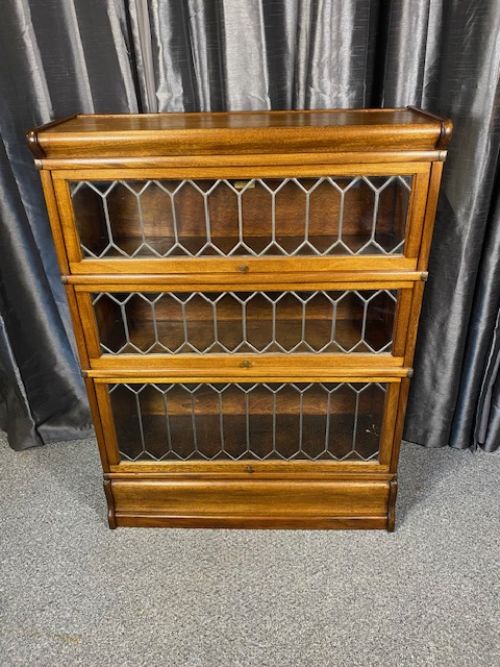
A three tier stacking bookcase is a modular sectional cabinet that offers flexible shelving with glazed lift-up doors.
Three Tier Stacking Bookcase
When you search for a three tier stacking bookcase, you are looking at modular sectional furniture designed to hold books behind protective glass panels. These cabinets are built in separate tiers that stack one upon another beneath a top cornice and above a base plinth.
The versions you are most likely to meet on this page hail from the early twentieth century, spanning Edwardian, Arts and Crafts, and Art Deco periods. They appear predominantly in oak and mahogany, with occasional variations in limed oak and wood inlay.
Makers such as Globe Wernicke, Lebus, Heal's, and Minty dominate these listings, establishing the standard forms for sectional barrister bookcases. Each tier operates independently with a metal or brass mechanism to lift and slide the glazed door inward.
Construction and materials
These bookcases were constructed using solid timbers like oak and mahogany, often framed to house glass panes secured with lead or traditional putty. The modular sections were engineered to interlock cleanly without permanent fixings, allowing the cabinet to be dismantled easily.
Makers integrated brass and metal hardware to govern the movement of the glazed doors, ensuring each tier functioned smoothly as a standalone unit. Detail work included subtle wood inlay and specialised finishes such as limed oak to suit changing aesthetic tastes across the decades.
Three Tier Stacking Bookcase Retail Price Guide 2026
Typical asking prices for three tier stacking bookcase among the pieces listed under this phrase on Sellingantiques today, from the lower quarter to the upper quarter. They describe what is for sale here now, not the wider market.
Every barrister had to ensure their heavy legal volumes did not trap wandering fingers when shutting those clever sliding glass doors.
Assessing quality and craftsmanship
The distinction between standard production and finer examples rests upon the selection of timber and the precision of the modular joinery. Solid oak and rich mahogany command attention for their grain depth and structural integrity compared to simpler utility builds.
Hardware implementation also defines the tier; original brass mechanisms and intact leaded glass elevate a piece above replacements or later adaptations. Maker attribution to firms like Globe Wernicke or Heal's signals higher standards of period cabinet making.
Globe Wernicke·Heal s·Lebus·Minty
The Three Tier Stacking Bookcase Glossary
- Sectional bookcase
- A piece of furniture comprising multiple detachable tiers stacked vertically to form a single tall cabinet. Each tier contains its own shelf and door.
- Barrister's bookcase
- A specialised office or library cabinet featuring glazed doors that lift and slide into the cabinet above the books. This design kept heavy legal volumes dust-free and accessible.
- Cornice
- The ornamental moulding fixed to the topmost section of the bookcase. It crowns the entire stacking structure.
- Plinth
- The foundational base block upon which the lowest tier of the stacking bookcase rests. It elevates the modular units off the floor.
- Leaded glass
- Glass panes held together within narrow strips of lead came. This technique is frequently seen in Arts and Crafts examples.
Three Tier Stacking Bookcase: Frequently Asked Questions
How do stacking bookcases work?
Each tier is an independent wooden box with its own glass door and a specialised internal linkage system. The sections simply rest on top of one another and can be separated for moving.
This modular engineering allows owners to add or remove tiers as their library grows or shrinks over time.
Who made these barrister bookcases?
Prominent makers represented in these designs include Globe Wernicke, Heal's, Lebus, and Minty. Each firm brought distinct hardware variations and timber selections to the modular format.
Many pieces also bear the hallmarks of Edwardian and Arts and Crafts cabinet makers working in oak and mahogany.
How do I date an antique sectional bookcase?
Dating relies on observing the timber choice, hardware style, and period characteristics such as Arts and Crafts leaded glass or Art Deco limed finishes. Most examples on this page originate from the early twentieth century, spanning 1900 to the 1930s.
Maker stamps and patent labels found inside the sections often provide precise manufacturing decades.
Can I separate the tiers easily?
Yes, the individual sections are designed to lift apart once the top cornice and base plinth are removed. They rely on gravity and interlocking tongue-and-groove edges rather than screws or glue.
This makes transporting a tall three-tier cabinet manageable for a single person.