



Three Piece Silver Set
A three piece silver set brings coordinated elegance to the table, uniting matching vessels from tea services to condiment groups.
Three Piece Silver Set
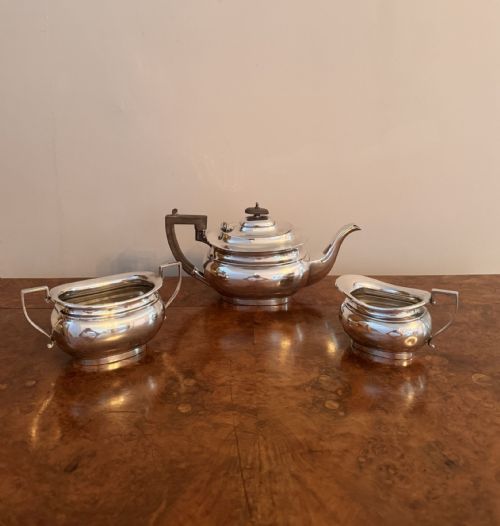
A three piece silver set comprises matched groupings designed for dining, tea service, or desktop presentation, most frequently encountered as tea sets, condiment groups, and christening sets across this selection. These ensembles date predominantly from the Victorian, Edwardian, and Art Deco periods, spanning the late nineteenth century through the mid twentieth century.
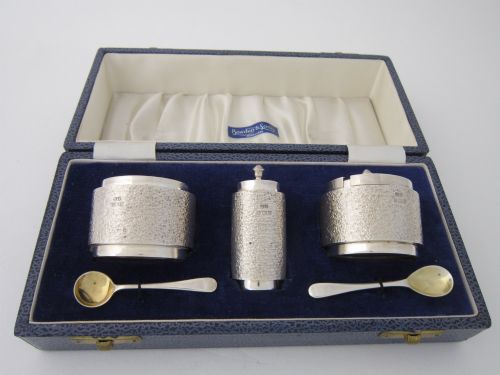
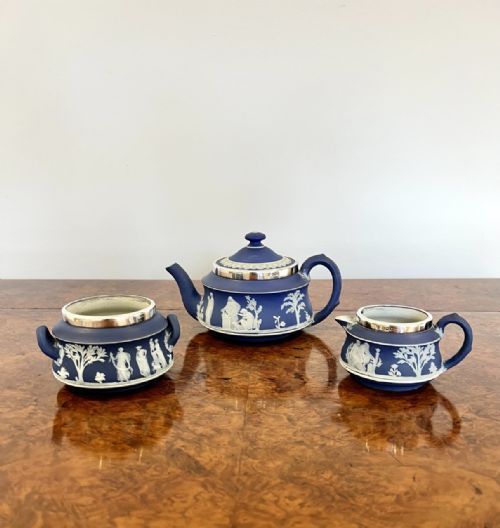
Tea services dominate the offerings, usually pairing a teapot with a cream jug and sugar bowl in matching metalwork or plate. Condiment sets and christening collections also appear regularly, offering matched salt cellars, mustard pots, and pepper shakers or fork, knife and spoon arrangements housed in fitted boxes.
Origins range widely across British manufacturing centres like Sheffield and Birmingham alongside continental and international workshops. Styles shift from ornate Victorian floral chasing and Edwardian elegance to geometric Art Deco lines and bark-finish mid-century modernism.
Materials and construction methods
Pieces are constructed from sterling silver or silver plate over a base metal foundation, occasionally incorporating supplementary materials such as ebony handles, marble, leatherette, and velvet linings in presentation boxes. Solid sterling examples bear hallmarks indicating assay offices in London, Birmingham, and Sheffield.
Manufacturing techniques combine traditional silversmithing methods like hammering and spinning with decorative treatments including embossing, engraving, and applied grapevine or bow garland detailing. Silver plated items utilise base metals coated in a layer of silver, sometimes accented with ebonised wood or ceramic elements like Jasperware.
Three Piece Silver Set Retail Price Guide 2026
Typical asking prices for three piece silver set among the pieces listed under this phrase on Sellingantiques today, from the lower quarter to the upper quarter. They describe what is for sale here now, not the wider market.
Judging quality and craftsmanship
Quality rests upon the weight of the metal, the crispness of chased or embossed ornamentation, and the integrity of joints and handles. Heavier gauges of silver or thick silver plate indicate superior manufacture, whereas thinner metals bend easily and wear through to the base material.
Attention to detail in handles, spouts, and hinges distinguishes finer work from standard commercial production. Sets retaining original fitted presentation boxes or bearing clear maker marks from established workshops demonstrate higher desirability among collectors.
Walker & Hall·Goldsmiths & Silversmiths Co·Atkin Brothers·Charles Horner·Deakin & Francis
The Three Piece Silver Set Glossary
- Sterling silver
- A silver alloy containing 92.5 percent pure silver and 7.5 percent other metals, usually copper, to increase durability. This standard is marked on British pieces by the lion passant hallmark.
- Silver plate
- A manufacturing method where a thin layer of pure silver is bonded to a base metal such as copper or nickel brass. This technique offered an accessible alternative to solid silver for domestic households.
- Bachelor tea set
- A smaller scale tea service traditionally intended for one or two drinkers, comprising a compact teapot, milk jug, and sugar bowl. These smaller sets date frequently to the Victorian and Edwardian eras.
- Cruet set
- A matched group of small containers designed to hold table condiments such as salt, pepper, and mustard. They often include fitted spoons and sit within a dedicated stand or tray.
- Hallmark
- An official stamp applied to precious metals by an assay office to guarantee the purity of the metal, the place of testing, and the year of manufacture. British hallmarks provide a reliable dating tool for antique silver.
Three Piece Silver Set: Frequently Asked Questions
What pieces belong in a three piece silver set?
A three piece silver set typically includes three matching vessels designed for a specific domestic purpose. In tea services, this means a teapot paired with a cream jug and sugar bowl.
For condiment collections, the grouping consists of three table vessels such as salt cellars, mustard pots, and pepper shakers. Christening sets provide three matched pieces for an infant, usually comprising a knife, fork, and spoon.
How do I care for silver plated tea sets?
Silver plated items require gentle cleaning using a dedicated silver polish and a soft cloth to remove tarnish without abrading the thin silver layer. Avoid harsh chemical dips that can strip delicate patinas or damage applied decorative elements.
Store pieces in dry conditions away from direct sunlight, and utilise fitted boxes or anti-tarnish cloths when the items are not on display.
What is a bachelor tea set used for?
A bachelor tea set was created for solitary use or small gatherings, offering a reduced scale compared to standard family services. The smaller teapot and matching vessels were well suited to parlour use or smaller drawing rooms.
These compact sets remain popular for display and intimate table settings due to their dainty proportions.
How can I date my silver set?
Solid silver items can be dated precisely using the hallmarks stamped into the metal, which indicate the specific assay office and active year letter. Maker marks and registration numbers also help pinpoint the production decade.
Stylistic indicators, such as Victorian floral embossing, Edwardian restraint, or Art Deco geometric motifs, provide a reliable guide for silver plated items lacking date letters.