
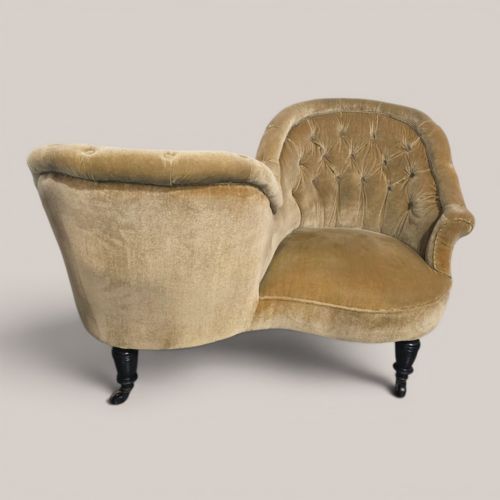


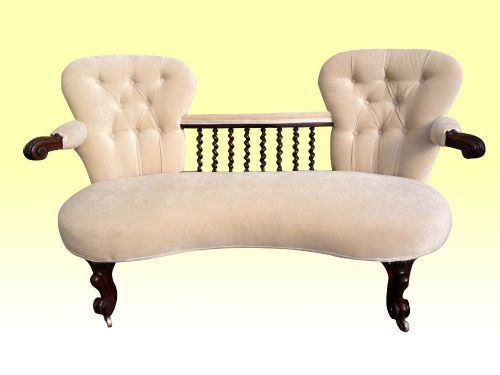
Tete a Tete Seat
These tete a tete seat pieces are designed for two people to converse face to face, offering an intimate conversation arrangement for any room.
Tete a Tete Seat
A tete a tete seat is a specialised double chair or sofa designed so two people can sit facing opposite directions while maintaining close proximity for conversation. You will frequently encounter Victorian examples on this page, alongside earlier Georgian and later pieces.
The forms vary from curved serpentine wooden frames to more elaborate conversational sofas and conversation seats. Walnut, rosewood, and giltwood frequently appear across the available seating.
Makers drew on diverse design influences, ranging from Victorian Rococo Revival and Louis XVI to Moorish Revival and Italian Rococo styles. These pieces function as striking focal points in reception rooms and large drawing rooms.
How they were made
Frames are constructed from solid timbers such as walnut, rosewood, hardwood, and fruitwood, often supported by brass elements. Hand carving shapes the wooden structures, as seen in the Italian giltwood and barley twist frames.
Upholstery techniques involve deep buttoning and traditional padding finished in velvet, leather, and various decorative fabrics. Gilded surfaces provide decorative embellishment on specific French and Italian frames.
Listings feature rosewood, walnut, and giltwood frames combined with velvet, leather, and fabric upholstery.
What varies in quality
The crispness of the hand carving on the wooden frames separates standard production from exceptional pieces. Elaborate details like barley twist supports and deep buttoning require precise craftsmanship.
The choice of primary timber influences the overall character, with dense hardwoods like rosewood and walnut representing the more robust end of construction. Original upholstery materials and gilding integrity also define the upper tier of examples.
The Tete a Tete Seat Glossary
- Tete a tete
- A double seat arrangement allowing two occupants to sit face to face in an S-shape or curved configuration. This French term translates directly to head to head.
- Barley twist
- A turning technique resembling a twisted rope, applied to wooden furniture legs and structural supports. This decorative detail is prominent in Victorian framing.
- Giltwood
- Timber coated with gold leaf or gold paint to simulate solid gold enrichment. It appears on decorative frames from various continental styles.
- Deep buttoning
- An upholstery method where tufting pulls the fabric deep into the padding to secure the filling and create a geometric pattern. It provides both structural firmness and texture.
- Rococo Revival
- A nineteenth-century design movement resurrecting the asymmetric curves, scrolling foliage, and shell motifs of the eighteenth century. This style frequently dictates the carved outlines of these seats.
Tete a Tete Seat: Frequently Asked Questions
What is a tete a tete seat used for?
These seats were originally built to allow polite, intimate conversation in drawing rooms without requiring people to turn their heads. The S-shaped configuration lets two occupants sit close together while facing opposite directions.
Today, they serve as freestanding sculptural statements in large bedrooms, dressing rooms, or reception halls. They provide functional seating while breaking up conventional furniture arrangements.
How do I date a conversation seat?
Dating relies heavily on identifying the primary wood, framing style, and upholstery techniques. Victorian examples often feature deep buttoning and rosewood or walnut frames with stylistic nods to earlier eras.
Earlier Georgian pieces display hand-carved giltwood surfaces and distinct structural proportions, whereas late nineteenth and early twentieth-century versions may introduce Moorish or continental revival influences.
Where should I place a tete a tete seat?
Because these seats are finished on all sides and feature curved profiles, they work best floating in the middle of a room rather than pushed against a wall. This placement allows the S-curve to be appreciated from every angle.
Ensure there is enough clear floor space around the piece to walk past it comfortably and to accommodate the seated occupants facing away from each other.
Are these seats comfortable to sit on?
Comfort depends on the historical padding and the specific depth of the seat, with many Victorian versions offering supportive sprung bases and deep buttoned backs. They are designed for shorter periods of conversation rather than lounging.
The unique configuration means you sit sideways relative to your companion, which creates a posture distinct from a standard sofa or armchair.