


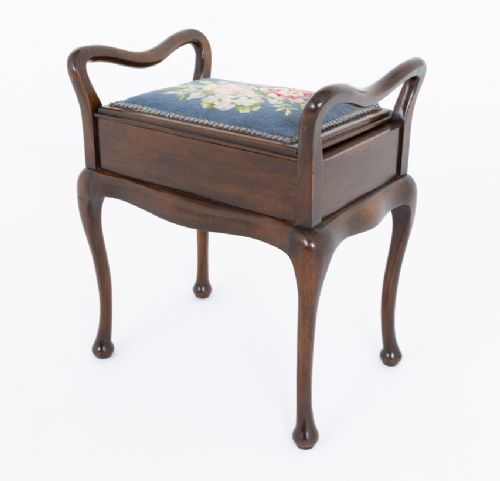


Tapestry Piano Bench
These tapestry piano bench examples combine practical seating with detailed needlework, offering both historical character and daily utility for your home.
Tapestry Piano Bench
When you search for a tapestry piano bench, you are looking at practical seating designed to sit beside a keyboard instrument or function as a dressing table stool. These pieces appear across several eras, with Edwardian examples and pieces from the 1900s, 1920s, 1890s, and 1860s frequently meeting the eye on this page.
The forms vary from compact piano stools to wider window seats and long dressing stools. Makers utilised various stylistic revivals, resulting in pieces reflecting Queen Anne, Chippendale, Jacobean, and Edwardian Neoclassical tastes alongside Victorian and Aesthetic Movement designs.
Materials and construction
The frames rely on robust timbers such as mahogany, walnut, and oak, occasionally embellished with boxwood inlay or brass fittings. These hardwoods provide structural stability for the supportive bases.
The top surfaces feature textile coverings including tapestry, fabric, wool, and needlepoint. Artisans mounted these woven textiles over padded seats fitted to the wooden frames.
Tapestry Piano Bench Retail Price Guide 2026
Typical asking prices for tapestry piano bench among the pieces listed under this phrase on Sellingantiques today, from the lower quarter to the upper quarter. They describe what is for sale here now, not the wider market.
Current listings feature pieces spanning from the 1860s Victorian era through the Edwardian period up to the 1930s.
Distinctions in quality
Quality rests in the precision of the woodwork, from carved walnut frames to inlaid mahogany details. Strong joinery and purposeful design differentiate standard utilitarian seating from finer period examples.
The complexity and execution of the top cover also set pieces apart. Intricate needlepoint and tapestry work demonstrate a higher level of craftsmanship than plain fabric upholstery.
Jas Shoolbred
The Tapestry Piano Bench Glossary
- Needlepoint
- A type of canvas work embroidery used for upholstery. This technique creates detailed patterned surfaces on the top of the seat.
- Cross stretcher
- Wooden bars connecting the legs near the base for added stability. These structural elements appear frequently on dressing table stools.
- Window seat
- An elongated stool designed to sit low beneath a window frame. These longer forms offer broader seating capacity than standard piano stools.
- Inlay
- Contrasting wood or material fitted into the surface of a primary timber. Boxwood details often adorn mahogany frames in this manner.
Tapestry Piano Bench: Frequently Asked Questions
What is a tapestry piano bench?
A tapestry piano bench is a low wooden seat featuring a woven textile or needlepoint top, traditionally used at a keyboard instrument.
These pieces also function as dressing table stools or window seats in various period styles.
How do I date a piano stool?
Dating relies on identifying the underlying timber, such as mahogany or walnut, alongside stylistic indicators like Edwardian inlay or Victorian carving.
Construction methods and the specific revival style also help narrow down the period of manufacture.
Where should I place these benches?
These versatile seats fit well at the foot of a bed, beneath a low window, or beside a dressing table.
Their compact size allows them to tuck neatly into hallways or act as extra seating in a living room.
Are these benches comfortable?
The upholstered tops provide padded support for sitting while playing the piano or dressing.
The inclusion of textile covers ensures a softer surface than plain wooden boards.