



Tall Slim Chest
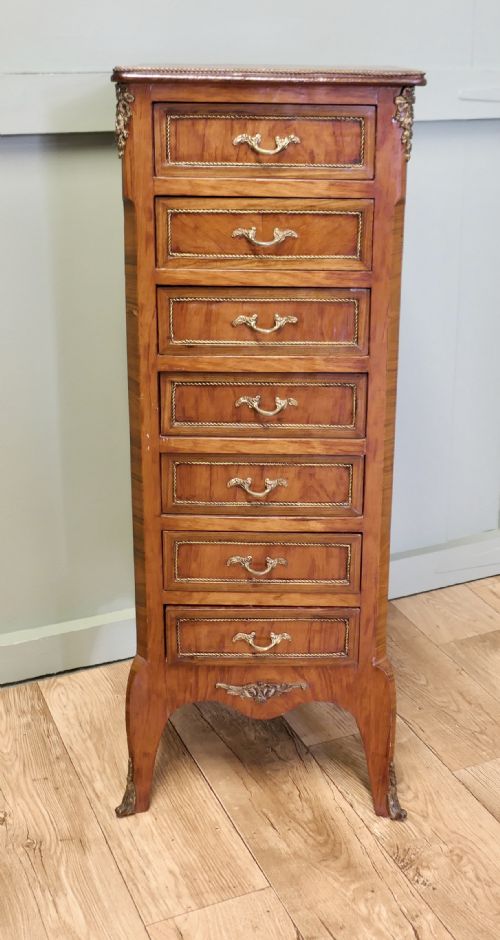
A tall slim antique chest offers vertical storage of considerable elegance, combining deep capacity with a remarkably small floor footprint.
Tall Slim Chest
A tall slim antique chest provides a practical answer for compact rooms requiring substantial drawer space. These pieces rise high while keeping a narrow profile, making them exceptionally useful for bedrooms or dressing rooms.
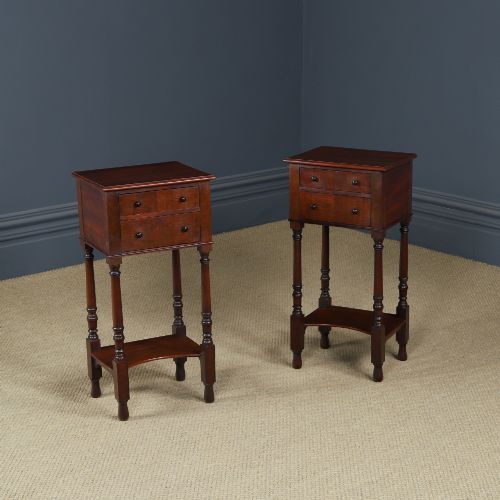
Edwardian examples in mahogany or walnut frequently appear alongside Victorian pieces and earlier Georgian designs. Alongside standard chests, variations such as Wellington chests, bedside cabinets, and narrow tallboys emerge across the selection.
How they were made
Cabinet makers relied primarily on solid mahogany and walnut, frequently selecting figured timbers for drawer fronts to create subtle visual depth. Flame mahogany veneer and contrasting inlay further distinguish the finer surfaces.
Brass handles, escutcheons, and occasional ormolu mounts complete the construction, secured alongside traditional dovetail joinery. Ebonised wood and gilt bronze details appear on specific revival styles.
Tall Slim Chest Retail Price Guide 2026
Typical asking prices for tall slim chest among the pieces listed under this phrase on Sellingantiques today, from the lower quarter to the upper quarter. They describe what is for sale here now, not the wider market.
Mahogany and walnut appear consistently across Victorian, Edwardian, and Georgian revival pieces in this selection.
What varies in quality
The selection of timber grain largely dictates the visual merit of each piece, with figured and flame mahogany commanding particular attention. Uniformity in timber choice across the entire carcass signals higher workshop standards.
Refinement in proportion and the crispness of applied mouldings or brass hardware separate standard utility pieces from finer cabinet work. Original surface patination preserved through careful ownership remains a defining characteristic.
The Tall Slim Chest Glossary
- Wellington chest
- A tall, narrow chest of drawers secured by a hinged locking stile on one side. This design originated in the nineteenth century.
- Tallboy
- A tall chest of drawers, often constructed as one chest stacked upon another. These pieces maximise vertical storage space.
- Flame mahogany
- Timber veneer cut from the branch forks of the mahogany tree, displaying a distinctive flickering flame pattern. Cabinet makers utilised this for prominent drawer fronts.
- Inlay
- Contrasting woods or materials embedded into the primary surface to create decorative patterns. This technique defines many revival styles.
- Ormolu
- Gilded bronze ornamentation applied to furniture, particularly prevalent on pieces influenced by French design. It provides metallic contrast to dark timber.
Tall Slim Chest: Frequently Asked Questions
Where should I place a narrow chest?
These compact pieces suit smaller bedrooms, hallways, or dressing areas where floor space is limited. Their vertical build provides ample storage without dominating the room.
They also function effectively as bedside storage when matching the proportions of larger beds.
How do I distinguish Edwardian pieces?
Edwardian items frequently utilise lighter mahogany or walnut timbers, often displaying delicate inlay work. Their construction reflects the revival styles popular during the early twentieth century.
Comparing the drawer linings and hardware against Victorian or Georgian equivalents helps confirm the period.
What is a Wellington chest?
A Wellington chest is a tall, narrow set of drawers featuring a locking side flap that secures all the drawers at once. This nineteenth-century form was designed for secure personal storage.
They are easily identified by their distinct vertical locking bar on the right side.
How should I care for mahogany surfaces?
Keep wooden surfaces away from direct sunlight and heat sources to prevent the timber from drying or fading. Regular dusting with a soft, dry cloth maintains the natural lustre.
Occasional application of appropriate wax polish helps nourish the antique finish.