




Sunset River Landscape Art
Sunset river landscape art captures dusk by the water, offering a peaceful view that brings warmth to any room.
Sunset River Landscape Art
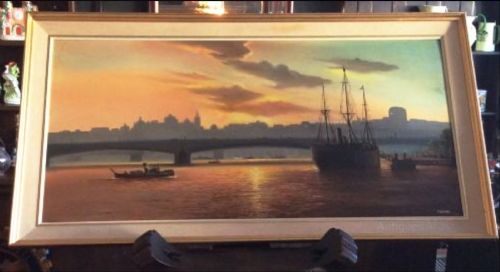
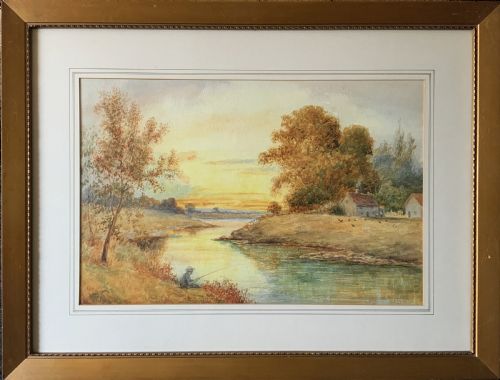
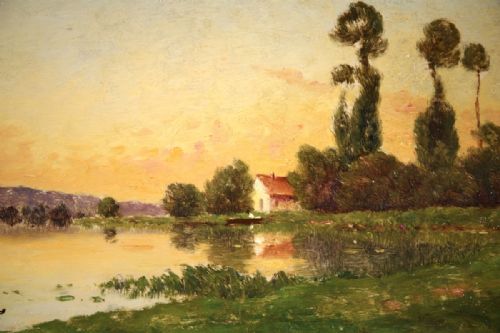
Sunset river landscape art covers oil paintings, watercolours, and wall art depicting waterways at dusk. These pieces range from Victorian British School scenes to Dutch School river views and Orientalist river tributaries.
Buyers are most likely to meet nineteenth-century works and mid-twentieth-century canvases on this page. Common subjects include the Thames, Scottish Highlands, woodland areas at sunset, and windmills by rivers.
The selection includes framed watercolours on paper and large oils on canvas. Many feature original wood frames adorned with gesso, gilt, and gold leaf.
How sunset river landscape art was made
Painters used oil on canvas and watercolour pigment on paper to capture the fading light of dusk. These materials allowed artists to build rich colour transitions across skies and water surfaces.
Frames were constructed from wood and finished with layers of gesso, gold leaf, and gilt to complement the warmth of the paintings.
Sunset River Landscape Art Retail Price Guide 2026
Typical asking prices for sunset river landscape art among the pieces listed under this phrase on Sellingantiques today, from the lower quarter to the upper quarter. They describe what is for sale here now, not the wider market.
Styles represented include the Barbizon School, Maritime Art, Dutch School, and Orientalism alongside British Victorian painting.
What varies in quality in sunset river landscape art
Quality rests in the handling of light and atmosphere across the water and sky. Stronger works show confident brushwork and a balanced composition that draws the viewer into the dusk scene.
The execution of the framing also influences the overall presentation. Original wood frames with well-preserved gold leaf and gesso add historical integrity to the piece.
Edward Williams·Henri Jaques Delpy·Edwin Lord Weeks·George Vicat Cole·David Watts·Frank Hider·A.De Breanski
The Sunset River Landscape Art Glossary
- Oil on canvas
- A painting technique using pigment suspended in drying oil applied to stretched canvas fabric. This medium dominated nineteenth-century landscape painting for its rich texture and depth.
- Watercolour pigment
- Fine pigment mixed with a water-soluble binder applied to paper surfaces. Artists utilised this method for luminous, translucent effects.
- Gesso
- A plaster-like mixture applied to wooden frames as a base before gilding. It provides a smooth surface for gold leaf application.
- Gold leaf
- Extremely thin sheets of beaten gold applied to frames and artworks. It catches ambient light to frame the painted dusk scene.
- Barbizon School
- A nineteenth-century French art movement focused on realist landscape painting. Practitioners painted outdoors to capture natural light and atmospheric conditions.
Sunset River Landscape Art: Frequently Asked Questions
What periods do these paintings come from?
The selection spans the nineteenth century through to the mid-twentieth century. You will find Victorian works alongside later interpretations.
Specific dates within titles point to active periods of the artists or the creation era of the canvas.
Are the frames original to the artwork?
Many pieces retain their period wood frames, often finished with gesso and gold leaf. These frames match the aesthetic of the nineteenth and early twentieth centuries.
Checking the frame materials helps contextualise the age of the complete piece.
How do I care for an oil on canvas?
Keep oil paintings away from direct sunlight and extreme humidity fluctuations. Dust the surface gently with a soft, dry brush.
Avoid using liquid cleaners on the canvas or the gilded wood frame.
What is the difference between oil and watercolour?
Oil paintings utilise canvas supports and offer thick, blendable colour layers with high durability. Watercolour paintings use paper supports and present a lighter, translucent quality.
Both mediums were used extensively to depict sunset and river scenes.