
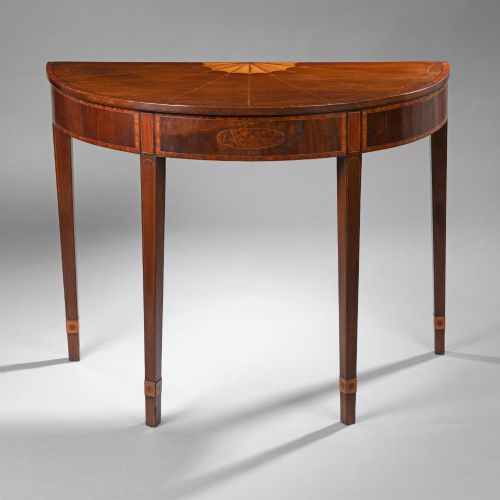


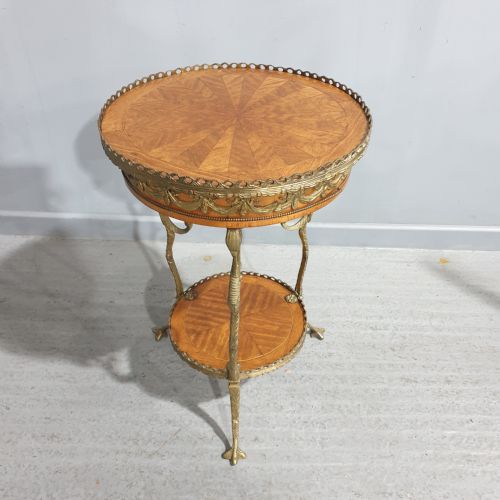

Sunburst Inlaid Table
A sunburst inlaid table brings a striking radial motif into a room, offering geometric warmth through contrasting timbers.
Sunburst Inlaid Table
A sunburst inlaid table combines functional surface area with meticulous geometric woodwork, often taking the form of centre tables, side tables, and occasional tables. These pieces draw the eye immediately through their radial veneer patterns, which radiate outward from a central point to create an illusion of depth and movement.
The versions most commonly met span the Georgian and Edwardian eras, alongside later Scandinavian Art Deco interpretations. Cabinetmakers utilised this design across console tables, card tables, and wine tables to elevate domestic spaces with formal elegance.
Origins vary from British workshops influenced by Sheraton Revival styles to French ateliers and Scandinavian studios. Each piece demonstrates how makers adapted the radial motif to different silhouettes, from demi lune shapes to circular occasional tables.
Materials and Construction
Craftsmen built these tables using foundational timbers like mahogany, oak, and satinwood, applying finely cut veneers to create the characteristic radial patterns. Flame birch and boxwood provided contrasting tones, allowing the segments of the sunburst motif to catch the light from different angles.
Timber inlay and brass details frequently accented the primary structures. Makers carefully bevelled and fitted each veneer piece by hand, securing them to stable timber bases to prevent warping over time.
Listings feature items spanning the eighteenth century, the Georgian era, the Victorian period, and the 1920s.
Distinctions in Quality
The fineness of the timber matching separates standard examples from exceptional ones. Superior pieces display seamless transitions between contrasting wood species, where the grain direction enhances the radial geometry rather than disrupting it.
Construction rigour is evident in the stability of the joints and the precision of the underlying veneer work. Higher quality examples maintain flush surfaces across complex multi-wood tops without lifting or shrinkage cracks in the central segments.
The Sunburst Inlaid Table Glossary
- Sunburst inlay
- A decorative radial pattern formed by triangular or wedge-shaped veneer pieces arranged to resemble radiating sun rays. This technique requires exact geometry and contrasting timber colours.
- Veneer
- A thin layer of finely figured wood applied to a stable secondary timber base. It allows makers to display striking grain figures that solid wood planks rarely provide.
- Demi lune
- A half-moon shape characteristic of console and card tables designed to sit flush against a wall. The straight edge faces the architectural boundary while the curved front projects into the room.
- Parquetry
- A geometric mosaic of wood pieces used for decorative surfaces on tables and cabinets. It differs from marquetry by relying strictly on angular geometric patterns rather than pictorial scenes.
- Satinwood
- A durable tropical hardwood prized for its golden lustre and reflective sheen. It served as a favoured surface timber for light-toned decorative table tops.
Sunburst Inlaid Table: Frequently Asked Questions
What is a sunburst inlaid table?
A sunburst inlaid table is a piece of furniture featuring a geometric radial design on its top surface, created by arranging contrasting wood veneers to radiate from a centre point.
These tables appear in various forms, including centre tables, side tables, and card tables, spanning periods from the eighteenth century through to the early twentieth century.
How do I care for inlaid wood?
Inlaid wood surfaces require stable environmental conditions away from direct sunlight and excessive moisture to protect the delicate veneer joints. Regular dusting with a soft cloth and occasional application of appropriate furniture wax maintains the timber finish without building up residue.
Avoid placing hot items or liquids directly onto the polished wood to prevent permanent staining or lifting of the underlying adhesive.
Where were these tables placed originally?
Console and demi lune tables traditionally stood against walls in formal hallways or drawing rooms, often accompanied by mirrors or decorative objects. Occasional and centre tables occupied the middle of reception spaces to hold lamps or display items.
Smaller wine tables and card tables were moved around rooms as functional pieces for social gatherings and evening entertainment.
How do I distinguish revival periods from older pieces?
Distinguishing periods involves examining the secondary timbers used underneath the visible veneers, as well as the tooling marks left by period woodworking saws. Georgian and eighteenth-century examples exhibit different construction habits and fastener types compared to Edwardian or Regency Revival pieces.
Stylistic proportions and the specific combination of woods, such as satinwood paired with padoukwood, provide further clues to dating an item accurately.