

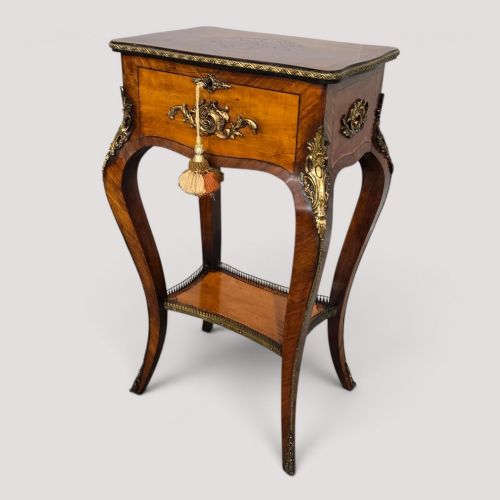


Standing Jewellery Cabinet
A standing jewellery cabinet organises your prized possessions with genuine period elegance, combining secure storage with a display surface for your keepsakes.
Standing Jewellery Cabinet
A standing jewellery cabinet brings together upright display vessels and dedicated storage pieces designed specifically for valuables, answering the search for a standing jewellery cabinet on this page. The selection encompasses varied forms from compact vitrines to larger floor-standing pieces suited to domestic interiors.
Most examples appearing in the current range span the Victorian and Edwardian eras alongside 19th-century interpretations. These items frequently manifest as bijouterie cabinets, display tables, and cabinets on stands.
Regional and stylistic diversity shapes the selection, ranging from traditional Chinese floor cabinets to Flemish Baroque and Sheraton Revival designs. Buyers encounter both circular French vitrines and rectilinear mahogany pedestals among the offerings.
Materials and construction
Cabinet makers utilised rich timbers including mahogany, walnut, satinwood, kingwood, and papier-mâché to build the foundational carcasses. Inlays of lighter contrasting woods and delicate marquetry frequently ornament the exterior surfaces.
Interior storage spaces often receive luxurious linings of velvet to protect delicate items. Stands and supports integrate closely with the main cabinet body, whether as slender tapered legs or more robust carved framing.
Standing Jewellery Cabinet Retail Price Guide 2026
Typical asking prices for standing jewellery cabinet among the pieces listed under this phrase on Sellingantiques today, from the lower quarter to the upper quarter. They describe what is for sale here now, not the wider market.
The selection spans several key eras, predominantly featuring Edwardian and Victorian pieces alongside 18th-century and 19th-century examples.
Assessing quality and craftsmanship
Distinctions in quality often rest on the precision of the timber work and the complexity of the marquetry or inlay. Finer pieces demonstrate seamless jointing and well-matched wood grains across prominent display surfaces.
The refinement of brass hardware, ormolu mounts, and original glass panels distinguishes superior examples from standard production. Interior treatments, particularly the choice and execution of velvet linings, reflect the original maker's investment in materials.
Stylistic cohesion between the cabinet and its stand dictates the visual success of elevation. Pieces retaining harmonious proportions across both upper display zones and lower support structures command greater admiration.
The Standing Jewellery Cabinet Glossary
- Bijouterie cabinet
- A glazed display case designed specifically for small ornaments, trinkets, and jewellery. These pieces usually feature glass tops and sides to allow overhead and lateral viewing.
- Vitrine
- A glass-fronted cabinet or case used for displaying fine objects or collections. The term derives from the French word for glass.
- Marquetry
- Decorative veneer work formed by fitting together small pieces of various coloured woods, ivory, or shell to create pictorial or geometric patterns. It differs from inlay by covering the entire surface.
- Ormolu
- Gilded bronze used for decorative mounts and furniture hardware. The technique involves applying a gold-mercury amalgam onto bronze before firing.
- Collectors cabinet
- A specialised storage piece containing multiple shallow drawers or compartments for housing natural history specimens, coins, or small artefacts. They often feature solid doors that conceal the interior trays.
Standing Jewellery Cabinet: Frequently Asked Questions
What is a bijouterie cabinet?
A bijouterie cabinet is a specialised display case designed for small valuables, medals, and jewellery. They typically feature glazed panels and velvet-lined interiors to present items clearly.
These pieces function both as decorative furniture and secure storage within a drawing room or bedroom setting.
Where should I place a vitrine?
A vitrine requires a stable position away from direct sunlight and extreme temperature fluctuations to protect delicate woods and interior fabrics. Placing them in well-lit rooms allows natural light to pass through the glass panels.
Ensure adequate floor space so that doors or hinged lids can open fully without obstruction.
What is the difference between a vitrine and a display cabinet?
A vitrine typically emphasises glass on multiple sides for maximum visibility of its contents, often standing on slender legs. Standard display cabinets might incorporate more timber framing and enclosed lower storage compartments.
Both serve to exhibit collections, but vitrines lean towards lighter, airier profiles suitable for smaller decorative objects.