


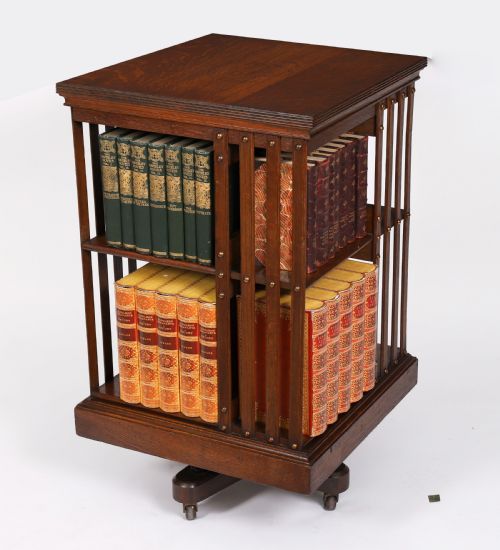

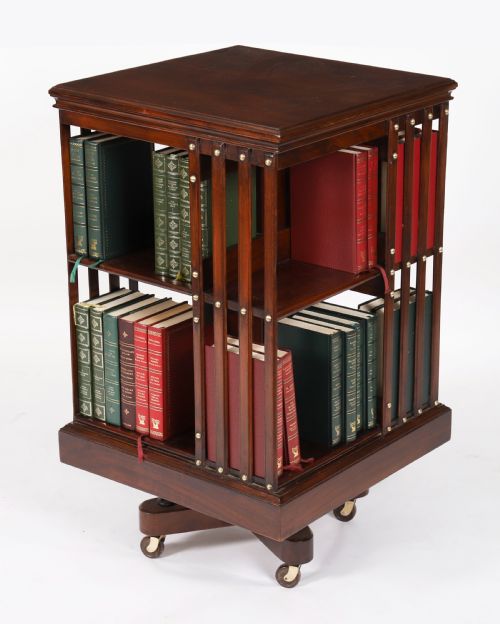


Standing Book Carousel
A standing book carousel provides accessible tiered storage for volumes, turning smoothly on a compact floor or table base.
Standing Book Carousel
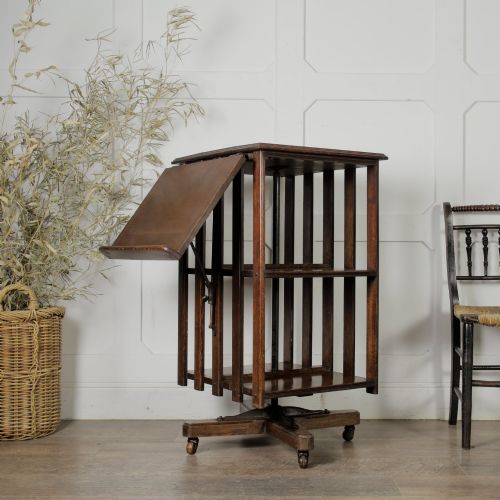
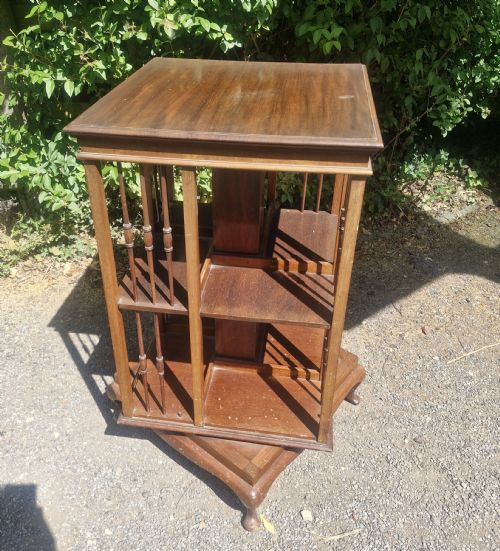
A standing book carousel is primarily encountered in revolving forms dating from the Victorian and Edwardian periods, designed to keep reference volumes close at hand. These pieces serve domestic libraries, studies, and drawing rooms by offering multi-directional shelving within a tight footprint.
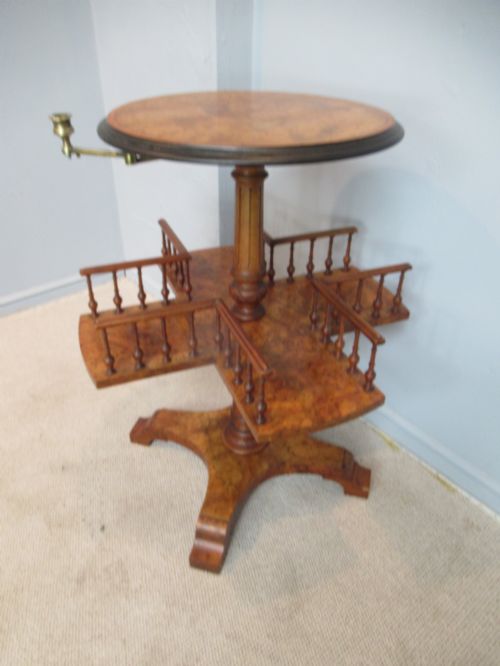
Most examples appearing here take the form of floor-standing or table-top revolving bookcases in oak or mahogany. Makers offered variations ranging from small tabletop stands to tall, multi-tiered units capable of holding substantial collections.
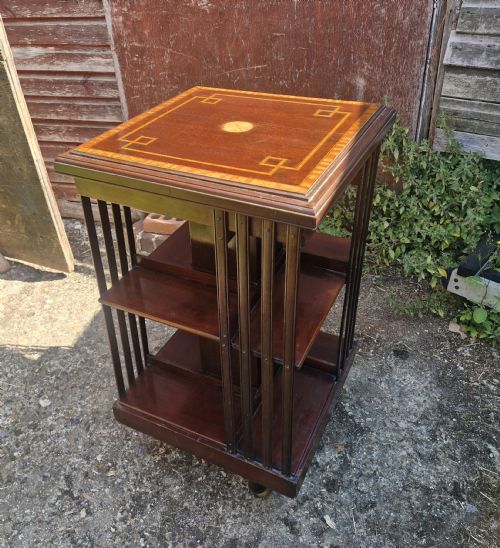
Originating largely from British workshops of the late nineteenth and early twentieth centuries, these rotating stands reflect the period demand for functional, space-saving library furniture. Buyers find both plain utility pieces in solid oak and highly decorative satinwood-inlaid variants.
Materials and construction
Cabinetmakers utilised robust hardwoods such as mahogany and oak to construct the main framework and tier dividers, ensuring the structure could bear the heavy weight of bound volumes. Burr walnut and kingwood appear on select pieces as decorative veneers, paired with satinwood inlay or ormolu mounts.
The pivotal movement relies on specialised internal mechanisms involving cast iron or brass fittings, which allow the loaded tiers to rotate smoothly without friction. Joinery techniques such as dovetailed shelves and panelled sides provide the necessary rigidity for daily turning.
Listings feature woods spanning mahogany, oak, walnut, satinwood, and kingwood, alongside functional brass and iron hardware.
Distinctions in quality
The mechanical action dictates much of the standing book carousel's utility, with superior examples turning silently and evenly on well-engineered concealed bearings. Inferior rotational systems develop a wobble or grind under load, indicating worn internal components.
Timber selection and decorative finish separate standard production pieces from fine cabinet work. Finely figured flame mahogany, crisp satinwood stringing, and well-cast ormolu distinguish the top tier of workshop output from utilitarian oak office furniture.
Maple & Co·Heals
The Standing Book Carousel Glossary
- Revolving bookcase
- A freestanding or table-top tier of shelves designed to turn on a central pivot for easy book selection.
- Flame mahogany
- A tropical hardwood cut to reveal a distinctive undulating grain pattern resembling flickering flames. It was favoured by Victorian cabinetmakers for prominent surfaces.
- Satinwood
- A pale, lustrous exotic timber used extensively for contrasting inlay, banding, and stringing on Edwardian furniture.
- Ormolu
- Gilded bronze cast into decorative mounts, handles, or decorative feet applied to high-status nineteenth-century furniture.
- Burr walnut
- A prized wood grain taken from the growth excrescences of walnut trees, displaying intricate swirling patterns.
Standing Book Carousel: Frequently Asked Questions
How do I maintain the revolving mechanism?
Keep the internal pivot clean and periodically check the central bearing assembly for dust or dry movement. A light application of appropriate lubricant helps maintain smooth rotation.
Avoid overloading individual tiers beyond their balanced capacity to prevent uneven wear on the central spindle and base supports.
Can these hold heavy hardback books?
Solid hardwood construction allows these rotating tiers to support substantial volumes, particularly on standard oak and mahogany models. Standard shelving depths comfortably accommodate most octavo and quarto reference books.
Distribution of weight matters greatly during loading, so heavier encyclopaedias and folios belong on the lower tiers to maintain stability.
How do I distinguish Edwardian from Victorian models?
Victorian examples generally feature heavier proportions, darker finishes, and robust oak or mahogany frames built for traditional studies. They lean toward solid utility or deep carving.
Edwardian pieces often introduce lighter satinwood stringing, inlaid decoration, and more refined profiles suitable for lighter drawing room schemes.
Where should I place a standing book carousel?
These pieces function well beside armchairs, desks, or in corners where 360-degree access provides practical utility without obstructing room flow. Floor models require a level surface to ensure the internal pivot turns true.
Keep them away from direct heat sources and strong sunlight to protect the polished wood surfaces and delicate veneers from drying out.