


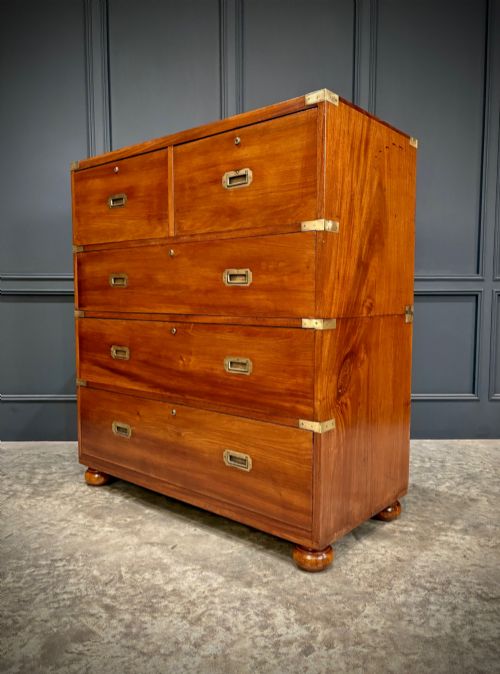


Split Military Campaign Chest
A split military campaign chest is a portable two-part set of drawers built for travel, offering sturdy construction and clever interior fittings.
Split Military Campaign Chest
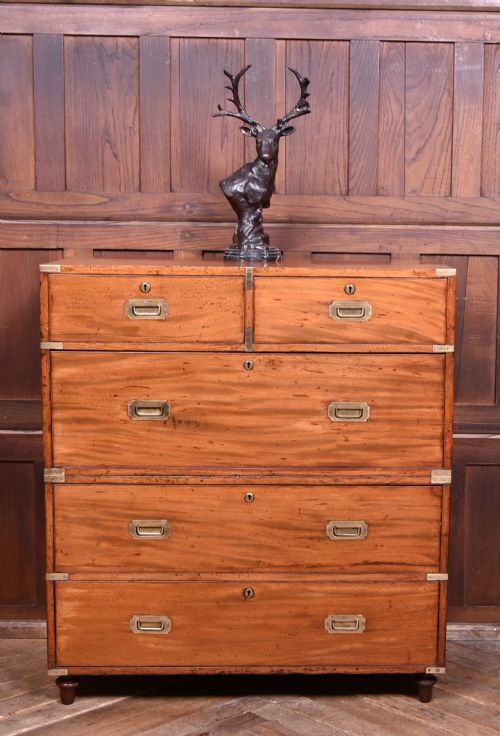
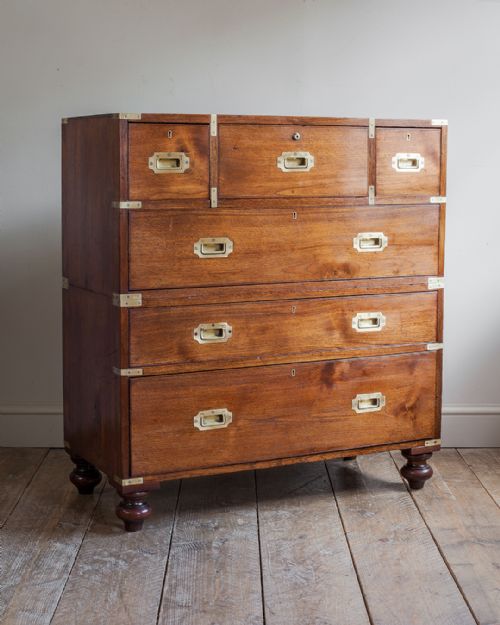
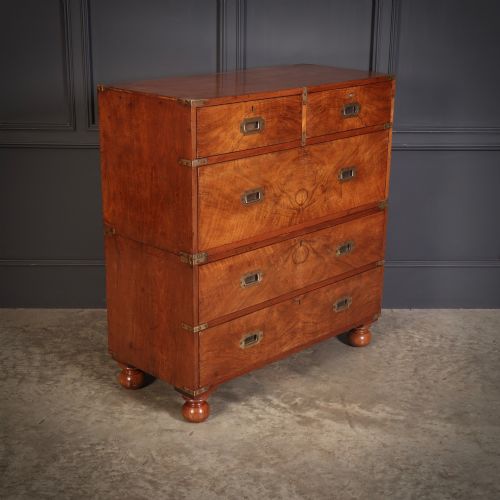
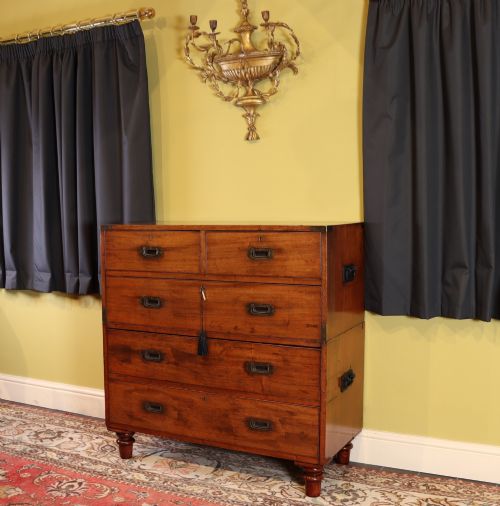
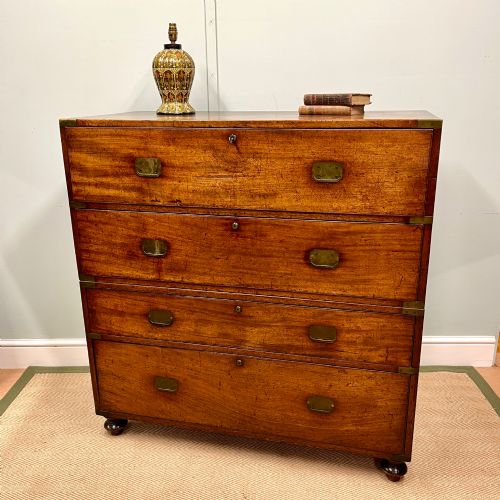
A split military campaign chest is designed for easy transport on active service, separating into two distinct sections for transit. The pieces on this page primarily date from the nineteenth century, encompassing the Victorian era and periods such as the eighteen-fifties and eighteen-sixties.
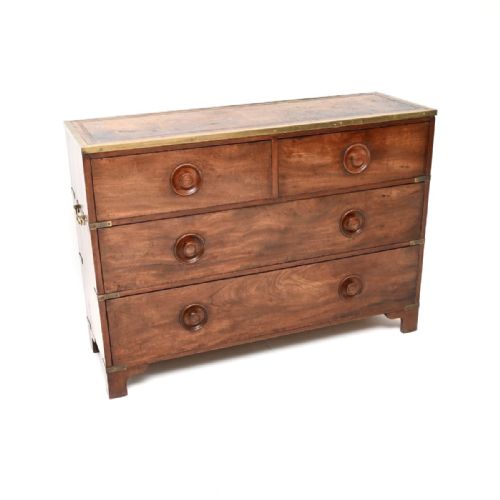
Most examples function as chests of drawers or cabinets, and many incorporate a fitted secretaire section with a drop-front writing surface. These items reflect British colonial and military deployments, appearing in utilitarian forms as well as more finished domestic adaptations.
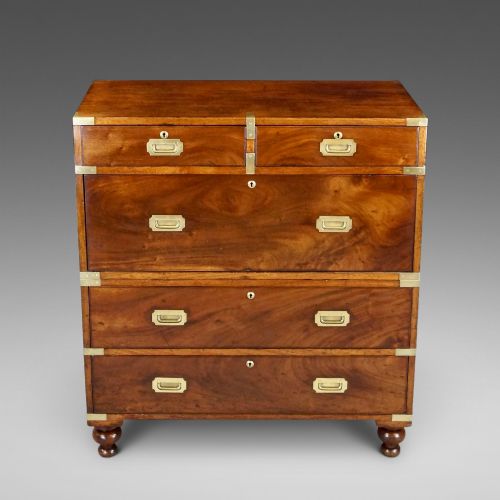
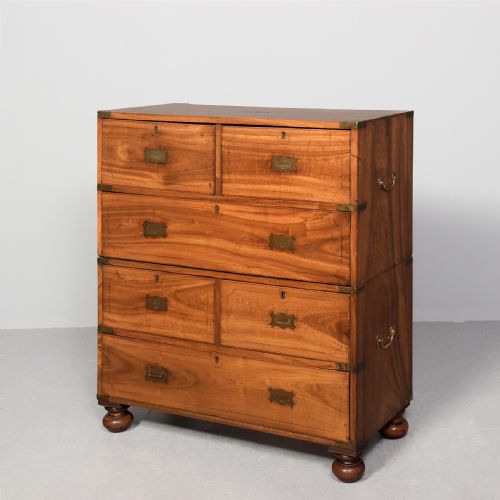
The dominant configurations found here split cleanly down the middle or separate into upper and lower carcases secured by metal brackets. Buyers frequently encounter robust timber carcasses equipped with recessed brass carrying handles and corner reinforcement plates.
How they were made
Makers utilised dense, durable timbers suited to tropical climates and rough handling, predominantly mahogany, teak, and camphor wood, alongside occasional examples in oak, padouk, and rosewood. These woods resist warping and splitting under harsh field conditions.
Joinery relies on sturdy carcass construction, often featuring flush brass bindings screwed into the edges and corners to protect against impact during transit. Recessed brass handles and flush drawer pulls ensure nothing catches or protrudes while the chests are packed.
Many interior drawers and secretaire compartments utilise secondary timbers like cedar, with internal pigeonholes and small drawers arranged behind a fall-front writing flap. Sections lock together using internal brass pins or side hooks before the two halves are separated for movement.
Opening certain camphor wood campaign chests releases a sharp, lingering herbal aroma carried across the oceans from nineteenth-century workshops.
What varies in quality
The selection of timber grain and the density of the wood determine visual refinement, with figured mahogany and highly aromatic camphor wood sitting at the upper end of the scale. Plain utility variants made for junior officers contrast with deeply carved Anglo-Indian or Chinese export pieces featuring elaborate brass strapping.
Hardware execution marks the difference between standard field equipment and officer-commissioned pieces, particularly the weight and fit of the recessed brass handles, corner brackets, and flush locks. Original locking mechanisms with matching keys and well-fitted internal stationery compartments indicate higher workshop standards.
Structural integrity depends on how cleanly the two sections separate and realign, alongside the tightness of the original dovetail joints in the drawer construction. Pieces retaining their original brass mountings and stable, unwarped drawer linings hold greater integrity than those with mismatched replacement hardware.
S. W. Silver and Co·Army and Navy
The Split Military Campaign Chest Glossary
- Campaign chest
- A modular chest of drawers built in two separate sections designed to be packed and transported easily during military campaigns. These units feature recessed hardware to prevent snagging.
- Secretaire chest
- A chest of drawers featuring a dedicated pull-out or drop-front drawer fitted with small compartments, pigeonholes, and a writing surface. This eliminates the need for a separate desk while travelling.
- Brass bound
- The technique of reinforcing cabinet corners and edges with flush-mounted brass strips and corner pieces. This protects the wood from heavy knocks during transit.
- Two-part
- A cabinet construction method where the main body splits horizontally into an upper and lower chest. Each section possesses carrying handles on the sides.
- Camphor wood
- An aromatic hardwood native to Asia, utilised for campaign chests due to its insect-repellent properties and distinct scent. It forms the basis of many pieces brought back from colonial outposts.
Split Military Campaign Chest: Frequently Asked Questions
Why do campaign chests split in half?
The two-part design allowed officers and colonial administrators to pack heavy belongings into manageable, balanced loads for mules, camels, or wagons. Each section could be loaded independently and secured safely.
Once at a destination, the two halves stacked neatly one on top of the other and locked together to form a single tall chest of drawers.
What woods were used for military chests?
Makers selected dense tropical hardwoods that could withstand extreme humidity and rough handling without warping. Mahogany and teak were standard for British colonial service, while camphor wood offered natural insect resistance.
Occasional examples use padouk, rosewood, or oak, depending on the region of manufacture and the officer's personal commission.
Are campaign chests heavy to move?
Solid hardwood construction makes individual sections weighty, but the side carrying handles allow two people to lift and transport each half comfortably. The division into two separate carcases halves the total lifting load.
This modular approach made shifting heavy personal effects practical during frequent relocations.