


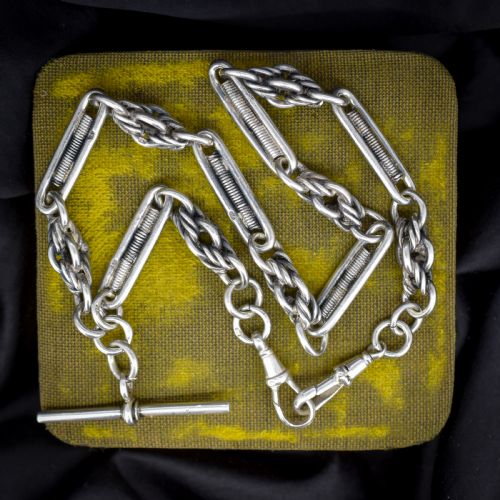


Solid Silver Chain Necklace
These solid silver chain necklace pieces are tactile historical links and pocket watch chains repurposed for the neck.
Solid Silver Chain Necklace
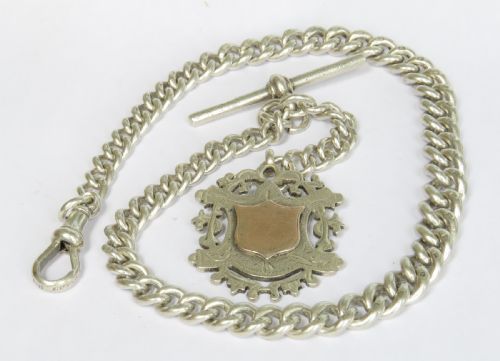
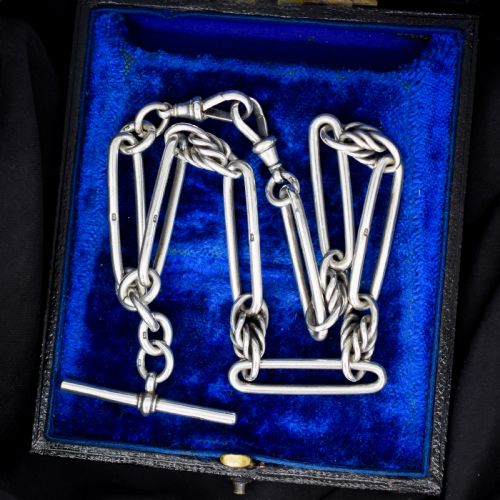
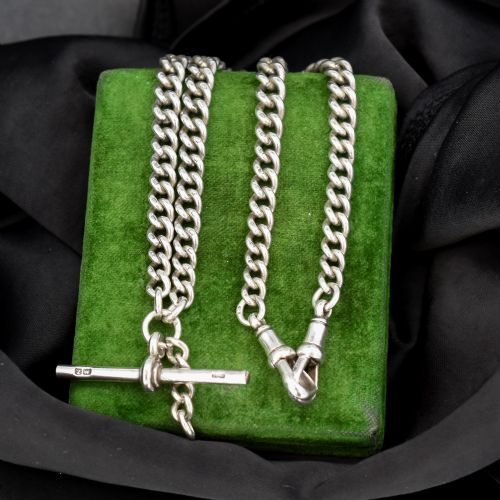
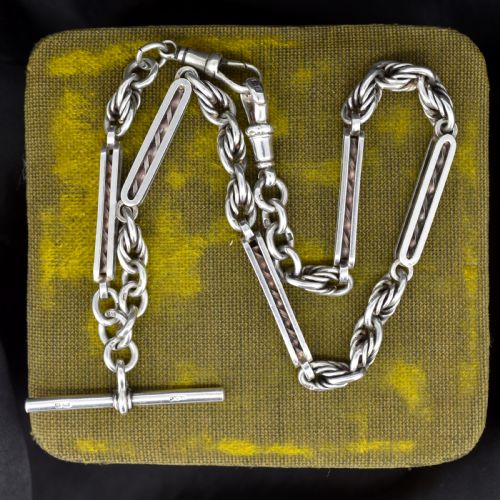
When you search for a solid silver chain necklace, you encounter substantial Victorian and Edwardian pocket watch albert chains, curb links, trombone links, and collar necklaces. Many of these pieces began life as functional watch chains, complete with original dog clips and T-bars that now serve as decorative clasps.
The selection spans from the nineteenth century into the twentieth century, taking in Victorian, Edwardian, Art Deco, and Modernist styles. You will find uniform curb links, love knot patterns, and elaborate pierced fringe collars alongside simpler twentieth-century designs.
Materials and construction
The primary metal across the inventory is sterling silver, often marked with period hallmarks denoting the assay office and year of production. Occasional rose gold accents appear on specific links, while construction techniques involve hand-assembled curb links, hollow or solid trombone sections, and intricate box links.
Makers utilised traditional silversmithing methods to fabricate jump rings, swivel dog clips, and T-bars. Pierced floral and heart motifs on collar necklaces demonstrate careful hand-sawing and engraving work.
Listings feature sterling silver and rose gold across periods from the nineteenth century to nineteen fifty, including Victorian and Edwardian styles.
Judging quality in silver chains
Quality rests in the original gauge of the silver wire and the tightness of the link construction. Heavier pieces, such as chunky curb link albert chains weighing nearly one hundred grams, demonstrate substantial metal weight compared to lighter variations.
The survival of original components like fully functioning swivel dog clips, matching T-bars, and legible hallmarks elevate a piece. Evidence of uniform wear across every individual link indicates careful handling over generations.
The Solid Silver Chain Necklace Glossary
- Trombone link
- A jewellery link design composed of elongated rectangular links joined by smaller circular or oval double links. This pattern originates from nineteenth-century watch chains.
- Dog clip
- A spring-loaded swivel clasp used on watch chains to secure a fob or pocket watch. On modern neckwear, it functions as the primary fastening mechanism.
- T-bar
- A short transverse bar attached to the centre of a watch chain. It was originally passed through a buttonhole to secure the watch.
- Collar necklace
- A wide neck ornament that sits close to the throat, often featuring fringe drops or pierced links. Victorian examples frequently utilise box or patterned links.
Solid Silver Chain Necklace: Frequently Asked Questions
Can I wear a pocket watch chain as a necklace?
Yes, pocket watch chains are frequently worn as necklaces today. The length and weight of an albert chain lend themselves well to being worn around the neck.
The original dog clips and T-bars provide secure and decorative fastenings that sit at the front or back of the neck.
What is a curb link chain?
A curb link chain consists of uniform interlocking links that have been twisted to lie flat. This design creates a smooth, fluid drape against the skin.
Heavier curb link chains from the nineteenth century offer a substantial, bold appearance suitable for daily wear.
How do I identify Victorian silver chains?
Victorian silver chains often feature hallmarks stamped onto individual links or the T-bar, indicating the year of assay. Styles from this era commonly include trombone links, love knots, and heavy curb patterns.
Many of these pieces incorporate functional elements like swivel dog clips originally intended for pocket watches.
What are fringe collars?
Fringe collars are Victorian necklace designs featuring a structured collar band with dangling decorative elements or beads. These pieces often showcase pierced floral, heart, or box link patterns.
They sit flat against the collarbone with the fringe movement adding texture to the overall piece.