
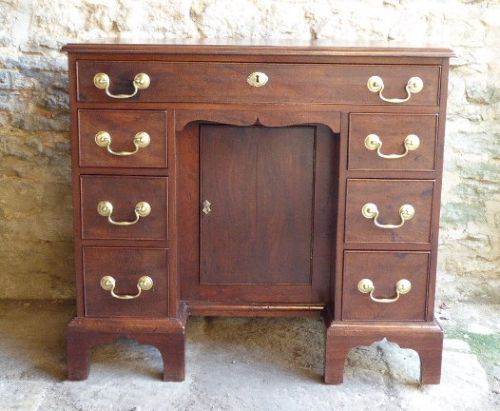
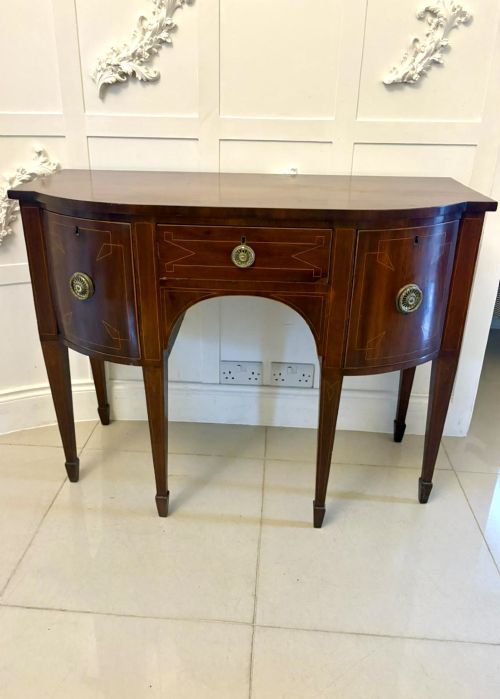
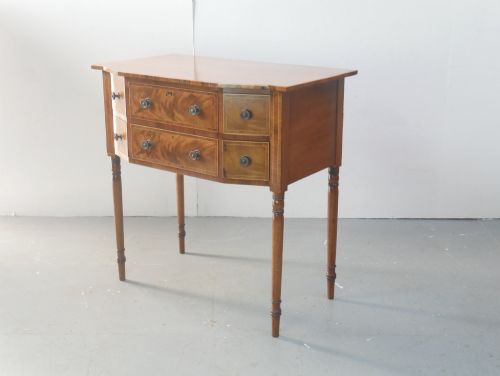
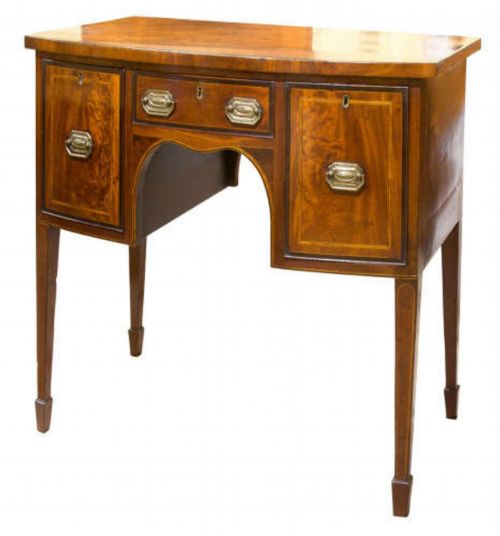
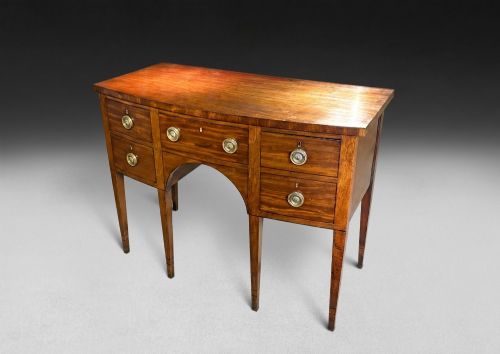


Small George III Sideboard
A small george iii sideboard is a compact serving piece designed for dining rooms, prized for elegant proportions and rich timber.
Small George III Sideboard
A small george iii sideboard brings eighteenth-century craftsmanship into a modern dining room or hallway without dominating the floor space. Most pieces encountered here feature bow-fronted or serpentine silhouettes fashioned in figured mahogany, occasionally accented with contrasting banding.
Makers of the period adapted standard proportions to suit smaller rooms, resulting in compact serving tables, servers, and kneehole formats. These functional items served dining spaces by holding cutlery, linen, and bottles, combining practicality with formal elegance.
The evidence shows forms ranging from traditional bow-front designs to pedestal variations and serving tables. Pieces date principally from the eighteenth century into the nineteenth, maintaining Georgian styling across various regional workshops.
Materials and construction methods
Cabinetmakers relied heavily on solid and veneered mahogany as the primary timber, selected for its rich grain and warmth. Workshops frequently added fine stringing and crossbanding in lighter woods such as satinwood, boxwood, and purpleheart to create crisp geometric borders.
Construction techniques involved careful seasoning of timber to prevent warping across curved drawer fronts and side panels. Drawer linings typically utilised secondary woods, joined with hand-cut dovetails that ensure structural integrity over centuries of daily use.
Brass hardware, including ring pulls and backplates, was cast and fitted by hand to complement the dark tones of the polished mahogany surfaces. Surface finishing relied on traditional wax polishing, which built up a deep, durable sheen over decades.
A few diminutive pieces appear with proportions so small they challenge the traditional definition of a server.
Assessing quality and craftsmanship
Superior examples distinguish themselves through the quality of the timber selection, particularly figured mahogany with striking grain patterns across the curved drawer fronts. Finer pieces demonstrate precise matching of veneers and meticulous inlay work that remains intact and crisp.
Proportion and execution separate standard workshop output from exceptional cabinet work. The sharpness of the cockbeading around drawers and the smooth operation of curved doors reflect the maker's skill and the time invested in construction.
The Small George III Sideboard Glossary
- Bow-front
- A convex, curved front profile popular on late eighteenth-century case furniture. This shape softens the room's geometry while maximising internal storage depth.
- Serpentine front
- A furniture front characterised by a double-concave curve flanking a central convex sweep. This complex shaping requires advanced woodworking skill.
- Inlay
- A technique where pieces of contrasting timber or metal are inserted into recessed cavities on the surface. It creates decorative borders and geometric motifs.
- Crossbanding
- A border of veneer laid with the grain running perpendicular to the central panel. This frames the primary timber and accentuates the edge.
- Cockbeading
- A small, rounded moulding projecting around the edges of drawer openings. It protects the drawer edges and adds a neat linear finish.
Small George III Sideboard: Frequently Asked Questions
Where did they go in the dining room?
These compact servers stood against perimeter walls to hold serving dishes, wine coolers, and cutlery during formal meals.
Their reduced footprint allowed them to fit into smaller Georgian dining spaces without obstructing movement.
How do I date a Georgian sideboard?
Dating relies on examining timber species, construction methods, hardware styles, and the presence of specific banding. Eighteenth-century pieces often feature hand-cut dovetails and native secondary woods.
Changes in leg style and apron design also help narrow down the period of manufacture.
Are bow front sideboards practical today?
The shallow ends and deeper centre of a bow front provide surprisingly versatile storage for modern tableware and linens.
Their compact dimensions make them suitable for hallways, living rooms, and contemporary dining areas.
What woods were used besides mahogany?
Cabinetmakers incorporated satinwood, boxwood, and purpleheart primarily as decorative veneers for stringing and crossbanding.
Oak occasionally appeared in regional pieces as a primary or secondary timber.