

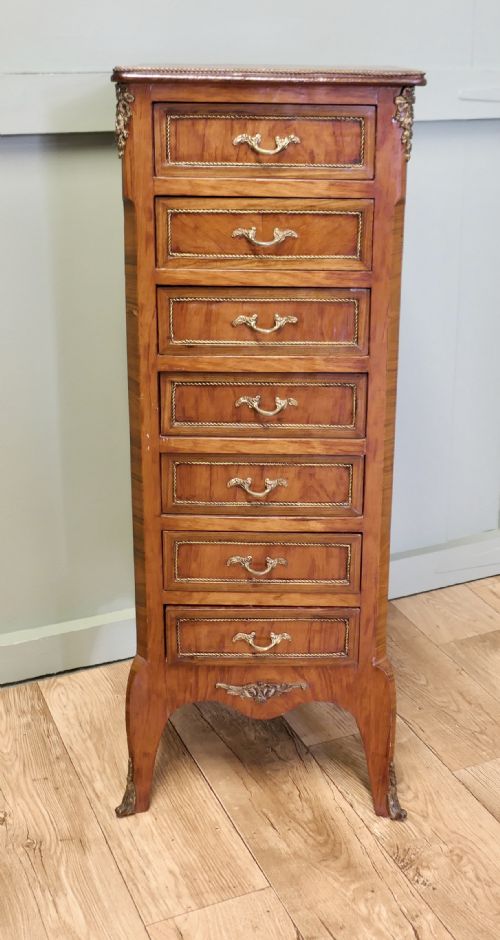


Slim Tallboy Chest
A slim tallboy chest brings vertical storage to tight spaces without sacrificing period timber and classic proportions.
Slim Tallboy Chest
When you search for a slim tallboy chest, you are looking at narrow, vertically stacked storage furniture designed to maximise capacity while occupying minimal floor space. The examples on this page span several decades and styles, including Edwardian, Victorian, and late Georgian periods.
The form frequently appears as a tall chest of drawers, a Wellington chest, or a chest on chest configuration in timber. You will also encounter revival styles such as Queen Anne, Georgian, and Louis XV iterations alongside compact cabinets and watchmakers banks.
Mahogany and walnut dominate the offerings, often enhanced by burr walnut veneers, brass hardware, and subtle inlay work. These pieces suit bedrooms and studies where standard horizontal furniture overwhelms the room.
Materials and construction
Cabinet makers built these pieces using solid timbers like mahogany and pine alongside decorative veneers such as burr walnut and plain walnut. Ebonised wood and applied ormolu sometimes appear for ornamental contrast.
Drawer construction relies on traditional joinery housed within tall vertical carcases, complemented by brass handles and locking mechanisms characteristic of Wellington chests.
Slim Tallboy Chest Retail Price Guide 2026
Typical asking prices for slim tallboy chest among the pieces listed under this phrase on Sellingantiques today, from the lower quarter to the upper quarter. They describe what is for sale here now, not the wider market.
Listings feature mahogany, walnut, burr walnut, and pine across periods from the 19th century through the Edwardian era.
What separates the best from the rest
The distinction in quality rests upon the choice of timber figure, particularly the richness of burr walnut or the depth of polished mahogany grain. Finer pieces display meticulous attention to proportion, matching veneer panels, and well-executed brass hardware rather than heavy or plain replacements.
Structural integrity of the tall carcase and smooth running drawers separate superior examples from more utilitarian workshop output.
The Slim Tallboy Chest Glossary
- Tallboy
- A tall chest of drawers, often built as a single tall carcase or as a chest on chest. This form provides substantial drawer capacity within a restricted footprint.
- Wellington chest
- A tall, narrow chest of drawers secured by a hinged vertical locking stile on one side. This mechanism locks all drawers simultaneously with a single key.
- Burr walnut
- A highly figured wood veneer taken from the wart or burl growths of walnut trees. It yields swirling, intricate patterns prized by cabinet makers.
- Ormolu
- Gilded bronze ornamentation applied to furniture. This technique adds metallic highlights, particularly associated with French Louis styles.
- Inlay
- Contrasting pieces of wood, metal, or shell fitted into the surface of a carcase to form decorative patterns. It defines many revival and Georgian pieces.
Slim Tallboy Chest: Frequently Asked Questions
How were these chests used?
These chests served primarily for storing clothing, linens, and personal valuables in bedrooms and dressing rooms. Their narrow proportions allowed them to fit into alcoves and tight corners where standard chests could not go.
Certain variations, such as Wellington chests and watchmakers banks, incorporated secure locking mechanisms or numerous shallow drawers for specialised items.
How do I live with a tall chest?
Living with a tall chest involves placing it against a stable wall where its height can be appreciated without risking balance. Because these pieces are tall and narrow, securing them properly to the wall ensures safety in daily use.
Pairing the timber tone with existing room decor allows the historical grain and brass hardware to stand out as focal points.
How do I tell periods apart?
Differentiating periods depends on observing timber choices, hardware styles, and decorative motifs like inlay or ormolu. Late Georgian and Victorian pieces often rely on solid mahogany and straightforward proportions, while Edwardian and revival pieces might feature burr walnut veneers and specific stylistic nods to Queen Anne or Louis XV forms.
Examining the construction methods inside the drawers and carcases offers further clues to the manufacturing era.