

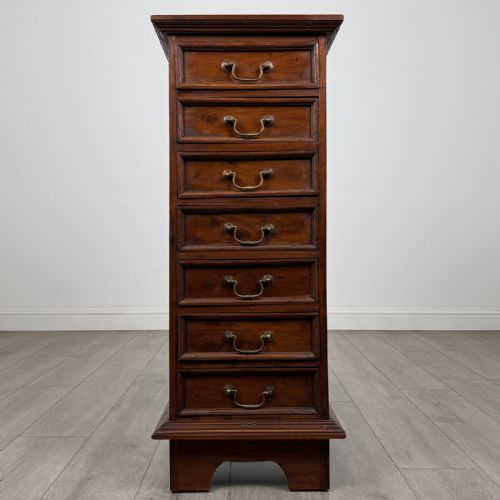
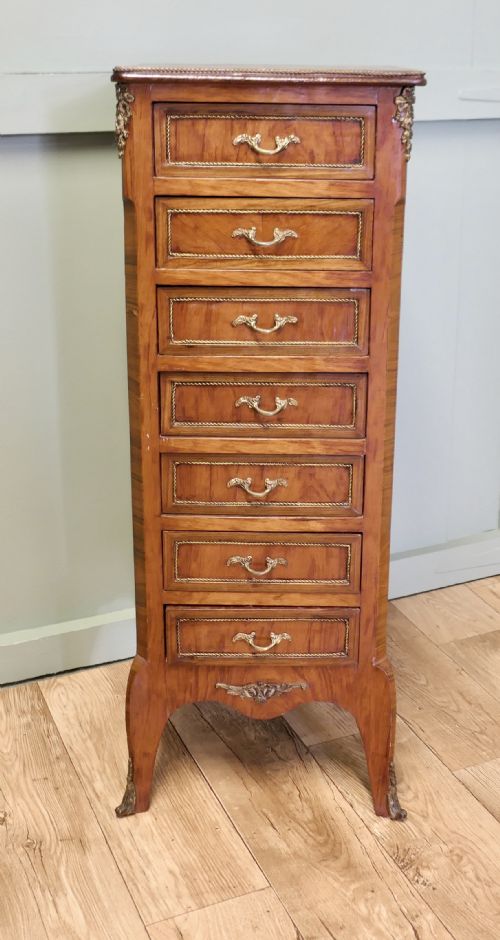


Slim Chest Drawers
These slim antique chest drawers offer vertical storage with compact footprints, perfect for tight spaces without sacrificing period character.
Slim Chest Drawers
A slim antique chest drawers provides generous vertical storage while occupying minimal floor space, making it an ideal choice for rooms with restricted layouts. Pieces on this page span from the late eighteenth century through the Edwardian era and into the nineteen thirties, encompassing both Georgian designs and revival styles.
The most common formats you will encounter are tall, narrow mahogany cabinets and bow fronted chests originating from the Edwardian period or the nineteenth century. Alongside standard drawer configurations, the selection includes specialised forms such as Wellington chests, bedside cabinets, and watchmakers banks of drawers.
Origins range widely, featuring English mahogany workshops, walnut pieces, and French Louis the Fifteenth style pieces alongside Danish pine examples. This variety ensures that whether you seek a formal Georgian Revival piece or a simple Edwardian utility, the proportions remain remarkably restrained.
Assessing quality and craftsmanship
Quality rests upon the selection of timber veneers and the precision of the cabinet maker in maintaining clean, vertical lines across tall proportions. Superior examples display carefully matched wood grain on the drawer fronts and tight, durable joints that withstand daily use.
The refinement of the hardware and the subtlety of decorative details such as brass handles or inlaid stringing distinguish standard utility items from finer domestic furnishings. Proportions remain paramount, with the best pieces achieving a delicate balance between height and narrow width.
The Slim Chest Drawers Glossary
- Mahogany
- A durable tropical hardwood prized for its rich reddish brown colour and smooth grain, frequently utilised in fine cabinet making.
- Bow front
- A convex curved drawer front that projects outward, commonly seen on Edwardian and Georgian revival chests to soften vertical lines.
- Wellington chest
- A tall, narrow chest featuring a hinged locking stile on one side that secures all the drawers simultaneously.
- Ormolu
- Gilded bronze ornamentation applied to furniture, characteristic of French revival pieces and high status cabinets.
- Inlay
- A technique of inserting contrasting pieces of wood or metal into the timber surface to create decorative patterns.
Slim Chest Drawers: Frequently Asked Questions
Where should I put a slim antique chest drawers?
These narrow chests suit alcoves, hallways, and compact bedrooms where standard furniture proves too deep. Their vertical orientation delivers practical storage without dominating the floor area.
They also function effectively as bedside cabinets or alternative storage in studies and dressing rooms.
How do I date a slim antique chest drawers?
Dating relies on timber choice, handle design, construction methods, and stylistic influences. Georgian and late eighteenth century pieces display different proportions and drawer linings compared to Edwardian revivals.
Examining the backboards and internal drawer construction often reveals clues about the period of manufacture.
What is the difference between a tallboy and a slim chest?
A traditional tallboy typically combines a chest of drawers on the bottom with a separate chest or cabinet on top. A slim antique chest drawers generally consists of a single tall, narrow vertical carcass.
Both forms maximise storage in limited floor spaces, but their interior architecture and heights differ.
Can I use a slim chest for modern storage?
The narrow drawer depths accommodate folded garments, documents, accessories, and everyday household items with ease. Their sturdy timber construction ensures they handle regular domestic use.
Care should be taken to balance loads in taller, narrower frames to maintain stability.