



Silver Teapot and Coffee Pot
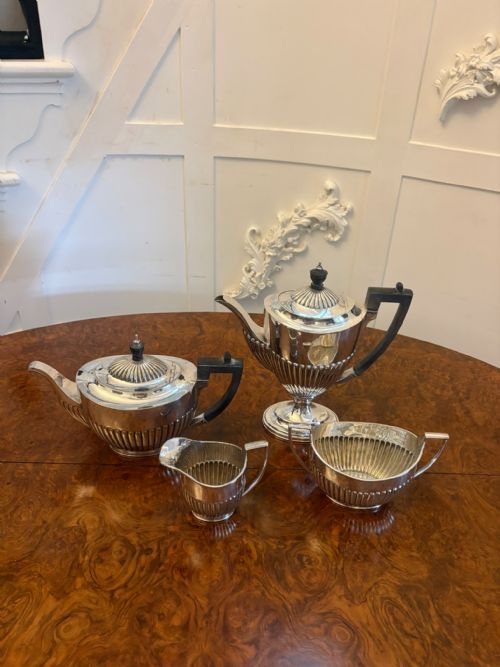
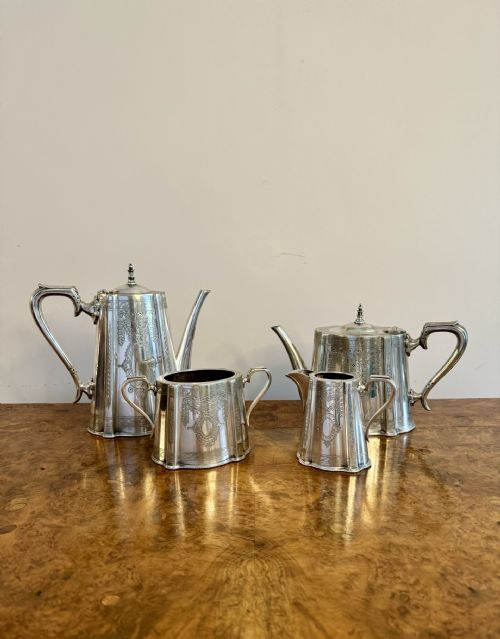
A silver teapot and coffee pot set brings coordinated hospitality to the table, uniting brewing vessels for both leaf and bean.
Silver Teapot and Coffee Pot
When you search for a silver teapot and coffee pot, you encounter matching services and standalone pots spanning from the Georgian period through to the twentieth century. These sets combine utilitarian function with domestic display, reflecting the evolving rituals of entertaining across the eighteenth, nineteenth, and twentieth centuries.
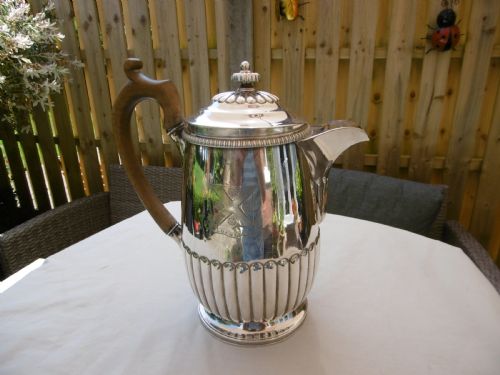
The most common examples on this page are Edwardian silver plated four-piece tea and coffee sets, alongside individual coffee pots in sterling silver and Old Sheffield Plate. These compositions frequently incorporate companion vessels such as cream jugs and sugar basins.
The materials range from solid sterling silver and Old Sheffield Plate to later electroplated nickel silver. Design vocabulary shifts from ornate Neoclassical and Regency styles to geometric Art Deco lines.
How they were made
Silversmiths formed sterling silver and copper through hammering, spinning, and soldering, often applying intricate chasing and repoussé work to create decorative surfaces. Old Sheffield Plate involved fusing a layer of silver to a copper ingot before rolling them into sheets.
Insulating handles and finials frequently incorporated bone or ebonised wood to prevent heat transfer during use. Later twentieth-century manufacturing shifted towards electroplating silver onto nickel silver bases.
Several coffee pots arrive equipped with personal family crests, ready to make your morning brew look like a peer's breakfast.
What varies in quality
The distinction between tiers rests upon the weight of the metal, the crispness of hand-chased ornamentation, and the integrity of the underlying structure. Maker attribution to notable workshops also elevates a piece.
Substantial gauge silver and well-preserved plating without wear to the base metal indicate superior manufacture, whereas thinner electroplate reveals base metals through handling.
Walker and Hall·Matthew Boulton·Joseph Craddock·Boardman Glossop and Co·Birmingham Silversmiths Company·Georg Jensen
The Silver Teapot and Coffee Pot Glossary
- Old Sheffield Plate
- A method of fusing silver to a copper core, common in pieces from the eighteenth and early nineteenth centuries. This technique produces a warm tone as the underlying copper occasionally shows through high points.
- Sterling Silver
- An alloy containing 925 parts of pure silver per thousand, ensuring durability in solid metal vessels. Hallmarks stamped into the body indicate the assay office, standard, and date of manufacture.
- Electroplated Nickel Silver
- A base metal alloy of copper, nickel, and zinc coated with a thin layer of silver through an electrical process. This method became widespread in the nineteenth century for mass production.
- Finial
- The small decorative knob attached to the lid of a teapot or coffee pot for lifting. These elements are often shaped in bone, wood, or cast metal to match the handle.
Silver Teapot and Coffee Pot: Frequently Asked Questions
How do I clean a silver coffee pot?
Wash the interior with warm soapy water and a soft brush to remove residue. Polish the exterior using a dedicated silver cloth or mild cream, avoiding harsh abrasives that scratch the metal.
Rinse thoroughly and dry with a lint-free cloth to maintain the finish and prevent tarnishing.
Can I use these pots for daily tea?
Solid silver and silver plated pots function adequately for serving hot beverages. Ensure you check the interior lining, particularly on older plated items, before regular use.
Hand washing is essential to preserve the surface and any organic handle materials.
What is Old Sheffield Plate?
Old Sheffield Plate is an early composite material made by fusing a sheet of silver to a copper base. This technique predates modern electroplating.
Items made this way display subtle copper highlights along raised edges where the silver has thinned through time.
How do I date a silver pot?
Sterling silver items carry hallmarks that indicate the assay office, standard mark, and a date letter corresponding to the year of testing. Plated items rely on stylistic markers, maker stamps, and construction methods.
Comparing the decorative motifs against known historical periods helps narrow down the decade of production.