


Silver Spoon Sugar Tongs
Silver spoon sugar tongs offer a matched service for the tea table, bringing solid silver and silver-gilt work to the formal gathering.
Silver Spoon Sugar Tongs
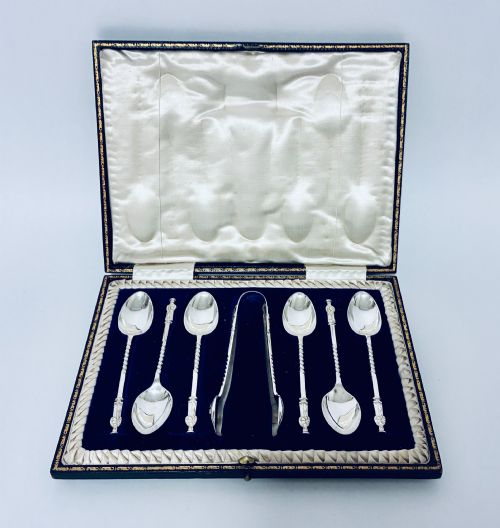
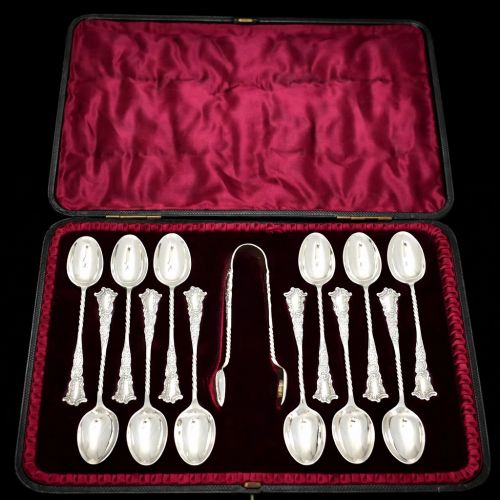
Silver spoon sugar tongs appear primarily in fitted presentation cases alongside teaspoons or apostle spoons, forming complete sets for afternoon tea. The forms span Victorian, Edwardian, and Art Deco periods, encompassing both plain and ornate designs.
A buyer examining silver spoon sugar tongs encounters groupings that often include six or twelve spoons paired with a matching pair of nips or tongs. These pieces originate from provincial assay offices like Chester, Exeter, Birmingham, and Sheffield, as well as London makers.
The most common configurations on this page combine silver teaspoons with sprung sugar tongs, frequently lined inside presentation boxes finished in leatherette, velvet, or satin.
How they were made
Silver spoon sugar tongs utilise sterling silver and silver-gilt, shaped through traditional silversmithing techniques and finished with hallmarks denoting the assay office and year. Many examples incorporate gilding to the bowl interiors or feature specialist guilloche enamel work.
The accompanying presentation containers rely on rigid leather or leatherette shells fitted internally with moulded bases lined in silk, velvet, or satin to secure the cutlery.
Listings feature sterling silver, silver-gilt, and enamel materials paired with velvet, silk, and leatherette presentation cases.
What varies in quality
Quality in silver spoon sugar tongs rests upon the crispness of the casting and chasing, particularly on apostle figures or decorative handles, where sharper detail indicates superior execution. The gauge of the silver also dictates the rigidity of the tongs and the substantial feel of the spoons.
The integrity of the original fitted case influences the overall standard, with intact velvet or silk linings and sound hinges preserving the complete ensemble as intended by the maker.
D&A·Robert Stebbings·David Anderson·Walker & Hall·Robert Pringle & Sons·Aldwinckle and Slater
The Silver Spoon Sugar Tongs Glossary
- Apostle spoons
- Spoons featuring small figures of the apostles cast on the handle ends, frequently found paired with sugar tongs in Victorian and Edwardian cased sets.
- Silver-gilt
- Sterling silver that has been coated with a thin layer of gold, providing a rich yellow lustre often seen inside the bowls of tea spoons.
- Guilloche
- An intricate mechanical engraving technique that produces precise geometric patterns beneath a translucent layer of enamel.
- Leatherette
- A simulated leather material utilised on the exterior of many Victorian and Edwardian presentation boxes.
- Assay office
- An official body responsible for testing the purity of precious metals and stamping items with appropriate hallmarks.
Silver Spoon Sugar Tongs: Frequently Asked Questions
What is included in a silver spoon sugar tongs set?
These sets typically pair a collection of teaspoons or apostle spoons with a matching pair of sprung sugar tongs or nips. They are frequently housed together in a fitted presentation box.
Many configurations include six or twelve spoons alongside the tongs, designed specifically for formal tea service.
How do I date silver spoon sugar tongs?
Dating relies primarily on the hallmarks stamped directly onto the silver components, which indicate the assay office and the specific year of manufacture. Stylistic indicators such as Victorian, Edwardian, or Art Deco forms also help place the set.
Makers' marks provide further confirmation of the period through recorded working dates of the silversmiths.
Were these sets made for everyday use?
Most silver spoon sugar tongs and their accompanying teaspoons were produced for formal hospitality and special occasions rather than daily dining. The inclusion of delicate presentation cases lined in satin or velvet points towards gifting and careful domestic preservation.
Over generations, many sets remained protected inside these fitted boxes, limiting wear.
How should I store cased silver spoon sugar tongs?
Keeping the pieces inside their original fitted case protects both the silver and the delicate interior linings of silk or velvet. Dry storage away from direct sunlight prevents tarnishing of the metal and degradation of the box materials.
Occasional gentle cleaning preserves the polished finish of the sterling silver.