
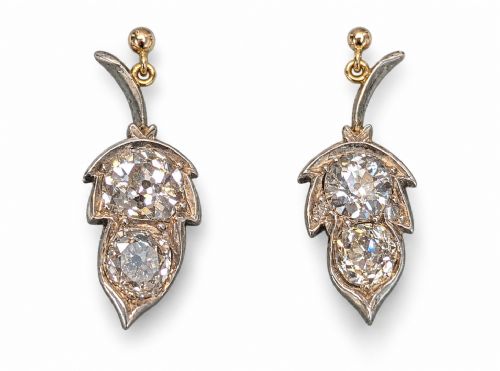
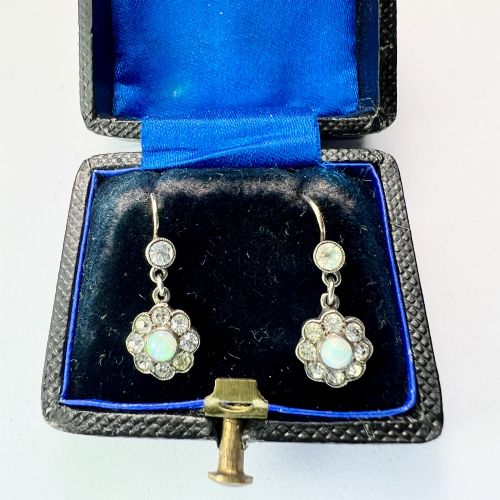


Silver Diamond Drop Earrings
These silver diamond drop earrings bring together historic craftsmanship and brilliant stones, offering understated elegance for any collection.
Understanding silver diamond drop earrings
Silver diamond drop earrings combine precious stones with structured silver settings to create hanging jewellery designed for pierced ears. The selection includes examples from the Victorian, Edwardian, and 1920s periods, showing how goldsmiths adapted forms across decades.
The Edwardian pieces on this page are most frequently encountered, alongside Victorian and early 20th-century items. These designs typically suspend old cut diamonds below the earlobe, creating movement and catching the light effectively.
Earrings from this category range from simple floral clusters to elongated linear drops incorporating pearl or gold details. Each piece reflects the aesthetic preferences of its originating era, from late Georgian roots through to the early decades of the twentieth century.
Materials and construction methods
Makers set diamonds into combinations of silver, gold, and platinum, frequently utilising 18ct gold alongside silver mounts to provide strength and contrast. This dual-metal technique allowed white precious metals to frame the stones while yellow gold reinforced the structural elements.
Stones are predominantly old cut and old European cut diamonds, shaped by hand rather than modern machinery. Natural diamond crystals also appear in certain Georgian and Victorian examples, maintaining their organic contours within traditional settings.
Retail Price Guide 2026
Typical UK retail prices for silver diamond drop earrings, calculated from the Sellingantiques database of over a million retail prices indexed since 2003. This retail price guide relies exclusively on Sellingantiques data; no external sources or auction records are used, so the figures do not describe the wider market.
Some Victorian pairs feature delicate gold bow motifs from which the diamond drops dangle.
Distinguishing quality across pieces
Quality separates simple production from superior craftsmanship through the handling of the metal and the integration of the stones. Finer examples display meticulous claw or collet work that secures the old cut diamonds without obscuring their facets.
The proportion and balance of the drop dictate the visual success of the earrings, ensuring they move gracefully when worn. Better pieces maintain integrity across every soldered joint and fastening, preserving their original fittings for pierced ears.
The Silver Diamond Drop Earrings Glossary
- Old cut diamond
- A hand-faceted diamond shape common in antique jewellery, featuring a small table and a high crown that produces a softer candlelit sparkle. These stones were shaped individually before automated sawing existed.
- Drop earrings
- Jewellery designed to dangle below the earlobe rather than sit directly against the skin. They create motion and draw the eye downwards.
- Collet setting
- A metal collar that encircles the girdle of a gemstone, holding it securely within the jewellery piece. This technique predates modern prong settings and offers a distinct historic outline.
- Pierced ears
- A method of wearing earrings where the wire or post passes directly through a hole in the earlobe. Many historic pairs are configured specifically for this type of fitting.
Frequently Asked Questions
How do I date antique drop earrings?
Dating relies on examining the cut of the diamonds, the mounting metals, and the overall construction techniques. Specific periods such as the Edwardian era or Victorian times exhibit characteristic design motifs.
Comparing the closure mechanisms and the arrangement of stones against known historical examples helps establish a reliable timeline for each pair of earrings.
What is an old European cut diamond?
An old European cut is a predecessor to the modern round brilliant diamond, characterised by a smaller table, a higher crown, and a distinctive open culet at the base. These stones were hand-cut during the nineteenth and early twentieth centuries.
Their proportions give them a unique optical performance that differs sharply from contemporary machine-cut gems.
Why use both silver and gold?
Jewellers combined silver and gold to exploit the distinct colour and structural properties of both metals. Silver provided a bright white surface that flattered the diamonds, while gold offered structural strength and prevented tarnishing against the skin.