



Silver and Enamel Perfume
Silver and enamel perfume bottles bring together precious metalwork and vibrant coloured glass to sit on a dressing table.
Silver and Enamel Perfume
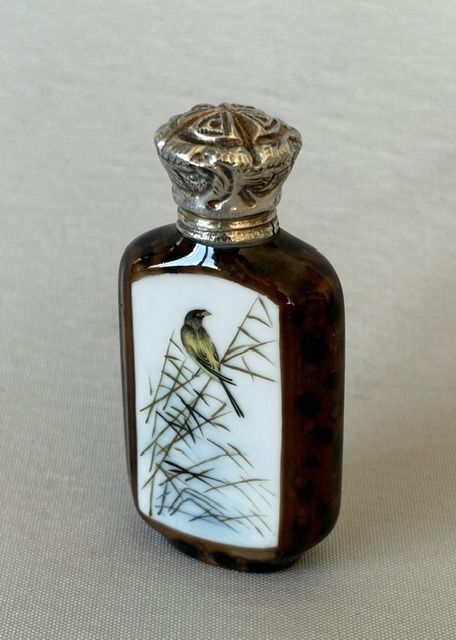
Silver and enamel perfume vessels span several decades from the late nineteenth century through to the middle of the twentieth century. These small containers take the form of scent bottles, scent flasks, and perfume atomizers alongside lidded vanity jars.
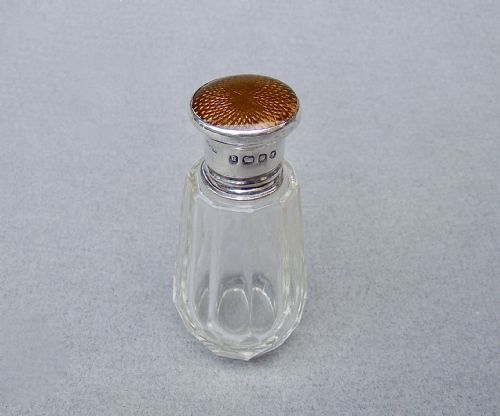
The objects combine sterling silver mounts with glass bodies, often cut or moulded, overlaid with colourful enamel or guilloche enamel. Examples range from small pocket bottles to larger vanity pieces intended for stationary display.
Design influences shift from the Aesthetic Movement and Edwardian pieces through French Belle Epoque work to geometric Art Deco creations and mid-century British examples.
Manufacturing and Materials
Silversmiths formed the mounts and collars from sterling silver, often working in Birmingham or London to produce fitted screw caps and hinged lids. These metal elements were frequently hallmarked to record the assay office and year of manufacture.
Glass bodies were blown and cut into panelled, reeded, or plain cylindrical shapes to hold the liquid contents securely. Cut glass adds refractive weight and texture beneath translucent enamel panels.
Enamelwork was applied to the silver surfaces using techniques such as guilloche, where a geometric pattern is engraved into the metal before a translucent layer of enamel is fused by heat.
Silver and Enamel Perfume Retail Price Guide 2026
Typical asking prices for silver and enamel perfume among the pieces listed under this phrase on Sellingantiques today, from the lower quarter to the upper quarter. They describe what is for sale here now, not the wider market.
Some dressing table bottles retain a faint trace of floral scent locked inside for nearly a century.
Assessing Quality
Quality rests upon the precision of the guilloche engraving beneath the translucent enamel and the crispness of the silversmith's mounting. Heavier gauge silver mounts and intricate engine-turned patterns indicate finer workshop production.
The integration between the glass body and the silver collar determines the structural integrity of the bottle. Well-fitted mounts and evenly distributed enamel coatings without surface disruption separate standard production from superior pieces.
Henry Perkins·Karl Palda·Mappin and Webb
The Silver and Enamel Perfume Glossary
- Guilloche enamel
- A decorative technique where metal is engine-turned with an intricate geometric pattern before translucent enamel is applied over the top. This allows light to reflect through the coloured layer to create a shimmering depth.
- Sterling silver
- An alloy of silver containing ninety-two point five percent pure silver and seven point five percent other metals, usually copper. It provides the durable framework for mounts, collars, and lids.
- Cut glass
- Glass shaped and patterned by holding it against a rotating abrasive wheel. This process creates deep facets that catch the light and add tactile weight to the vessel.
- Perfume atomizer
- A spray bottle mechanism fitted to a glass container to disperse scent in a fine mist. These often feature bulb pumps or metal plunger pumps integrated into the silver mount.
- Vanity jar
- A short container with a wide silver and enamel lid designed to hold powders or creams on a dressing table rather than liquid scent.
Silver and Enamel Perfume: Frequently Asked Questions
What are these perfume bottles made of?
These pieces combine sterling silver mounts with glass bodies and decorative enamel surfaces. The glass is often cut or moulded, while the metal components provide structural collars and lids.
Enamel is fused onto the silver, sometimes over an engine-turned guilloche pattern, creating coloured translucent panels across the top or body of the vessel.
How do you date these scent bottles?
Dating relies heavily on hallmarks stamped into the silver mounts by assay offices such as those in London and Birmingham. These marks indicate specific years of manufacture.
Stylistic shifts also help establish age, moving from the decorative floral motifs of the Edwardian era to the geometric lines of Art Deco design.
How were these bottles used?
They were designed for personal grooming and fragrance application, sitting upon dressing tables or carried in handbags for daily use. Some contained liquid scent applied via a glass dauber attached to the stopper.
Others functioned as atomizers with spray mechanisms or served as wide-necked jars for holding scented powders and vanity creams.
How should I clean silver and enamel?
Cleaning requires gentle care to protect the delicate glass and the fused enamel surface from harsh abrasives. Silver polish should be kept away from the enamel panels to prevent scratching or chemical dulling.
Soft cloths are best used to remove dust from the silver mounts and glass bodies without disturbing the fitted collars or hinges.