

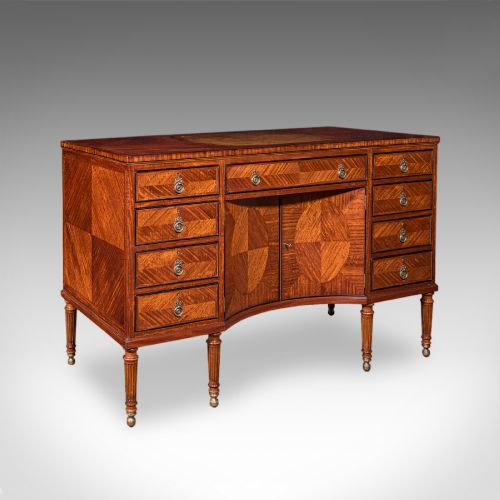
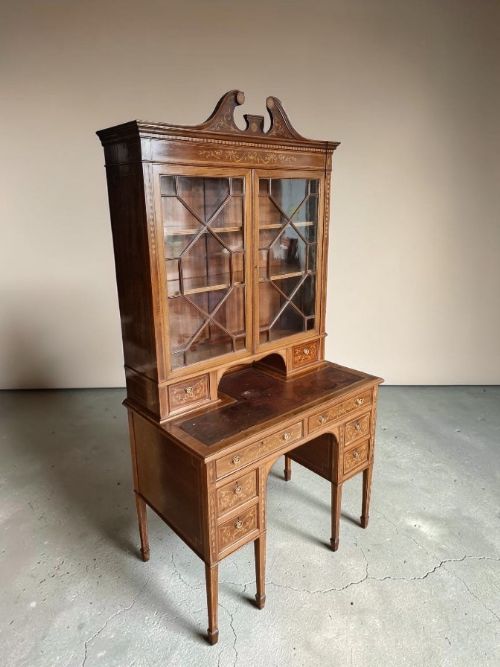


Sheraton Revival Kneehole Desk
These sheraton revival kneehole desk pieces are refined writing furniture drawing on eighteenth-century classicism, offering fitted drawers and elegant proportions for the home study.
Sheraton Revival Kneehole Desk
When you search for a sheraton revival kneehole desk, you encounter Edwardian and late nineteenth-century interpretations of neoclassical furniture forms. These pieces typically take the form of compact writing desks, dressing tables, and freestanding kneehole desks featuring central recessed spaces flanked by banks of drawers.
The examples found in this inventory span from eighteen-eighty to nineteen-ten, heavily anchored in the Edwardian period. They capture the lighter proportions and decorative aesthetic of the late Georgian revival, distinct from the heavier Victorian styles that preceded them.
How they were made
Cabinetmakers constructed these desks using solid mahogany and satinwood timbers, often applying contrasting satinwood inlay to create geometric borders and neoclassical motifs. Surfaces frequently incorporate inset leather writing panels and protective glass tops.
Hardware consists of brass drawer pulls and handles that complement the lighter wood tones. Inlay techniques demand precise hand-cutting of contrasting veneers fitted precisely into channels carved within the primary timber.
Sheraton Revival Kneehole Desk Retail Price Guide 2026
Typical asking prices for sheraton revival kneehole desk among the pieces listed under this phrase on Sellingantiques today, from the lower quarter to the upper quarter. They describe what is for sale here now, not the wider market.
Materials appearing across the inventory include mahogany, satinwood, brass, leather, glass, and detailed satinwood inlay.
What varies in quality
The standard of execution in the satinwood inlay creates the primary distinction between ordinary production and finer cabinetwork. Sharp, tightly fitted joints and crisp botanical or classical motifs indicate superior workshop output.
Materials also dictate rank, with select satinwood framing and figured mahogany commanding greater regard than plain secondary timbers. The presence of hand-decorated elements and integrated leather surfaces further elevates the individual piece.
James Shoolbred of London
The Sheraton Revival Kneehole Desk Glossary
- Kneehole desk
- A writing table featuring a central recessed space for the legs, positioned beneath a drawer and flanked by two pedestals of drawers. This configuration became popular in the eighteenth century and saw renewed production during the revival periods.
- Satinwood inlay
- A decorative technique where contrasting light-coloured satinwood veneers are embedded into the surface timber. This creates delicate borders, urns, or floral motifs characteristic of late Georgian and revival design.
- Edwardian
- Pertaining to the period of the reign of King Edward the Seventh from nineteen-one to nineteen-10, though the aesthetic often encompasses late nineteenth-century transitional work. Furniture from this era favours lighter forms and bright inlay.
- Serpentine
- A furniture front or edge shaped with a convex centre flanked by concave curves. This subtle undulating line requires considerable woodworking skill to execute properly on drawer fronts and sideboards.
Sheraton Revival Kneehole Desk: Frequently Asked Questions
What is a sheraton revival kneehole desk?
It is a revival piece inspired by eighteenth-century neoclassical designs, featuring a central kneehole space and multiple small drawers.
These desks emerged during the late nineteenth and early Edwardian periods, prioritising elegant proportions and decorative inlay over heavy mass.
How do I date an Edwardian desk?
Dating relies on recorded construction traits, material combinations, and stylistic markers typical of the years between eighteen-eighty and nineteen-ten.
Makers of this era frequently combined mahogany with satinwood inlay, reflecting a conscious revival of earlier Georgian aesthetics.
Are these desks suitable for daily use?
They function well as writing tables or laptop stations when fitted with stable leather writing surfaces and sturdy drawer construction.
Care should be taken to protect antique polished wood surfaces from moisture and heavy impacts during everyday work.
What wood was used for these desks?
Cabinetmakers primarily utilised mahogany and satinwood as the main timbers for both structural carcases and visible drawer fronts.
Contrasting satinwood inlay provided decorative contrast, while brass hardware completed the polished aesthetic of the period.