



Set Six Teaspoons
These set six teaspoons bring period craftsmanship to the table, offering a matched service of silver for everyday use or display.
Set Six Teaspoons
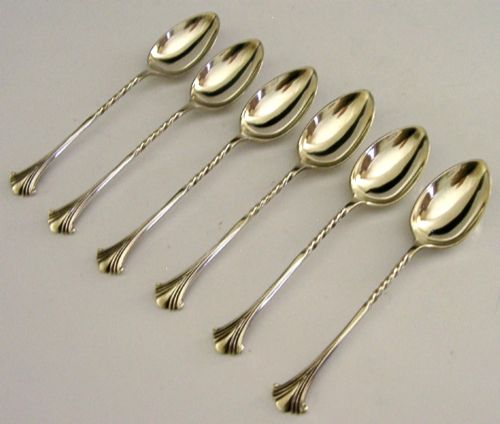
When you search for set six teaspoons, you find matched collections of small eating and stirring spoons gathered together in cases or groupings. These items span various eras, from the intricate work of the Georgian period through Edwardian and Art Deco designs up to Mid-Century Modern pieces.
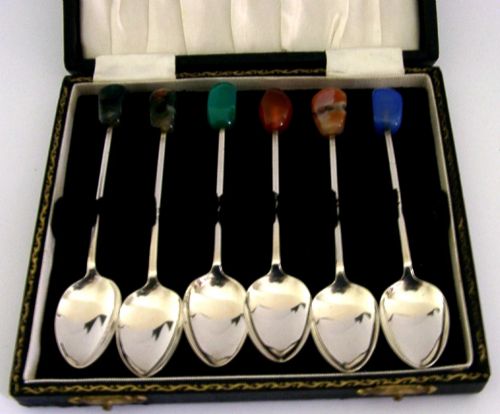
You are most likely to meet sterling silver and silver teaspoons on this page, often presented in fitted boxes lined with silk, velvet, or satin. Some sets include companion pieces like sugar tongs, whilst others feature specialised bowls inset with agate or finished with coloured enamel.
Origin and period dictate the character of each collection, ranging from the bright-cut engraving of eighteenth-century London makers to the sleek, modernist lines of the 1950s and 1960s. These sets reflect changing social rituals around tea and coffee consumption over multiple centuries.
How They Were Made
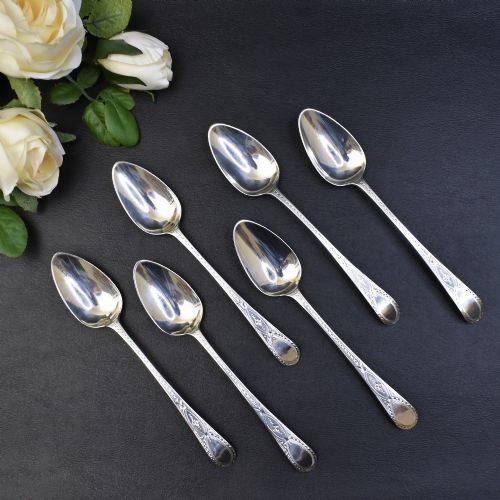
Silversmiths shaped these teaspoons using traditional techniques of hammering, casting, and hand-engraving, applying hallmarks to certify the metal standard. Many Georgian examples show delicate bright-cut work, where faceted cuts catch the light along the stem.
Twentieth-century sets often incorporate decorative finishes such as enamel work or parcel-gilding, known as silvergilt, where a thin layer of gold coats the silver surface. Presentation boxes utilise materials like leatherette, silk, satin, and velvet to cradle the spoons securely.
Set Six Teaspoons Retail Price Guide 2026
Typical asking prices for set six teaspoons among the pieces listed under this phrase on Sellingantiques today, from the lower quarter to the upper quarter. They describe what is for sale here now, not the wider market.
One sporting set links silver enamel spoons directly to the Tamesis Sailing Club.
What Varies in Quality
The distinction between standard utility ware and finer pieces rests on the crispness of the ornamentation and the integrity of the original set. Crisp bright-cut engraving and intact enamel or agate insets elevate a collection above plain, utilitarian spoons.
The presence of a matching fitted case lined in silk or velvet enhances the coherence of the set. Consistency in the hallmarks across all six spoons confirms that the group started life together rather than being assembled later.
P A W Bateman
The Set Six Teaspoons Glossary
- Bright-Cut
- A form of engraving executed with flat-bottomed gouges that leave faceted cuts reflecting light brilliantly. This technique was particularly popular on Georgian silverware.
- Hallmark
- An official stamp applied by an assay office to indicate the purity of the metal, the maker, and the year of production. British silver bears these marks as a guarantee of quality.
- Silvergilt
- Silver that has been coated with a thin layer of gold on its surface. This finish gives the metal a warm, dual-toned appearance.
- Agate
- A form of quartz exhibiting coloured bands or cloudy masses, sometimes utilised for decorative handles or insets on spoons. It adds natural colour and texture to the piece.
- Enamel
- A glassy substance fused to metal through firing to produce a smooth, coloured surface. It appears on decorative handles and bowls in twentieth-century sets.
Set Six Teaspoons: Frequently Asked Questions
What are set six teaspoons used for?
These sets were primarily designed for stirring sugar or milk into tea or coffee during formal gatherings and afternoon tea services. They also function well for serving small desserts or preserves.
Over time, many families kept these sets specifically for entertaining guests, which is why so many survive today complete with their original presentation cases.
How do I date a silver teaspoon set?
Dating relies heavily on the hallmarks stamped into the metal, which include symbols for the assay office, the maker, and a specific date letter. Style also offers strong clues, ranging from Georgian bright-cut engraving to Art Deco geometric lines.
Comparing the shape of the bowl and the decoration on the handle against known period designs helps narrow down the era of manufacture.
Are these teaspoons safe to use daily?
Sterling silver and silver spoons are robust enough for regular daily use provided they are washed by hand rather than put in a dishwasher. Hand washing protects delicate finishes like enamel, gilding, and agate.
Using them regularly actually prevents tarnish from building up heavily, keeping the metal bright through gentle friction.
What does silvergilt mean on a spoon?
Silvergilt describes silver that has been plated with a thin layer of pure gold, giving the metal a rich golden hue while retaining the structural strength of silver underneath. This technique was often applied to the bowls of teaspoons and coffee spoons.
It protects the silver from tarnishing in areas that come into contact with food acids and adds a decorative contrast to the handle.