

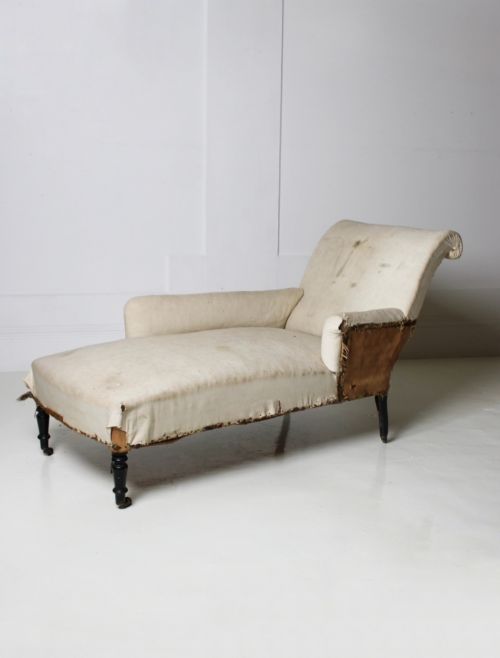
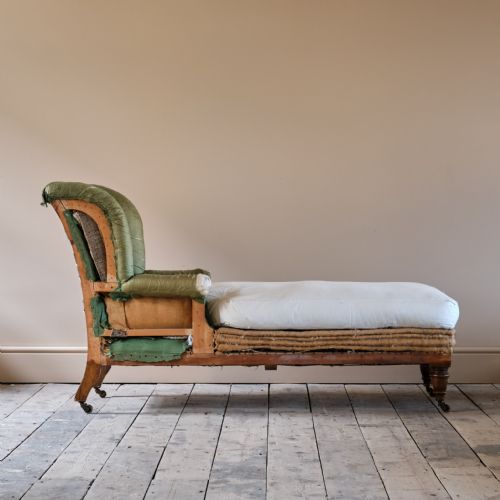


Scrolled Back Daybed
These scrolled back daybed examples bring classic nineteenth century comfort into a room with their graceful, sweeping timber frames.
Scrolled Back Daybed
A scrolled back daybed sits between a chair and a sofa, offering a long seat for reclining with an elevated end for support. The scrolled back daybed design appears across nineteenth century periods, moving from Regency lines to heavier Victorian upholstery.
Most pieces seen here take the form of chaise longues, day beds, or low benches with distinctive curved timber ends. Country house examples sit alongside more formal rosewood and mahogany pieces, while occasional miniature furniture pieces also emerge.
Makers such as Holland & Sons and Miles & Edwards produced these seating forms during the Victorian and Regency eras. The search phrase covers both fully upholstered reclining daybeds and exposed timber frames ready for fresh fabric.
How they were made
Cabinet makers utilised dense hardwoods like mahogany and rosewood for the structural frames, often turning the legs to support heavy upholstered bodies. Beech provides internal framing, while brass castors allow these substantial seats to move across a floor.
Upholstery techniques involve traditional stuffing secured beneath calico and top fabrics, paired with polished woodwork that showcases the grain. Ebonised finishes and Anglo Indian carving traditions also appear on specific scroll back bench frames from the mid nineteenth century.
Scrolled Back Daybed Retail Price Guide 2026
Typical asking prices for scrolled back daybed among the pieces listed under this phrase on Sellingantiques today, from the lower quarter to the upper quarter. They describe what is for sale here now, not the wider market.
What varies in quality
The refinement of the timber carving and the elegance of the scroll dictate the upper tier of these pieces. Crisp turnings on the legs and retained original castors distinguish better examples from simpler country house variants.
The integrity of the frame construction and the quality of the primary hardwood timber set individual pieces apart. Rosewood and mahogany frame surfaces show greater depth than secondary woods, whilst maker attributions elevate certain pieces.
Holland & Sons·Miles & Edwards
The Scrolled Back Daybed Glossary
- Chaise Longue
- A long reclining chair that combines a seat with a single elevated backrest for resting.
- Castor
- A small wheel fitted to the base of furniture legs to allow easy movement across carpets and floorboards.
- Calico
- A plain woven cotton fabric traditionally used as the foundational inner lining beneath top upholstery.
- Ebonised
- Timber treated with a dark stain or finish to imitate the appearance of expensive ebony wood.
- Turned legs
- Wooden supports shaped on a lathe to create cylindrical, fluted, or bulbous decorative profiles.
Scrolled Back Daybed: Frequently Asked Questions
How do I use a daybed today?
These pieces fit naturally into studies, large living rooms, or bedrooms as a comfortable spot for daytime reading and resting. Their low profile avoids blocking light from windows while adding architectural interest to empty wall spaces.
Position the piece so the scrolled end acts as a focal point in the room. Pairing the seating with a small reading lamp creates a dedicated relaxation zone.
How do I date a scrolled back daybed?
Look to the timber species, leg turnings, and framing style to determine the period of manufacture. Regency and early Victorian pieces tend to feature lighter mahogany or rosewood, whereas later Victorian iterations often present heavier proportions.
Hardware such as brass castors and internal stuffing materials also offer clues to the decade of production. Maker stamps, where present on the timber frame, provide a precise attribution.
How do I care for antique upholstery and wood?
Protect antique wood frames from direct sunlight and sudden temperature changes to prevent the timber from splitting or warping. Dust carved rosewood and mahogany regularly with a dry cloth and avoid harsh chemical polishes.
Upholstered sections benefit from gentle vacuuming using a soft brush attachment. Professional cleaning preserves delicate fabrics and maintains the underlying stuffing.