
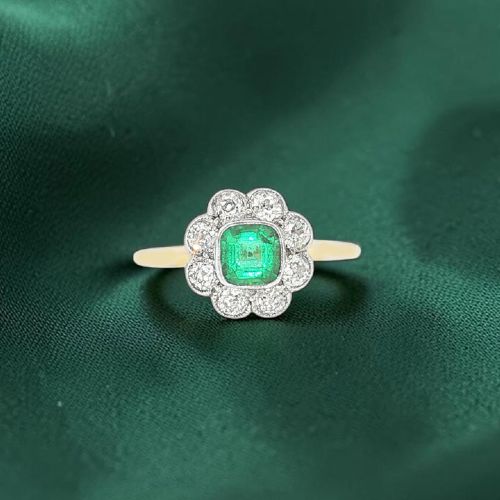
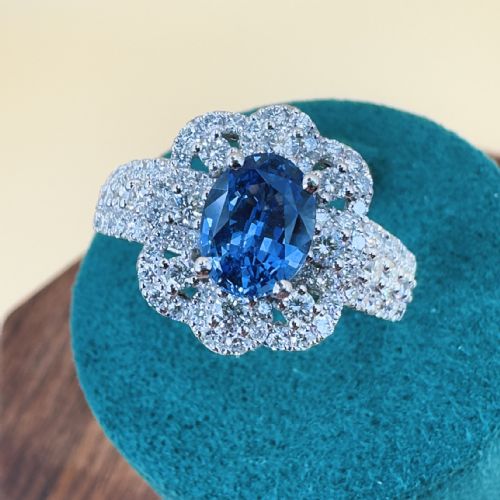


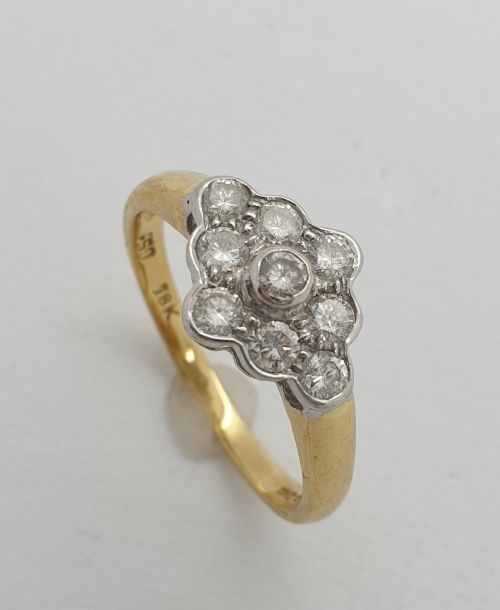
Scalloped Diamond Cluster Ring
These scalloped diamond cluster ring examples combine central gemstones with brilliant diamond borders in striking geometric or scalloped forms.
Scalloped Diamond Cluster Ring
A scalloped diamond cluster ring brings together a prominent centre stone, such as a sapphire, emerald, ruby, or diamond, surrounded by smaller diamonds to create a floral or scalloped outline. Pieces matching this description span multiple eras, notably the Edwardian period and the Art Deco style, alongside mid-century creations from the 1930s, 1940s, 1950s, and 1960s.
The format relies on maximising brilliance by setting multiple diamonds closely around a focal gem. Buyers frequently encounter Edwardian interpretations featuring intricate white gold work alongside bolder 1930s Art Deco geometric configurations.
What varies in quality
Quality differences lie in the selection and matching of the central gemstone alongside the cut and clarity of the surrounding diamonds. Finer examples display harmonious proportions between the centre stone and the surrounding cluster border.
The crispness of the metalwork, particularly in platinum and 18ct white gold settings, distinguishes exceptional workmanship from standard production.
Certain rings manage to pack an entire garden's worth of sparkle into a scalloped frame smaller than a postage stamp.
Le Vian
The Scalloped Diamond Cluster Ring Glossary
- Cluster ring
- A ring featuring a central gemstone surrounded by a group of smaller stones, typically diamonds. This arrangement maximises visual impact and perceived size.
- Old cut diamond
- A diamond cut by hand before the advent of modern brilliant-cut standards, characterised by a smaller table, higher crown, and open culet. These stones exhibit a softer, warmer candlelit sparkle.
- Cabochon sapphire
- A sapphire shaped and polished with a smooth, rounded surface rather than faceted. This historic cutting style highlights the deep blue colour of the gemstone.
Scalloped Diamond Cluster Ring: Frequently Asked Questions
How do I wear an antique cluster ring?
These rings suit daily wear provided appropriate care is taken with settings and gemstone hardness. Pairing them with plain bands prevents rubbing against other jewellery.
Consider removing the ring during rigorous physical activities to protect the delicate claw settings.
How do I identify an Art Deco cluster ring?
Art Deco examples typically display geometric symmetry, strong lines, and platinum settings. The diamond arrangements often favour old-cut stones in square, rectangular, or scalloped motifs.
Makers from this period embraced contrasting materials like white gold and platinum.
What materials were used in Edwardian cluster rings?
Edwardian rings frequently utilise 18ct white gold combined with platinum settings to highlight diamonds. Central stones often include emeralds, sapphires, or diamonds.
Lace-like metalwork is characteristic of this period's jewellery design.