

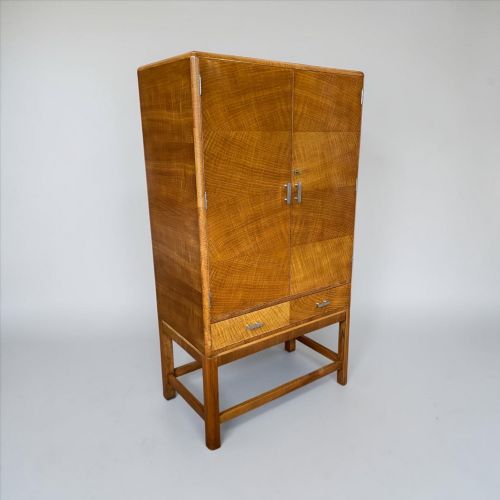
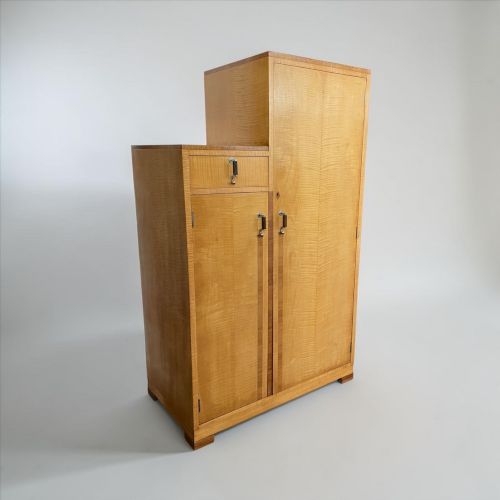
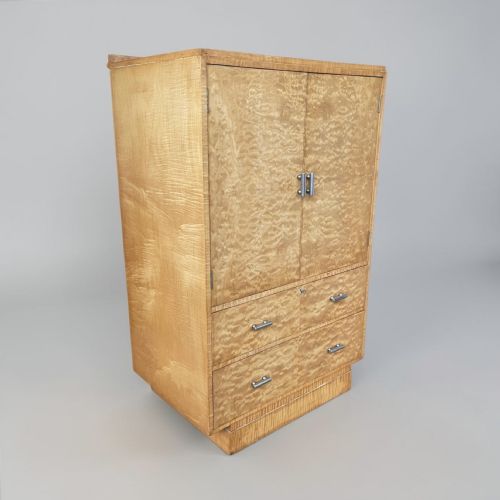
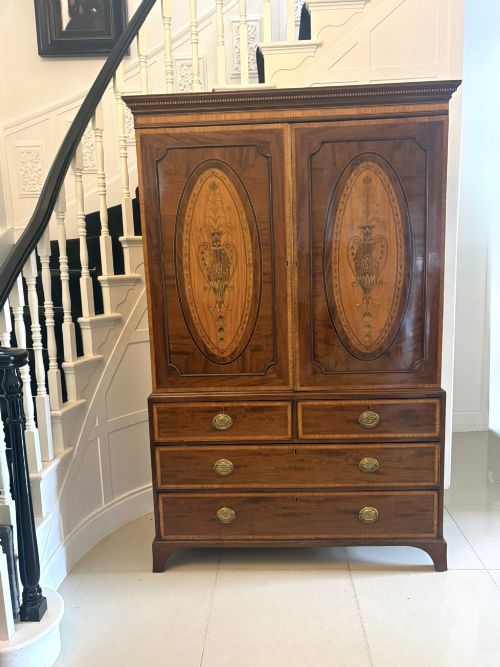
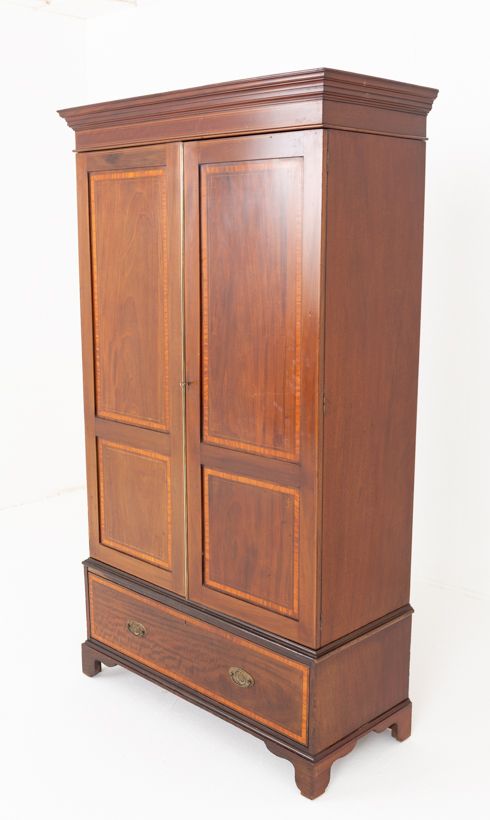
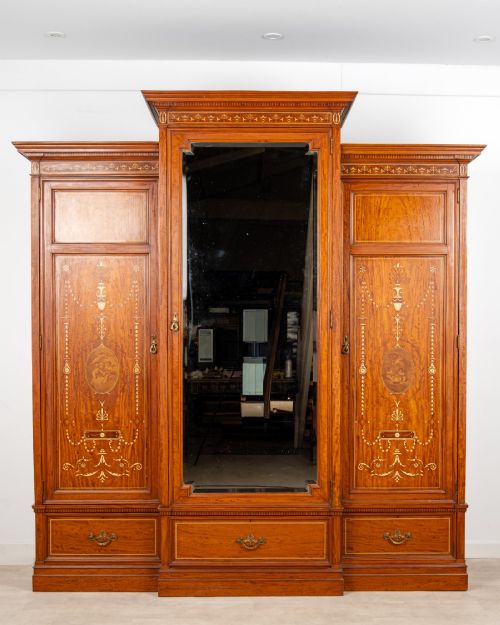
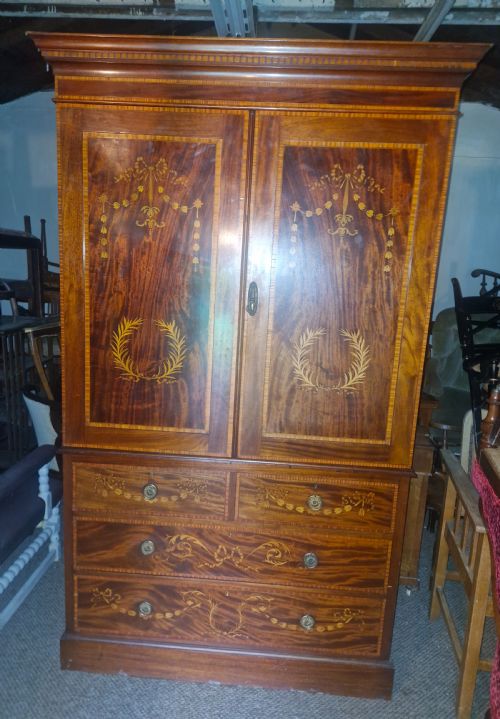


Satinwood Press Cupboard
These satinwood press cupboard pieces bring together figured cabinet timbers and interior storage trays in forms spanning George III to Art Deco.
Satinwood Press Cupboard
A satinwood press cupboard combines upper linen storage enclosed by doors with a lower chest of drawers, offering a substantial silhouette for domestic storage. When searching for a satinwood press cupboard, you encounter forms ranging from Georgian housekeeper wardrobes to Edwardian inlaid armoires and later tallboys.
The material characterises the group, appearing as solid satinwood or as detailed banding and veneers upon mahogany and other timbers. Pieces span periods from the late eighteenth century through the Victorian and Edwardian eras up to Art Deco designs.
How They Were Made
Cabinet makers utilised dense timbers like mahogany and birch as structural carcasses, applying figured satinwood veneers and decorative banding to principal surfaces. Marquetry, painted details, and contrasting stringing provide the characteristic ornament across many examples.
Internal elements often include sliding trays or linen slides within the upper section above fitted drawers, whilst brass hardware secures the heavy doors.
Satinwood Press Cupboard Retail Price Guide 2026
Typical asking prices for satinwood press cupboard among the pieces listed under this phrase on Sellingantiques today, from the lower quarter to the upper quarter. They describe what is for sale here now, not the wider market.
Listings span Georgian, Victorian, Edwardian, and Art Deco periods, utilising satinwood, mahogany, birch, and birds-eye maple veneer.
What Varies in Quality
Construction standards depend upon the selection of timber veneers and the precision of the marquetry or banded inlay. Superior examples display seamless grain matching across large door panels and robust internal framing for the sliding press trays.
The refinement of brass mounts, the integrity of the fitted interiors, and the subtlety of painted or inlaid decoration distinguish the finest cabinets from standard production.
Druce & Co.·Waring & Gillow·Heal's·Edwards & Roberts·Lamb of Manchester
The Satinwood Press Cupboard Glossary
- Satinwood
- A hard, yellowish timber native to tropical regions, prized for its lustrous, light-reflecting grain. It is frequently employed as a fine veneer or banding on larger cabinet pieces.
- Linen press
- A large piece of furniture designed for storing folded garments and bedding, typically featuring sliding trays enclosed by upper doors above a chest of base drawers.
- Bandings
- Narrow strips of contrasting timber inlaid around the edges of drawer fronts and door panels. This technique frames the primary wood surface.
- Marquetry
- The art of forming decorative patterns on a wooden carcass by fitting together small pieces of different veneers. It creates pictorial or geometric designs.
- Swan-neck pediment
- A broken arch top moulding featuring two opposing curved scrolls that rise to central terminals. It often appears on Georgian case pieces.
Satinwood Press Cupboard: Frequently Asked Questions
What is a satinwood press cupboard?
A satinwood press cupboard is a large storage piece featuring upper doors enclosing sliding shelves or hanging space, positioned above a chest of drawers.
These cabinets utilise light satinwood veneers or solid timber, often displaying mahogany banding and detailed inlay work.
How do I date a press cupboard?
Dating relies on stylistic clues such as swan-neck pediments and Georgian proportions versus Edwardian painted decoration or Art Deco geometry.
Construction methods and timber choices also indicate the period of manufacture, moving from eighteenth-century carcases to later nineteenth-century styles.
Where were press cupboards used?
These large cabinets served principally in bedrooms and dressing rooms to store folded linens, household textiles, and garments before fitted wardrobes became standard.
Housekeeper rooms also utilised them for domestic storage due to the deep sliding trays contained within the upper section.
How do I care for satinwood furniture?
Protect the polished wooden surfaces from direct sunlight to prevent the light satinwood grain from darkening or fading over time.
Maintain a stable indoor humidity and apply microcrystalline wax occasionally to nourish the historic timber and veneer.