
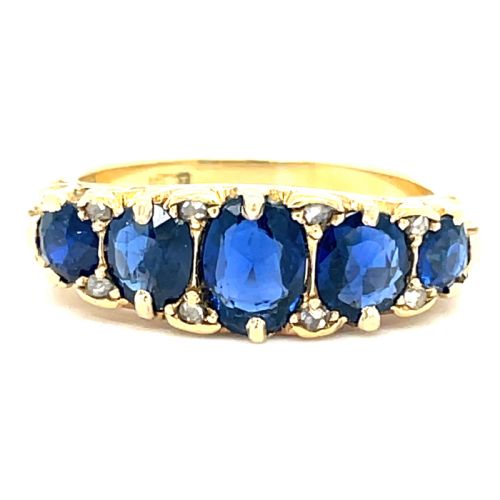
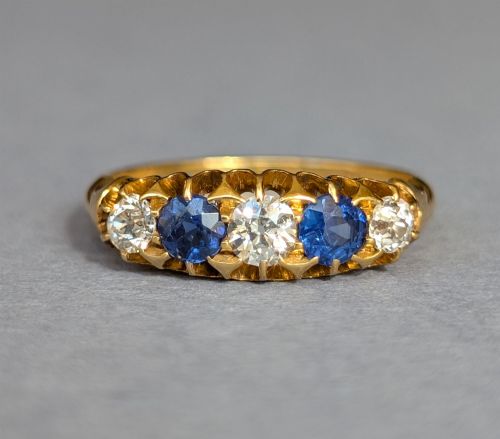


Sapphire Half Hoop Ring
A sapphire half hoop ring combines rich blue stones with brilliant diamonds, offering a classic finger-hugging silhouette favoured since the nineteenth century.
Sapphire Half Hoop Ring
A sapphire half hoop ring typically presents a row of alternating or grouped gems set across the top of the finger, creating a low-profile band. These jewels appear most frequently from the Victorian and Edwardian eras, spanning the turn of the twentieth century. Examples often incorporate old cut diamonds alongside blue sapphires in neatly arranged sequences.
The five-stone configuration emerges as the predominant layout among these pieces, presenting a balanced arrangement across the hand. Variations include boat-shaped or bateau mountings that curve gently along the finger. Most surviving pieces date from the reign of Edward VII and late Victorian years, carrying hallmarks from London and other assay offices.
Makers of these rings utilised precious metals to mount the gems securely while maintaining a refined profile. The pieces function well for daily wear or special occasions, retaining the distinct character of early twentieth-century jewellery design. Collectors encounter both graduated stone sizes and uniform layouts within this category.
How they were made
Goldsmiths worked primarily in eighteen-carat gold and eighteen-carat yellow gold to construct the band and setting. Stones were held securely using traditional claw or boat-shaped mountings shaped by hand.
Cutters employed old cut diamonds alongside natural sapphires, shaping the gems by hand to fit closely together across the hoop. This technique ensured each stone caught the light while maintaining the characteristic low profile of the period.
What varies in quality
The depth of colour in the sapphire and the clarity of the old cut diamonds determine the visual impact of the piece. Matching stones evenly across a five-stone or half hoop setting requires careful selection by the original jeweller.
The preservation of the gold band and the crispness of London hallmarks or other assay marks indicate how well the ring has survived over the decades. Heavier gauge gold settings provide greater durability for regular wear.
The Sapphire Half Hoop Ring Glossary
- Half hoop ring
- A ring set with a row of stones across the top half of the band rather than encircling the entire finger. This design became immensely popular during the Victorian and Edwardian periods.
- Old cut diamond
- A hand-faceted diamond cut before modern machinery standardised the process, typically featuring a small table and high crown. These stones exhibit a softer, warmer sparkle under candlelight.
- Five stone ring
- A jewellery mounting featuring five principal gems aligned across the finger. They are frequently arranged with alternating diamonds and sapphires.
- Bateau ring
- A boat-shaped ring setting that curves gracefully along the finger. The term derives from the French word for boat.
- Basaltic sapphire
- A sapphire originating from basaltic geological sources, known for deep, saturated blue tones. These stones carry distinct mineral inclusions that identify their origin.
Sapphire Half Hoop Ring: Frequently Asked Questions
How do I date a sapphire ring?
Dating relies on hallmarks stamped inside the band, the cutting style of the diamonds, and the overall mount design. London assay marks and specific gold purities help narrow the decade.
Old cut diamonds and boat-shaped settings point towards late nineteenth and early twentieth-century craftsmanship.
Are these rings suitable for daily wear?
Eighteen-carat gold and sapphire offer good durability for regular use, provided the settings remain secure. The low profile helps prevent accidental catches on clothing.
Checking the claws periodically with a jeweller ensures the stones stay firmly in place.
What is an old cut diamond?
An old cut diamond is shaped by hand rather than by automated machinery, resulting in unique facets and a charming, deep-set sparkle. These stones are characteristic of antique jewellery.
They pair naturally with vibrant blue sapphires in Edwardian and Victorian settings.