
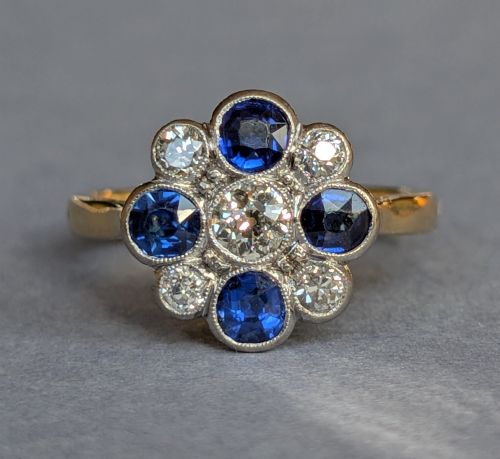
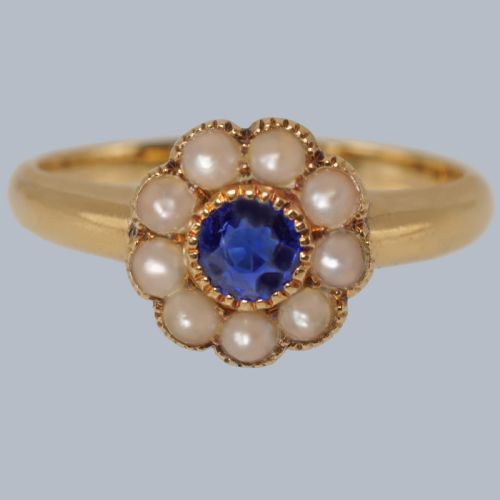


Sapphire Flower Cluster Ring
A sapphire flower cluster ring brings together vibrant central stones and diamond petals, offering a timeless floral form that sits proudly on the hand.
Sapphire Flower Cluster Ring
A sapphire flower cluster ring is an iconic jewellery form designed to mimic the natural geometry of a blossom, placing a central sapphire amidst a border of surrounding stones. The pieces gathered here span from the late nineteenth century through the Edwardian, Art Deco, and mid-century periods, showing how goldsmiths adapted floral motifs across generations.
You are most likely to encounter 18ct gold, white gold, and platinum settings housing blue sapphires alongside sparkling diamonds. Traditional daisy styles utilise a bright central sapphire framed by closely set diamond petals, creating a brilliant contrast that defined both Victorian and Edwardian tastes.
Alternative interpretations incorporate split pearls or opals alongside sapphires within nine-carat or eighteen-carat gold mounts, particularly in pieces from the mid-twentieth century. These variations offer a softer aesthetic while maintaining the distinctive clustered silhouette that characterises the entire group.
Materials and construction methods
Goldsmiths utilised durable metals such as platinum and eighteen-carat white or yellow gold to securely house the intricate arrangements of gemstones. Platinum became especially favoured during the Edwardian era for creating fine, lace-like claw settings that maximised the light entering each diamond and sapphire.
The stones are typically arranged in tight clusters, where prong or bezel settings hold the central sapphire firmly in place while smaller melee diamonds or pearls form the outer petals. This dense configuration requires precise stone-cutting and meticulous metalwork to ensure the flower motif remains balanced and structurally sound.
Several pieces embrace the botanical theme so thoroughly they double as permanent indoor gardens for your hand.
Evaluating craftsmanship and stone selection
The distinction between average and exceptional pieces rests upon the saturation and vibrancy of the central sapphire, alongside the matching quality of the surrounding diamonds. Cornflower blue sapphires with vivid, even coloration elevate a piece significantly compared to darker or uneven stones.
Proportion and symmetry dictate the visual success of the flower cluster, requiring petals of uniform size and spacing that encircle the centre stone harmoniously. The delicacy of the metalwork, particularly in Edwardian platinum-topped mounts, further separates standard production from finer master jeweller output.
The Sapphire Flower Cluster Ring Glossary
- Cluster ring
- A ring featuring a central gemstone surrounded by a group of smaller stones. This arrangement maximises overall visual presence on the finger.
- Daisy ring
- A specific floral cluster design comprising a central coloured stone encircled by white diamond petals. This style gained immense popularity during the Victorian and Edwardian periods.
- Cornflower sapphire
- A term describing sapphires displaying a medium-vivid blue hue reminiscent of the flower. These stones are particularly sought after by collectors.
- Split pearl
- A small, hemispherical pearl halved for use in jewellery settings. Victorians frequently utilised them to create soft, luminous borders around coloured gems.
Sapphire Flower Cluster Ring: Frequently Asked Questions
How do I wear a cluster ring daily?
These rings suit everyday wear provided you consider the hardness of the surrounding materials and mountings. Platinum and eighteen-carat gold offer robust foundations for daily use.
Take care to remove the ring during heavy manual tasks to protect the delicate claw settings holding the sapphire and diamond petals.
What distinguishes Edwardian clusters?
Edwardian examples often feature platinum-topped yellow gold combined with intricate openwork metal. The sapphire and diamond arrangements emphasise lightness and grace.
This era favoured airy, lace-like structures that allowed maximum light to pass through the cluster.
How are mid-century rings different?
Mid-century pieces from the nineteen-fifties and sixties tend to utilise heavier gold settings and bolder geometric profiles. White gold became widely popular for modern engagement rings.
These later designs often feature larger carat weights and more streamlined floral silhouettes.
Can I resize a vintage cluster ring?
Most gold and platinum cluster rings can be resized by a skilled jeweller without compromising the setting. The shank thickness dictates the ease of adjustment.
Consult a specialist who can protect the surrounding stones from heat during the alteration process.