

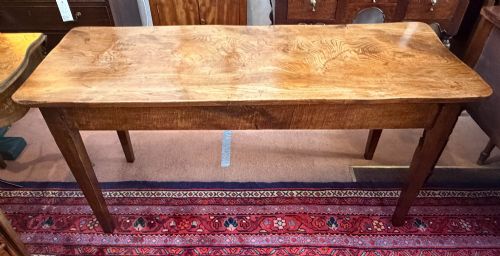


Rustic Farm House Table
A rustic farm house table brings years of kitchen meals and gatherings into your dining room with honest timber and solid utility.
Rustic Farm House Table
A rustic farm house table serves as the hearty centre of a home, built for daily dining and kitchen work rather than formal display. When you search for a rustic farm house table, you encounter substantial dining tables, kitchen tables, and trestle tables shaped by decades of practical use.
The pieces on this page stem predominantly from the 18th century and 19th century, alongside earlier 17th century examples and Victorian pieces. You will find regional variations including French provincial, Scandinavian country, and English country house designs.
Most examples rely on generous plank tops supported by sturdy legs or trestle bases, designed to accommodate families and guests with ease. The forms range from simple pine kitchen tables to grander oak and elm refectory dining tables.
Materials and construction methods
Joinery on these tables relies on traditional methods designed for strength, utilising sturdy timber frames and pegged joints that hold firm under heavy daily loads. Cabinet makers selected domestic hardwoods and softwoods suited to local availability.
Pine and oak form the backbone of these tables, frequently paired with elm, cherrywood, ash, or birch depending on regional workshops. Planks are joined to create expansive tabletops, sometimes enhanced by breadboard ends or extension leaves for versatility.
Rustic Farm House Table Retail Price Guide 2026
Typical asking prices for rustic farm house table among the pieces listed under this phrase on Sellingantiques today, from the lower quarter to the upper quarter. They describe what is for sale here now, not the wider market.
Several tables retain the faint flour dust and ink stains of past generations who used them for bread-making and household accounts.
Judging quality in country tables
Quality rests upon the integrity of the timber selection and the honesty of the construction, where well-seasoned woods maintain their structure across centuries. Tables built from dense oak or mature pine show superior durability compared to lighter utility pieces.
The balance between top planks and underframe proportion dictates the visual harmony of a piece. Finer examples display thoughtful edge moulding and secure joinery that keeps the top flat despite generations of atmospheric changes.
The Rustic Farm House Table Glossary
- Refectory table
- A long, narrow dining table traditionally used in communal dining halls and adopted for domestic country kitchens. These tables feature strong stretcher rails connecting the legs for added stability.
- Trestle table
- A table comprising two or more supports connected by a horizontal beam that holds up a broad plank top. This design allows for maximum legroom along the length of the table.
- Plank top
- A tabletop constructed from several wide boards laid side by side. Older tables often utilise thick single-growth boards that display rich grain patterns.
- Breadboard end
- A transverse piece of wood fitted to the ends of a plank top to keep the main boards flat and stable. This technique accommodates the natural expansion and contraction of timber.
- Extension leaf
- A removable or sliding board designed to lengthen the dining surface. These mechanisms allow a table to adapt easily for larger gatherings.
Rustic Farm House Table: Frequently Asked Questions
How do I clean a pine farmhouse table?
Wipe surfaces down using a damp cloth with mild soap, avoiding harsh chemical cleaners that strip historical patination. Dry the timber thoroughly afterwards to protect the grain.
Apply natural beeswax periodically to nourish old pine and maintain a soft sheen without building up heavy artificial layers.
Can I use an antique table daily?
These tables were constructed specifically for heavy daily work in kitchens and dining rooms. Their robust timber frames handle normal family life with ease.
Use heat mats and coasters to protect older wood finishes from moisture rings and sudden thermal shocks during meals.
What is the difference between oak and pine?
Oak offers a dense, heavy hardwood structure with prominent grain patterns that withstands generations of hard use. It generally feels more formal and darkens gracefully with age.
Pine provides a lighter softwood alternative with a casual domestic character, often showing knots and soft dings that record its history.
How do I date an old wooden table?
Examine the underside and joinery for hand-tool marks, pegged joints, and the method used to attach the top to the frame. Machine-sawn boards typically point towards later periods.
Consider the wood species and wear patterns around the seating areas, which accumulate organically over decades of use.