
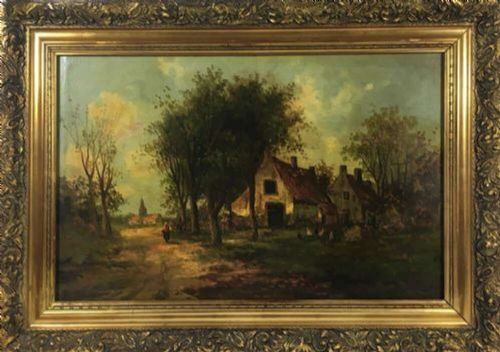


Rustic Country Village Scene
These rustic country village scene works bring rural street life and quiet hamlets into a room with oil and watercolour brushwork.
Rustic Country Village Scene
A rustic country village scene captures rural settlements, local inns, and street life through oil paintings and watercolours. The examples found here span the nineteenth century into the Edwardian era, taking in British and French landscape traditions.
The most common formats on this page are oil on canvas and watercolour on paper, framed in wood and giltwood. Makers range from named academic painters to primitive folk artists working in quiet rural settings.
How They Were Made
These works rely on oil paint applied to canvas or wood panels, alongside watercolours on paper. Gold leaf and giltwood feature in the frames that enclose the paintings.
Techniques range from Barbizon School and impressionist brushwork to primitive folk art methods. Canvases occasionally show historic repairs on the reverse, marking their age.
One canvas holds a quiet secret: a historic repair patch stitched onto the back long ago by an unknown hand.
What Varies in Quality
Quality rests upon the confidence of the brushwork and the clarity of the composition, separating academic hands from simpler folk art. The handling of light across village streets and figures defines the stronger pieces.
Framing also distinguishes the range, with original giltwood frames carrying more character than later replacements. The preservation of the canvas or paper surface dictates the overall visual impact.
David Woodlock·Robert McGregor·Walter Henry Sweet·Henry Charles Bryant·Joseph Thors·William Greaves·John Holland Snr·John Baragwanath King
The Rustic Country Village Scene Glossary
- Barbizon School
- A nineteenth-century French movement focused on direct observation of rural landscapes and village life. Painters in this circle preferred working outdoors to capture atmospheric light.
- Oil on Canvas
- Pigment mixed with drying oil applied to a stretched woven fabric support. This medium allowed artists to build rich textures across the surface.
- Watercolour
- A paint consisting of water-soluble pigments applied to paper. It yields translucent washes well suited to coastal villages and country lanes.
- Giltwood
- Timber coated with a thin layer of gold leaf or gold paint. It provides traditional framing for nineteenth-century fine art.
- Primitive Folk Art
- Painting created outside academic traditions by self-taught makers. These works emphasise direct storytelling over formal perspective.
Rustic Country Village Scene: Frequently Asked Questions
What periods do these village paintings cover?
The works span from around eighteen hundred through the nineteenth century and into the Edwardian period. Many date specifically from the mid nineteenth century to nineteen thirty.
This timeframe includes Victorian academic pieces alongside primitive folk art and impressionist interpretations of rural life.
Are these paintings executed in oil or watercolour?
Both mediums appear across the selection. Oil paintings utilise canvas or wood panels, while watercolours are worked on paper.
Artists chose their medium to suit the subject, whether capturing deep shadows in a village tavern or bright light on a country road.
How should I hang a framed oil painting?
Ensure the wall can bear the weight of the wood and giltwood frame. Use secure fixings suited to the wall construction.
Keep the piece away from direct sunlight and strong heat sources to protect the canvas and paint layers over time.
How can I tell a folk art piece from an academic work?
Academic paintings demonstrate formal training through perspective and light handling, often linked to established schools like the Barbizon movement. Folk art relies on direct, simplified representation.
Primitive works prioritise narrative charm over strict anatomical or architectural accuracy.