
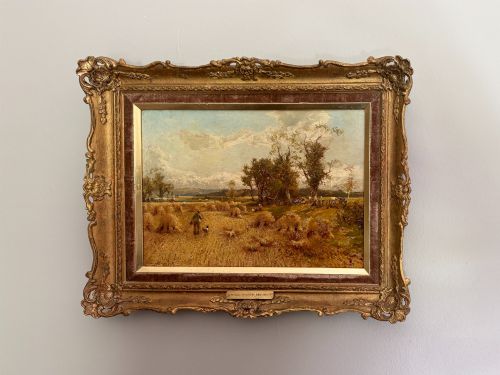


Rural Agricultural Scene Picture
A rural agricultural scene picture captures the working life of the countryside, bringing the traditional charm of the land into your home.
Rural Agricultural Scene Picture
A rural agricultural scene picture depicts the traditional working life of the countryside, focusing on farming, livestock and field labour. You will frequently encounter watercolours and oil paintings dating from the nineteenth and early twentieth centuries. These artworks capture specific moments in agrarian life, such as haymaking, ploughing and farmyard tasks.
The pieces on this page span several decades, moving from Victorian pastoral depictions into early twentieth-century British impressionism and realism. Subjects often include shire horses, farm hands and loaded carts against pastoral backdrops. Each work serves as a historical record of rural communities before mechanisation transformed the landscape.
Factors determining quality
The distinction between standard works and finer examples lies in the artist's ability to render human figures and working animals with anatomical accuracy and natural movement. Superior pieces convey genuine atmosphere and depth, rather than relying on formulaic countryside tropes.
Condition of the medium significantly influences quality, particularly the absence of heavy foxing on paper watercolours or significant craquelure and pigment loss on oil canvases. Original period framing also contributes to the integrity of the piece.
Listings span the nineteenth century through the 1960s, featuring watercolours and oil paintings on canvas and paper.
Henry Bailey·John Atkinson·James William Booth·George Soper·Arthur Charles Dodd·Rowland Henry Hill·Joseph Kirkpatrick·John Percy Cooke·Arthur Claude Strachan·Walter Duncan·George Hamilton Constantine·Fred Lawson
The Rural Agricultural Scene Picture Glossary
- Watercolour
- A painting method in which the paints are made of pigments suspended in a water-based solution. It was widely utilised by British landscape artists for its luminous transparency.
- Oil on canvas
- Pigments bound in a medium of drying oil applied to a stretched cloth surface. This technique allowed artists to build rich layers of colour and texture.
- Pastoral
- An artistic style portraying rural life in a traditionally idealized and peaceful manner. It focuses on shepherds, farm hands and quiet agricultural settings.
- Gilt
- A thin layer of gold leaf applied to wood or other materials. It frequently adorns the frames surrounding nineteenth-century paintings.
Rural Agricultural Scene Picture: Frequently Asked Questions
What subjects appear in these pictures?
These artworks primarily depict traditional farming activities such as harvesting, haymaking, ploughing with shire horses, and farmyard scenes. You will also see depictions of farm hands, livestock, and loaded carts.
The focus rests heavily on the daily labour and seasonal rhythms of rural communities before modern mechanisation took over the countryside.
How should I hang watercolour paintings?
Watercolours are sensitive to strong sunlight and can fade significantly if placed in direct beams for long periods. You should position them away from bright windows and damp walls to preserve the paper and pigments.
Keeping them behind protective glass in their original frames helps shield the delicate washes from environmental moisture and airborne dust.
How do I identify the period of a painting?
You can often determine the era by examining the clothing of the figures, the framing style, and the painting technique itself. Nineteenth-century works tend towards detailed realism, while those from the early twentieth century show looser impressionistic influences.
Signatures, dates inscribed by the artist, and the backing materials of the frame provide further clues to the exact decade of creation.
What is rural genre painting?
Rural genre painting refers to works that portray aspects of everyday life among country people and agricultural workers. Rather than focusing solely on landscape, these pieces tell a story about human labour and community.
They offer a window into social history, capturing the tools, attire, and environments of past generations.