


Rural Agricultural Oil Canvas
Rural agricultural oil canvas works capture the grit of working farms, offering timeless views of shire horses, heavy plough teams and harvest fields.
Rural Agricultural Oil Canvas
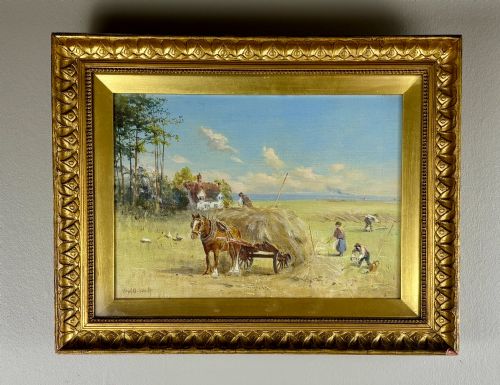
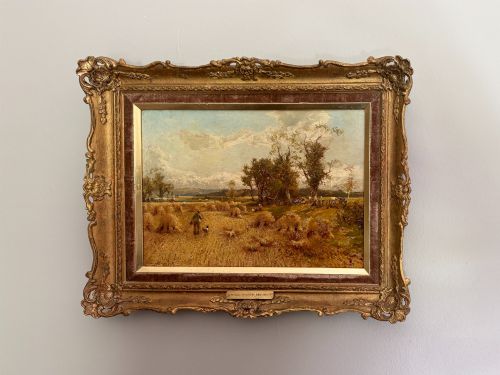
Rural agricultural oil canvas works record the labour of the countryside, focusing on horses, harvest scenes and farmyard life. Collectors seek these pieces for their documentation of traditional rural routines, particularly working heavy horses and seasonal haymaking.
The selection ranges from Victorian realist depictions to mid-century naive school interpretations. Works span from the nineteenth century through the Edwardian era into the mid-twentieth century.
Framed examples dominate the available selection, often housed in traditional wooden or ebonised surrounds. Buyers frequently encounter representations of shire horses at work, plough teams and wheat harvests.
Materials and construction
Painters applied oil paint directly onto stretched canvas surfaces using traditional bristle brushes. The heavy consistency of oil pigment allowed artists to build textured brushstrokes, particularly visible in depictions of animal coats and churned earth.
Supporting structures rely on wooden stretchers and frames constructed from timber, gesso and gilt. Ebonised wooden frames provide a contrasting dark border that accentuates the lighter tones of the pastoral scenes.
Shire horses feature so often in these fields that visitors might start listening for the steady clop of heavy hooves on damp earth.
Factors determining quality
Anatomical accuracy in the rendering of shire horses and working animals distinguishes superior compositions. Stronger works demonstrate a deep understanding of equine muscle structure and movement during ploughing or hauling.
Atmospheric perspective and the handling of natural light elevate specific pieces above standard depictions. The placement of figures within the landscape creates a balanced composition that anchors the rural narrative.
Raimond Louis Lecourt·James Kyd·Herbert Royle·James William Booth·Arthur Winter Shaw·Arthur Charles Dodd·Vernon Stokes·Joseph Paulman·Frederick William Jackson·John Percy Cooke·W E Millner·Ernest Higgins Rigg·George Cole·Frederick J Haycock·George Wright·B J Burrows
The Rural Agricultural Oil Canvas Glossary
- Canvas
- A heavy woven fabric used as a surface for oil painting. It is stretched tightly across a wooden frame before pigment is applied.
- Gesso
- A plaster-like mixture applied to wooden frames as a base for paint or gilding. It provides a smooth surface for decorative mouldings.
- Genre painting
- A style depicting scenes from everyday life, including farmworkers and agricultural labour. These works focus on ordinary people engaged in daily tasks.
- Ebonised frame
- Wood treated to imitate the dark, dense appearance of ebony. This dark finish creates a sharp boundary around the painted canvas.
Rural Agricultural Oil Canvas: Frequently Asked Questions
What periods do these paintings cover?
The available works span from the nineteenth century through Victorian and Edwardian periods into the mid-twentieth century. Artists recorded agricultural scenes across these decades using traditional oil techniques.
Most pieces reflect the prevailing realism of their respective eras, documenting rural life before mechanisation altered farming methods.
How should I care for an oil canvas?
Keep the canvas away from direct sunlight and damp environments to protect the paint layer and wooden stretcher. Gentle dusting with a soft, dry brush maintains the surface.
Avoid using liquid cleaners or placing the work near heat sources that might cause the canvas to warp or the oil paint to crack.
What subjects appear most frequently?
Shire horses, plough teams, hay wagons and harvest fields dominate the subjects. Artists frequently portrayed farmworkers tending to livestock and crops.
These pastoral motifs offer a direct record of traditional farming practices and rural communities across Britain and France.
Are original frames included?
Many listings feature period wooden frames, including ebonised timber and gilt surrounds. These housings complement the era in which the canvas was painted.
Review the specific details for each piece to confirm the exact framing material accompanying the artwork.