
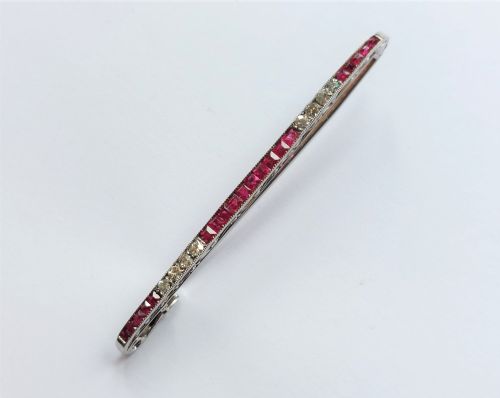

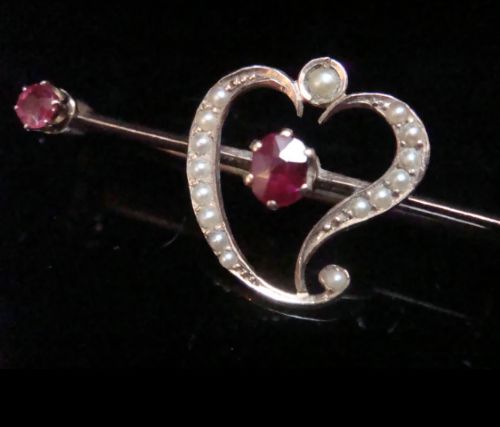


Ruby Bar Brooch
A ruby bar brooch brings together deep red stones and linear metalwork, offering a wearable piece of history from the Victorian to the mid-century eras.
Ruby Bar Brooch
A ruby bar brooch spans various historical periods including Victorian, Edwardian, Art Deco, and mid-century fine jewellery. These items typically feature a slender horizontal metal pin set with rubies, often accompanied by diamonds, pearls, or emerald paste. The selection includes geometric Art Deco designs alongside floral and crescent motifs.
Buyers frequently encounter pieces fashioned from nine-carat and eighteen-carat yellow, rose, and white gold, as well as silver and platinum. Forms range from straight linear bars to novelty subjects such as bicycles, insects, cockerels, and monkeys. The stones are integrated into both traditional mountings and intricate openwork settings characteristic of early twentieth-century workshops.
How they were made
Maker's methods relied on precious metals like gold, silver, and platinum to form the structural foundation of each ruby bar brooch. Silver and platinum were frequently utilised in Edwardian and Art Deco pieces to hold diamond and ruby clusters securely.
Goldsmiths combined gemstones such as rubies and diamonds with pearls and enamel work using traditional setting techniques. Stones were hand-set into gold and platinum frames, ranging from nine-carat yellow gold to eighteen-carat white gold.
Menagerie motifs include a tiny gold cockerel, a monkey, an insect, and a bicycle alongside traditional crescent moons.
What varies in quality
Quality differences stem from the selection of materials and the complexity of the design. Pieces featuring platinum settings, larger diamond carat weights, and Burmese rubies sit at the upper end of the scale compared to simpler nine-carat gold examples.
The precision of the metalwork, whether in a geometric Art Deco pattern or a figurative animal subject like an insect or bicycle, dictates the overall standard. Finer execution involves meticulous stone matching and delicate pierced metal construction.
The Ruby Bar Brooch Glossary
- Bar brooch
- A horizontal pin designed to fasten garments, usually featuring a narrow metal shaft decorated with stones or central motifs. This form was especially popular during the Victorian and Edwardian periods.
- Art Deco
- A design style emerging around the nineteen-twenties characterised by geometric symmetry, clean lines, and stylised motifs. Pieces from this era often incorporate platinum and calibrated rubies.
- Old cut
- A diamond cutting style prevalent in antique jewellery featuring a smaller table, higher crown, and open culet. These stones display a softer, chunkier sparkle than modern brilliant cuts.
- Crescent brooch
- A piece of jewellery shaped in the form of a crescent moon, frequently studded with pearls, diamonds, or rubies. This motif symbolises renewal and femininity in antique design.
Ruby Bar Brooch: Frequently Asked Questions
How do I wear an antique brooch today?
A ruby bar brooch secures easily to the lapel of a tailored jacket, a heavy winter scarf, or the neckline of a structured dress.
Ensure the safety catch functions properly before fastening it to delicate fabrics to prevent snagging.
How can I tell an Edwardian brooch from an Art Deco one?
Edwardian examples tend to use platinum and silver-topped gold with floral, ribbon, or garland motifs, often incorporating pearls and softer rubies.
Art Deco pieces favour sharp geometric symmetry, straight lines, and precise stone settings typical of the nineteen-twenties.
Were these brooches worn every day in the past?
In the Victorian and Edwardian eras, fastened accessories served both practical and decorative purposes for daytime and evening attire.
Sturdier designs in nine-carat or fifteen-carat gold suited frequent wear, while delicate platinum and silver pieces were reserved for formal occasions.
What is paste in antique jewellery?
Paste refers to heavy, hand-cut glass used in historical pieces to imitate gemstones like rubies and emeralds.
Skilled artisans shaped and foiled these glass stones by hand, making paste items collectible works of decorative art in their own right.