
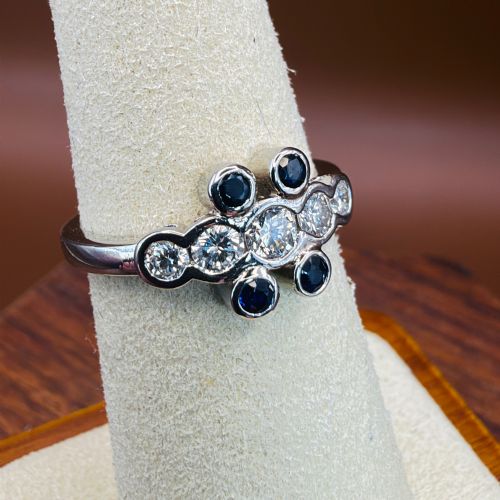
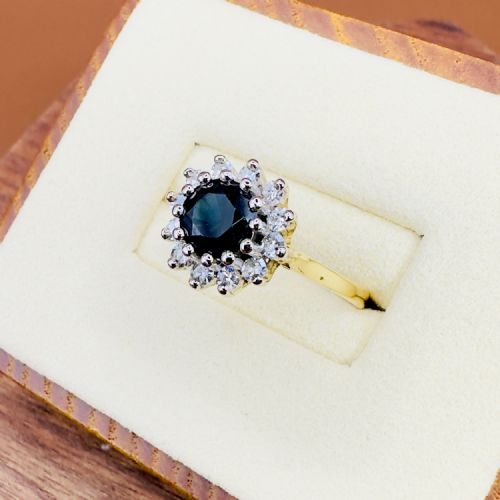
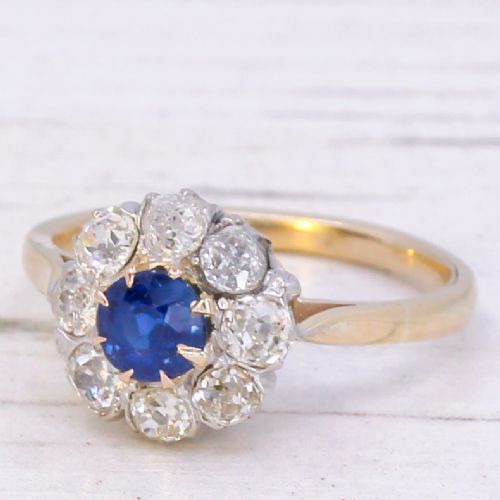


Round Sapphire Cluster Ring
A round sapphire cluster ring is a timeless statement of concentric sparkle, pairing a central blue stone with a bright border of diamonds.
Round Sapphire Cluster Ring
A round sapphire cluster ring centres on a circular blue corundum framed by a sparkling halo of diamonds, creating a floral or target silhouette. This arrangement maximises the visual presence of the stones on the hand, offering a bold yet balanced proportion that has endured across multiple decades.
The pieces on this page span the Edwardian era through the mid-twentieth century, including Art Deco designs and 1950s French creations. Buyers will encounter both delicate daisy motifs from the early twentieth century and more substantial target rings or flower clusters from later decades.
Materials vary across these periods, pairing platinum and white gold with traditional yellow gold settings to complement the deep blue of the central sapphire. Dress rings in this category often utilise heavier carat weights and distinct geometric outlines, reflecting the shifting aesthetic preferences of their respective eras.
Materials and Construction
The mounting of these clusters relies heavily on platinum and 18ct gold, both yellow and white, chosen for their structural strength in holding multiple claw-set or bezel-set stones securely. Platinum gains favour in the Edwardian and Art Deco pieces for its ability to be drawn into fine, lace-like millgrained wires without sacrificing durability.
Diamonds are traditionally cut in old mine, brilliant, or single facets to catch the light around the central sapphire, which itself ranges from lighter Ceylon origins to darker basaltic stones. Goldsmiths arranged these surrounding stones closely to minimise visible metal, creating the uninterrupted halo effect characteristic of the cluster form.
Early twentieth-century jewellers often topped yellow gold shanks with platinum so white diamonds looked brighter against the metal.
Assessing Quality in Cluster Rings
The distinction between tiers of quality rests on the saturation and uniformity of the central sapphire matched with the brilliance and clarity of the surrounding diamonds. Superior examples demonstrate a vivid, even blue in the corundum that holds its colour under various lighting conditions, paired with stones free from distracting inclusions.
Craftsmanship dictates the longevity and visual harmony of the piece, particularly in the precision of the setting work and the symmetry of the surrounding halo. Better execution shows meticulous claw placement and secure mounting that protects the girdle of each stone while maintaining a light, balanced profile on the finger.
The Round Sapphire Cluster Ring Glossary
- Cluster ring
- A ring featuring a central gemstone surrounded by a border of smaller stones, typically diamonds. This style concentrates visual impact on the finger.
- Target ring
- A specific geometric style of cluster ring featuring concentric circles of contrasting colours or materials, highly popular during the Art Deco period. The concentric bands create a bullseye visual effect.
- Old mine cut
- An antique diamond cut characterised by a cushion shape, high crown, small table, and large culet. This cut was hand-faceted to catch candlelight.
- Daisy ring
- A small cluster ring resembling a floral bloom, usually featuring round white diamonds set around a central coloured stone. Edwardian examples often utilise yellow gold and platinum combinations.
- Basaltic sapphire
- A sapphire originating from alkali basaltic terrains, often displaying a deep, intense blue with high iron content. These stones provide a robust, saturated focal point for vintage mountings.
Round Sapphire Cluster Ring: Frequently Asked Questions
How do I wear a cluster ring daily?
Wear your cluster ring with care during rigorous manual tasks to protect the smaller claw settings around the halo.
Pair it alongside plain bands rather than another diamond ring to prevent rubbing against the outer stones.
What periods do these rings represent?
These rings represent the Edwardian era, the Art Deco period, and mid-century designs up through the 1960s.
Each period brings distinct metal choices and geometric arrangements to the classic circular halo format.
How do I clean a sapphire ring?
Clean your sapphire ring using warm water, mild washing-up liquid, and a very soft brush to remove oils from beneath the stones.
Avoid harsh chemical dips that might damage older gold or platinum settings and antique metal alloys.
How can I tell an Edwardian ring apart from a 1950s ring?
Edwardian rings frequently utilise platinum-topped yellow gold with delicate milgraining and lace-like floral motifs.
Fifties rings often present heavier white gold or platinum mountings with bolder, more stylised target or flower cluster silhouettes.