

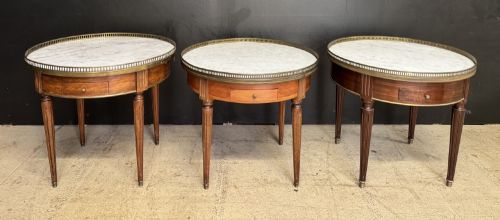
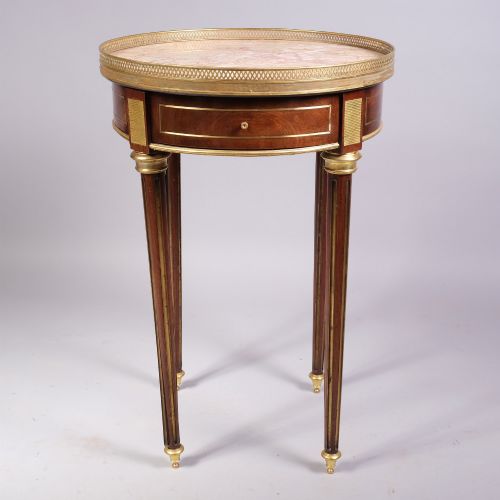
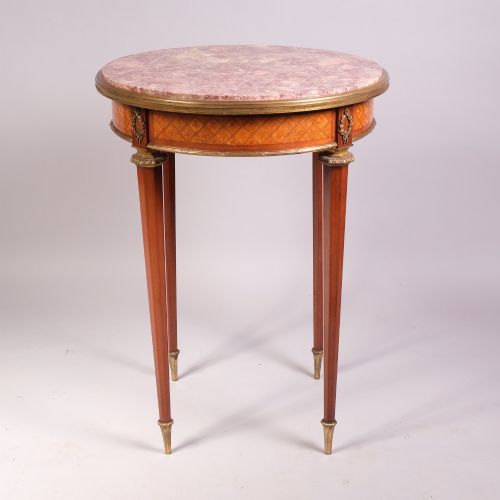
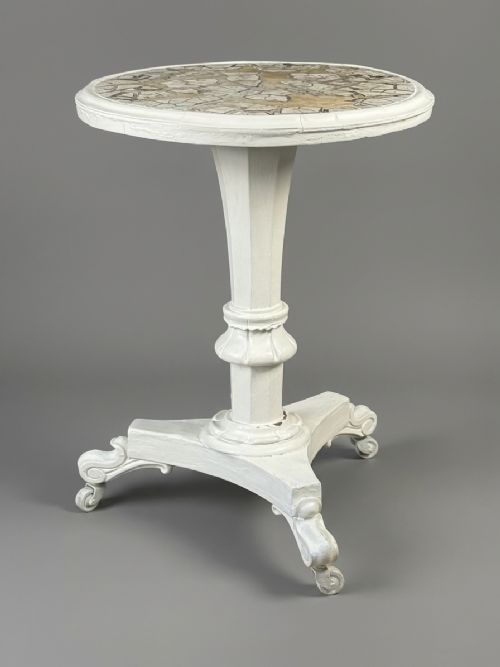


Round French Lamp Table
A round french lamp table brings continental polish to a room, offering a compact surface raised on slender supports.
Round French Lamp Table
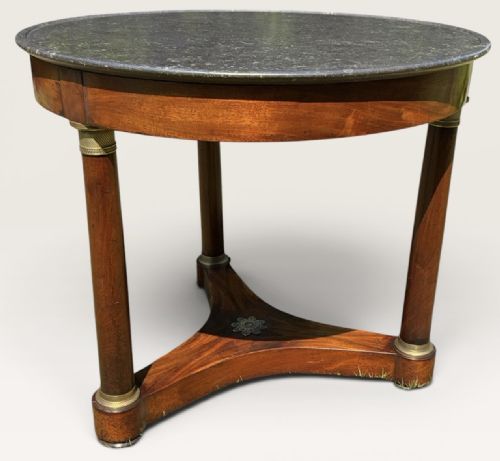
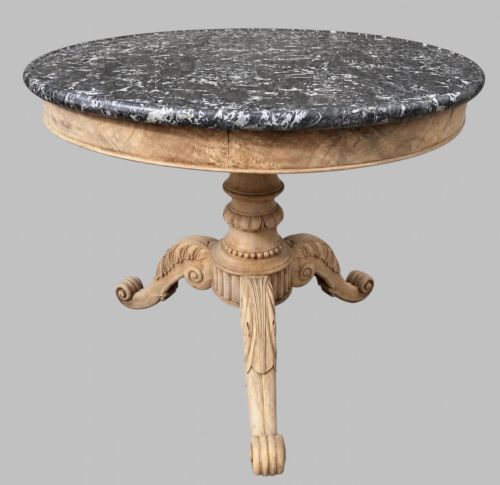
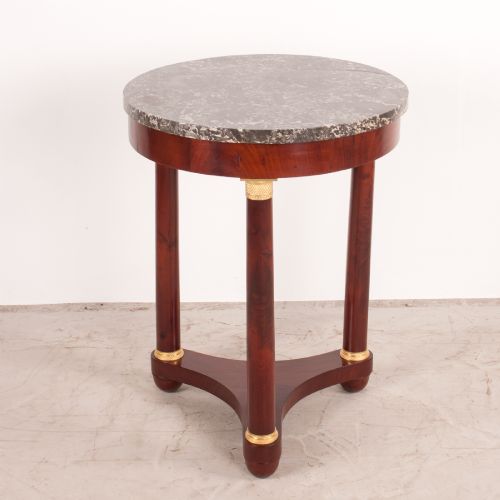
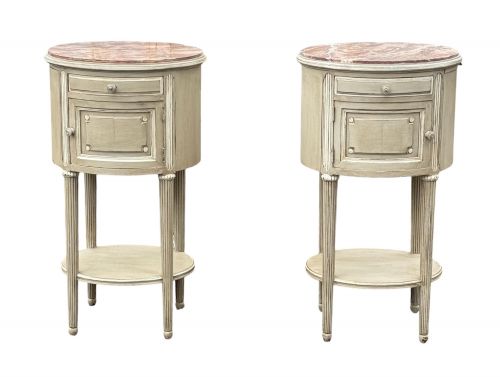
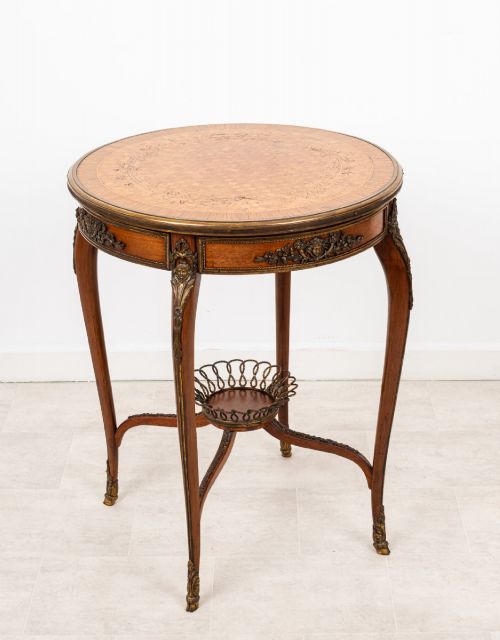
A round french lamp table is a small circular piece designed for occasional use, frequently taking the form of a freestanding guéridon or a bouillotte table with a raised gallery rim. These items function as bedside stands, side tables, or central display surfaces in a room.
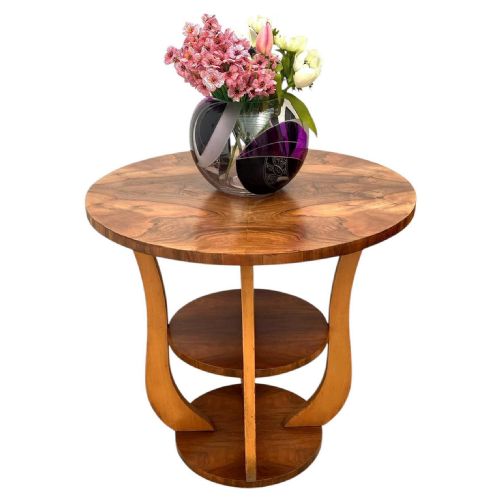
The varieties seen on this page span the nineteenth century and the early twentieth century, drawing on French Empire, Louis XVI, and Art Deco design vocabularies. Mahogany, walnut, and kingwood predominate, often paired with inset marble tops or brass mounts.
Makers and workshops of the periods produced these circular tables as adaptable furnishings, resulting in pieces that range from restrained mahogany models to highly decorative giltwood and ormolu-adorned examples.
How they were made
Cabinetmakers constructed the carcases using timbers such as mahogany, walnut, kingwood, and burr elm, sometimes applying painted finishes or giltwood embellishments. Tops frequently incorporate white marble or specimen stone, supported by brass galleries or ormolu mounts.
Support structures rely on turned central pedestals, slender columns, or four curved legs, occasionally joined by lower tiers or canework undershelves. Joinery techniques reflect the period of manufacture, from nineteenth-century Empire framing to Art Deco tiered construction.
Round French Lamp Table Retail Price Guide 2026
Typical asking prices for round french lamp table among the pieces listed under this phrase on Sellingantiques today, from the lower quarter to the upper quarter. They describe what is for sale here now, not the wider market.
Several nineteenth-century tables come equipped with hidden candle slides, reminding us of evenings spent playing cards by flickering light.
What varies in quality
The distinction between standard production and finer work lies in the selection of timber veneers and the crispness of bronze or brass mounts. Finer examples display carefully matched burr walnut or kingwood grains alongside finely chased ormolu details rather than plain cast replacements.
The integrity of the marble top and the weight of the supporting column dictate the physical stability of the piece. Tables with solid marble inserts and heavy bronze ornaments maintain a balanced stance, whereas lighter occasional pieces rely on precision joinery at the leg joints.
The Round French Lamp Table Glossary
- Guéridon
- A small French round table, typically supported by a single central pillar or slender legs. This form originated in the seventeenth century and remained popular through the nineteenth and twentieth centuries.
- Bouillotte table
- A small French neoclassical occasional table featuring a raised brass gallery rim designed to stop items from sliding off. They frequently incorporate marble tops and small pull-out candle slides.
- Ormolu
- Gilt bronze ornamentation applied to furniture mounts and decorative details. The technique involves treating metal with a mercury and gold amalgam to achieve a rich golden finish.
- Kingwood
- A dense, richly figured Brazilian timber utilised for decorative veneers in fine cabinetmaking. It displays dark violet-brown contrasting stripes that suit polished circular table tops.
- Specimen stone
- Inset pieces of various polished marbles or mineral fragments arranged within a tabletop surface. This decorative technique appears on select nineteenth-century occasional tables.
Round French Lamp Table: Frequently Asked Questions
What is a bouillotte table?
A bouillotte table is a specific type of round French table distinguished by a raised brass gallery edge around the top. They were traditionally used for card games.
Most examples feature inset marble tops and small candle slides pull out from beneath the rim. Their compact proportions make them suitable as bedside or lamp tables today.
Where should I place a guéridon?
A guéridon works effectively beside an armchair, in the corner of a reception room, or as a central lamp stand. Their circular footprint allows them to fit into tight spaces.
Because many examples feature marble tops, they resist moisture well when holding drinks or potted plants.
How do I identify a Louis XVI style table?
Louis XVI style tables typically exhibit straight, fluted legs, symmetrical neoclassical geometry, and restrained proportions. Decoration leans towards classical urns, ribbons, and gilt bronze mounts.
These pieces contrast with the more curved, flowing lines of earlier Louis XV furniture.
Are marble tops original to these tables?
Marble tops on nineteenth-century French tables were generally fitted by the original cabinetmaker to provide a durable, cool surface. White or veined marble is standard for bouillotte and Empire guéridon tables.
Inspect the underside of the marble and the seating rebate to confirm it sits correctly within the wooden frame.