


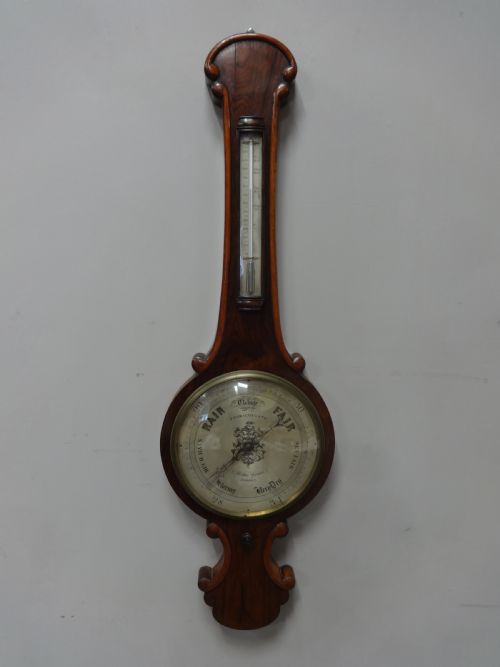


Rosewood Weather Glass
These rosewood weather glass examples combine rich timber cases with mercurial or aneroid movements to gauge atmospheric pressure.
Rosewood Weather Glass
A rosewood weather glass takes several distinct shapes across the nineteenth century, most notably the wheel barometer, the banjo barometer, and the stick barometer. These instruments measure changing atmospheric pressure to predict local meteorological conditions, housed within deeply grained timber cases.
The wheel barometer and banjo barometer forms dominate the available examples, often featuring a circular dial alongside a thermometer. Marine stick barometers and mercury barometers appear with similar frequency, representing the more utilitarian yet beautifully finished instruments of the period.
Makers housed these sensitive mechanisms in decorative rosewood enclosures, frequently embellished with boxwood inlay and mother of pearl. Victorian examples bridge domestic interior decoration with scientific utility, displaying the darker reddish-brown hues characteristic of seasoned rosewood.
Materials and construction methods
Cases utilise solid and veneered rosewood foundations, selected for dense grain patterns and finished with traditional polishing techniques. Artisans integrated boxwood stringing and mother of pearl inlay directly into the timber surfaces to create contrasting geometric or floral motifs.
Internal mechanisms rely upon sealed glass tubes containing mercury or silvered metal scales calibrated for pressure readings. Brass bezels, dials, and Fahrenheit thermometers complement the dark timber housing while protecting the delicate glass instrumentation from accidental damage.
Rosewood Weather Glass Retail Price Guide 2026
Typical asking prices for rosewood weather glass among the pieces listed under this phrase on Sellingantiques today, from the lower quarter to the upper quarter. They describe what is for sale here now, not the wider market.
Listings span the nineteenth century, including Georgian, Regency, and Victorian periods utilising rosewood, brass, glass, and mother of pearl.
Distinguishing quality across examples
Superior execution shows in the precision of the boxwood inlay and the intricate placement of mother of pearl panels across the rosewood case. Finer instruments display crisp engraving on the silvered metal dials and well-balanced proportions throughout the trunk and cistern cover.
The reputation of the maker heavily influences the standing of an individual barometer, alongside the original condition of the mercury or aneroid movement. Cases retaining their uncompromised timber patination and original brass fittings demonstrate higher fidelity to their period of origin.
Ganthony of London·Fagioli of Clerkenwell London·Jenkins Of Old Swindon·Joseph Somalvico & Co
The Rosewood Weather Glass Glossary
- Rosewood
- A dense, heavy timber featuring dark brown and purplish grain patterns, prized for nineteenth-century cabinet work and instrument cases.
- Aneroid barometer
- A barometer that measures pressure changes through the expansion and contraction of a flexible metal box, omitting liquid mercury entirely.
- Mercurial barometer
- An instrument utilising a column of liquid mercury balanced against atmospheric pressure within a sealed glass tube.
- Mother of pearl
- The iridescent inner layer of certain mollusc shells, utilised here for delicate inlay work on barometer cases.
- Wheel barometer
- A barometer design featuring a circular dial where a float and pulley system translates column movement into pointer rotation.
Rosewood Weather Glass: Frequently Asked Questions
What is a rosewood weather glass?
A rosewood weather glass is a nineteenth-century barometer housed in a decorative rosewood case, designed to monitor atmospheric pressure shifts.
These instruments combine scientific utility with fine cabinetmaking, serving both a practical meteorological function and a decorative domestic purpose.
How do I read a mercury barometer?
Mercury barometers display atmospheric pressure through the height of a liquid column against a calibrated silvered metal scale. Higher readings indicate fair weather, while dropping levels suggest approaching rain or storm conditions.
Most traditional instruments include a secondary manual pointer to track changes relative to the current mercurial position.
Where were these barometers made?
Many instruments originate from London workshops and regional makers operating throughout the nineteenth century. Makers signed their brass scales or dials, recording their trade locations directly onto the face of the barometer.
Specialist barometer makers often collaborated with cabinetmakers to produce the intricate rosewood and inlaid cases.
How do I care for a rosewood case?
Rosewood cases require stable indoor humidity away from direct sunlight and heat sources to prevent timber splitting and veneer lifting. Gentle dusting with a dry cloth preserves the polished surface without stripping the historic finish.
Avoid applying modern liquid furniture polishes, which can degrade the aged polish and accumulate around inlay details.