



Rosewood Table Mirror
A rosewood table mirror brings warmth and reflective depth to a room, offering a functional piece of period furniture designed to sit upon a surface.
Rosewood Table Mirror
A rosewood table mirror is a compact dressing or vanity accessory that rests upon a chest, table, or bureau, reflecting the fine grain of tropical timber. These pieces appear alongside related forms such as hand mirrors and dressing tables, though the table mirror itself remains distinct by its stationary tabletop mount.
The pieces on this page span the nineteenth century, taking in Regency, Victorian, and Edwardian periods. Alongside traditional British examples, one encounters items influenced by French design or featuring marquetry and inlay work.
Makers and craftsmen applied this dense, rich timber to smaller accessories just as they did to larger console tables and chiffoniers. Buyers select them for their deep reddish-brown tones and the way the timber patinates over decades of use.
Materials and construction
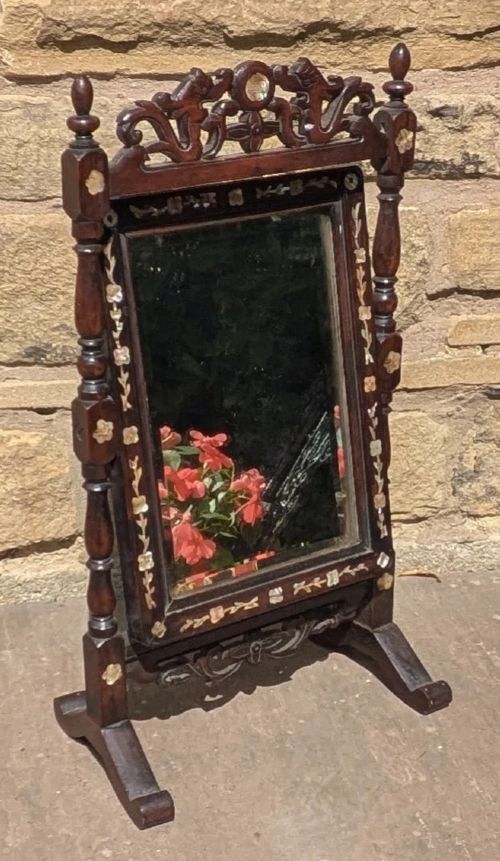
Makers constructed these mirrors using solid rosewood or applied fine veneers over secondary timbers, often accentuating the design with brass fittings or glass plates. The natural density of the wood allowed for clean lines and stable frames that could support pivoting mirror glass.
Surface ornamentation involved subtle techniques such as parcel-gilding, crossbanding, or inlay, reflecting the prevailing styles of the nineteenth century from Regency restraint to Edwardian refinement.
Rosewood Table Mirror Retail Price Guide 2026
Typical asking prices for rosewood table mirror among the pieces listed under this phrase on Sellingantiques today, from the lower quarter to the upper quarter. They describe what is for sale here now, not the wider market.
Mother-of-pearl details catch the candlelight just as they did when Victorian rooms glowed with oil lamps.
Judging quality in rosewood mirrors
Quality rests in the selection of the timber grain and the precision of the joinery around the mirror frame. Superior pieces show thoughtful matching of rosewood veneers and robust pivoting mechanisms that hold the glass steady at any angle.
The clarity and weight of the original mirror glass, together with the crispness of any brass or inlaid details, separate standard items from those of finer workshop origin.
Jas Shoolbred·Donald Ross
The Rosewood Table Mirror Glossary
- Rosewood
- A dense, heavily grained tropical hardwood prized for its deep colour and durability in fine furniture. It takes a high polish and often displays dark streaks.
- Parcel-gilding
- A technique where small portions of an object are partially gilded with gold leaf to highlight carved details or mouldings. This adds subtle contrast against the dark rosewood.
- Crossbanding
- A decorative border veneer laid perpendicular to the grain of the main surface. It creates a neat, framed visual boundary on tabletops and mirror surrounds.
- Veneer
- A thin layer of superior wood applied to a base timber to provide a decorative surface. In nineteenth-century pieces, skilled cabinetmakers cut these veneers to show off symmetrical grain patterns.
Rosewood Table Mirror: Frequently Asked Questions
Where should I place a table mirror?
These mirrors sit comfortably upon a chest of drawers, sideboard, or dressing table in a bedroom or hallway. Their compact footprint allows them to add light and reflection to smaller spaces without requiring floor area.
Ensure the surface is stable and level so the mirror frame remains secure during use. Position the piece to capture natural light from a window for the best reflective effect.
How do I care for rosewood furniture?
Rosewood benefits from occasional treatment with appropriate wax to nourish the timber and maintain its natural lustre. Avoid placing the mirror in direct sunlight or near heat sources to prevent the wood from drying out.
Dust the frame gently with a dry, soft cloth. Keep moisture away from both the timber and the edges of the mirror glass to protect the backing.
Are these mirrors easy to move?
Table mirrors are designed as portable furnishings rather than fixed architectural fixtures. You can easily shift them between rooms depending on where you need a reflective surface or a decorative accent.
When lifting the piece, support both the base and the frame rather than pulling on the pivoting arms. This prevents strain on the original joints and fixings.
How do I identify the period of a mirror?
Period identification relies on observing the timber choice, construction methods, and decorative motifs such as Regency curves or Edwardian simplicity. Cabinetmaking techniques evolved through the nineteenth century, leaving subtle clues in the backboards and fixings.
Comparing the style against dated furniture forms like chiffoniers or writing desks helps confirm the era of manufacture. Look closely at how the glass is secured within the frame.