




Rosewood Slant Desk
These rosewood slant desk examples combine rich timber with practical writing surfaces, offering compact elegance for daily correspondence.
Rosewood Slant Desk
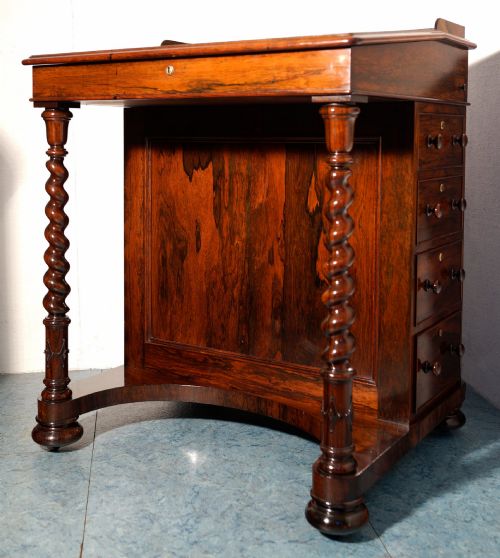
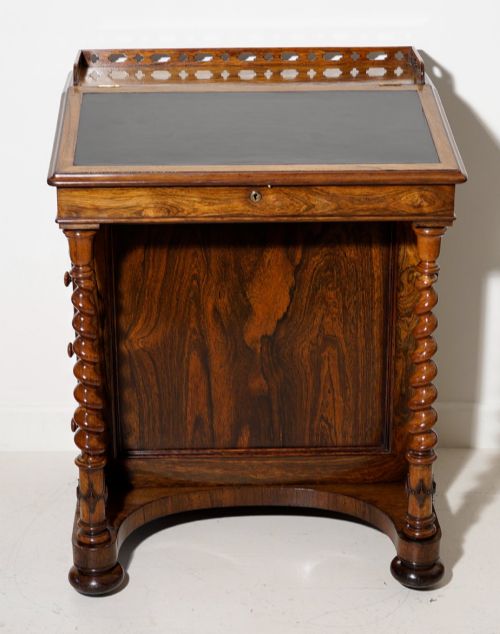
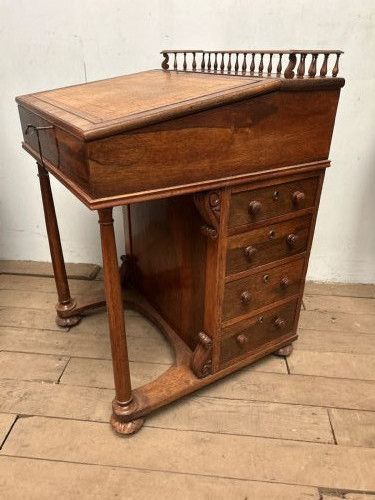
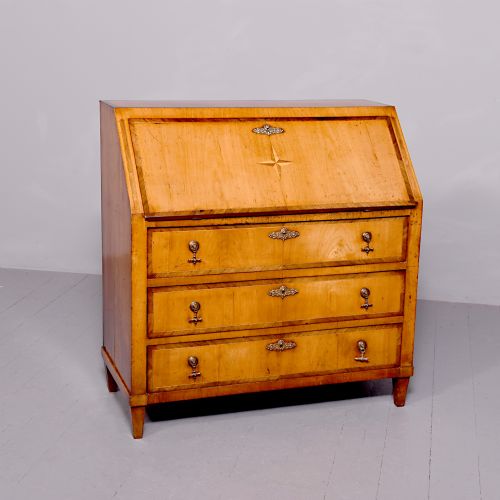
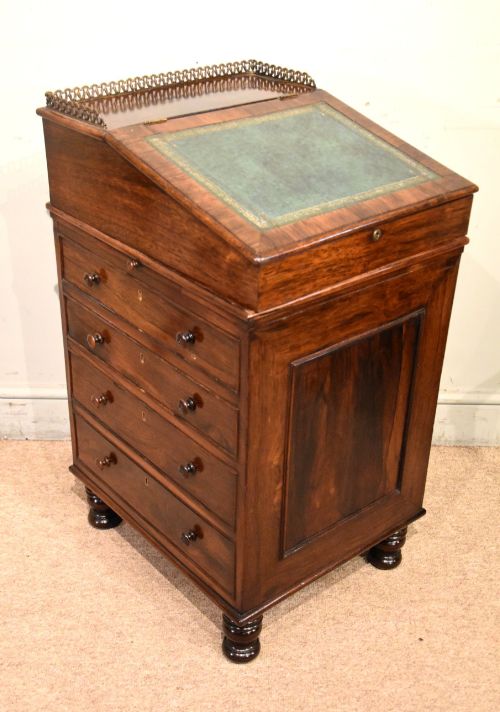
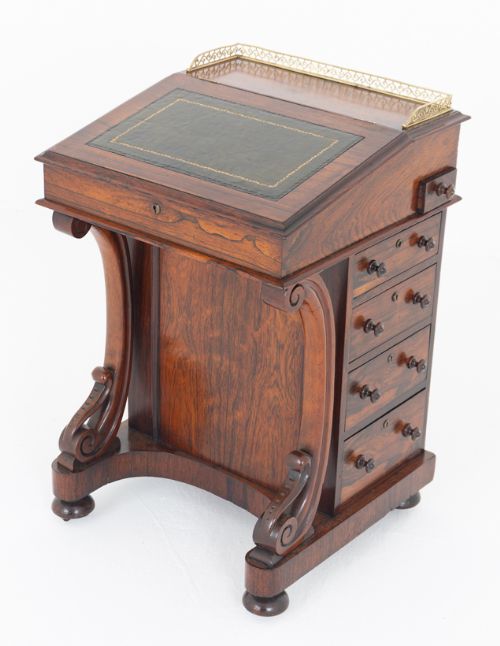
A rosewood slant desk encompasses compact Davenport desks, bureau de dame forms, and occasional writing boxes from the Regency, Victorian, and Edwardian eras. Buyers encounter numerous Davenport desks featuring slope fronts alongside French bureau de dame pieces and inlaid writing furniture.
The material palette spans solid Brazilian rosewood through to veneered surfaces combined with satinwood inlay, walnut, and brass mounts. Pieces originate from English workshops as well as Continental, French, and Portuguese makers working across the nineteenth century.
Materials and construction
Cabinet makers utilised dense rosewood timbers, frequently applying veneers over secondary woods to create richly figured surfaces on writing slopes and drawer fronts. Brass inlay, ormolu mounts, and delicate wood inlays adorn many examples from the Regency and Victorian periods.
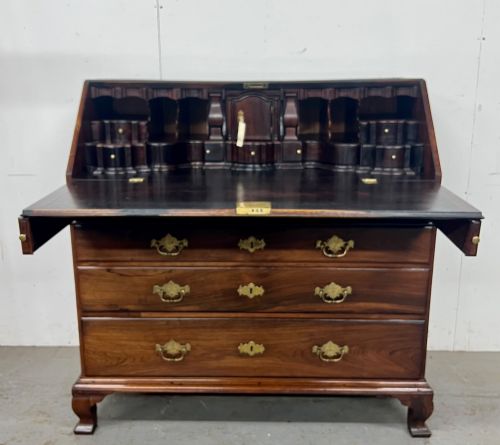
Internal compartments, sliding tops, and writing surfaces integrated leather inserts and glass elements to balance utility with decorative refinement. Structural joinery accommodated small drawers and stationary compartments within compact desk bodies.
Rosewood Slant Desk Retail Price Guide 2026
Typical asking prices for rosewood slant desk among the pieces listed under this phrase on Sellingantiques today, from the lower quarter to the upper quarter. They describe what is for sale here now, not the wider market.
Listings feature 19th-century rosewood slant desks across Regency, Victorian, and Edwardian periods, incorporating brass, leather, and marquetry.
Distinctions in execution
Refinement of the wood grain and precision in the execution of wood inlay or brass stringing set finer examples apart from standard production. The crispness of carved details, quality of internal stationery fittings, and original hardware integrity govern overall standard.
Proportion and stability in smaller forms like the Davenport desk dictate how successfully the piece balances decorative presence with functional writing utility.
Gillows
The Rosewood Slant Desk Glossary
- Davenport desk
- A compact pedestal desk featuring a sloping, hinged writing surface and a set of drawers accessed from the side. This form gained popularity during the Regency and Victorian periods for domestic correspondence.
- Bureau de dame
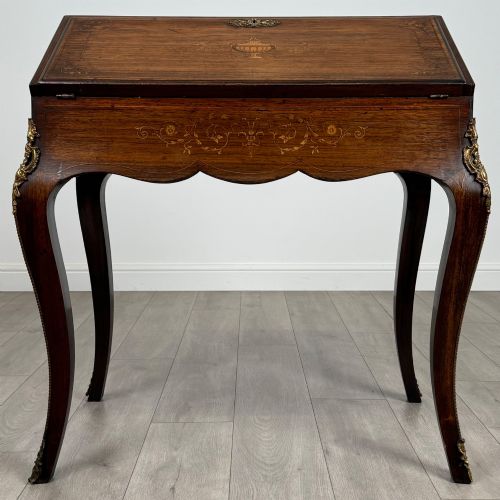
- A small ladies writing desk, often featuring a cylinder or slant front above delicate cabriole or tapered legs. These pieces frequently incorporate extensive marquetry or ormolu mounts.
- Bonheur du jour
- A light, freestanding ladies writing table equipped with a small cabinet or set of pigeonholes on the upper surface. The form emerged in France before spreading to British cabinet makers.
- Ormolu
- Gilded bronze mounts applied to furniture for decorative enrichment, common on French revival pieces. The technique requires meticulous casting and gold amalgamation.
- Marquetry
- The art of applying decorative veneer pieces in geometric or floral patterns to wooden surfaces. Cabinet makers utilised contrasting timbers like satinwood and walnut to achieve varied tones.
Rosewood Slant Desk: Frequently Asked Questions
What is a Davenport desk?
A Davenport desk is a compact writing cabinet with a sloping lid that lifts to reveal storage, sitting atop a pedestal of side drawers.
Cabinet makers designed these pieces during the early nineteenth century to occupy minimal floor space while providing a dedicated writing surface.
How do I date a rosewood desk?
Dating relies on stylistic markers such as Regency proportions, Victorian brass inlay, or Edwardian satinwood details, alongside construction methods.
Examining internal drawer linings and secondary timbers helps establish whether a piece originates from the Regency or later Victorian period.
Where were these desks used?
These pieces served primarily in private drawing rooms, boudoirs, and libraries for personal correspondence and estate management.
Their compact dimensions allowed placement in residential reception rooms where large partner desks proved impractical.
How should I care for rosewood?
Maintenance involves keeping timber away from direct sunlight and maintaining stable indoor humidity to prevent veneer lifting.
Applying occasional appropriate wax polish helps preserve the natural grain and sheen of the polished rosewood surface.