

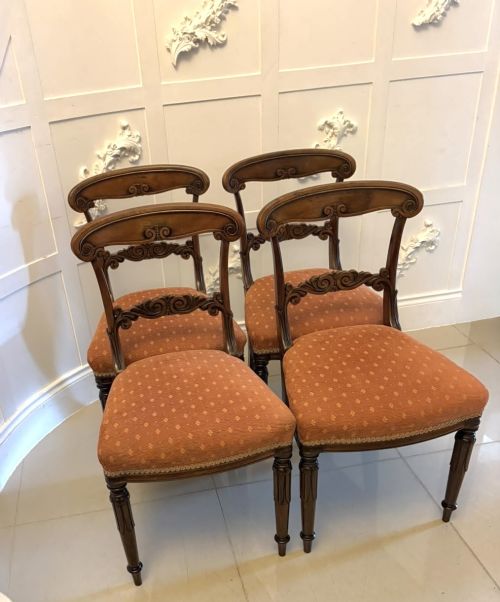


Rosewood Dining Room Chairs
Rosewood dining room chairs bring rich timber grain and classic nineteenth-century proportion to the table.
Rosewood Dining Room Chairs
Rosewood dining room chairs are nineteenth-century seating pieces built primarily during the Regency, William IV, and Victorian periods. These chairs usually appear in matched sets ranging from four to eight pieces, designed to seat diners around a formal mahogany or rosewood table.
The most common examples on this page date from the Victorian era and the Regency period, often featuring carved details or brass inlay. Buyers encounter forms ranging from early nineteenth-century Regency designs to mid-Victorian balloon back shapes.
How They Were Made
Cabinet makers constructed these chairs using dense rosewood timber, selected for its deep colour and pronounced dark grain. Workshops often incorporated carved wooden elements and brass inlay to embellish the frames.
Seats were upholstered over webbing and stuffing using various textiles, including velvet, silk, damask, and needlepoint fabric. Many surviving examples retain or have been restored with traditional textile coverings.
Rosewood Dining Room Chairs Retail Price Guide 2026
Typical asking prices for rosewood dining room chairs among the pieces listed under this phrase on Sellingantiques today, from the lower quarter to the upper quarter. They describe what is for sale here now, not the wider market.
Duck egg blue needlepoint seats bring a sudden pop of colour to dark nineteenth-century rosewood.
What Varies in Quality
Quality in these chairs rests upon the crispness of the timber carving and the retention of matched sets rather than assembled groups. Finer examples display superior timber selection with rich figuring across all frames in the set.
The sophistication of the design dictates the tier of the piece, moving from plain balloon backs to grand Regency models with intricate brass work and carved detailing. Original upholstery materials and untouched timber surfaces elevate the standing of a set.
Gillows
The Rosewood Dining Room Chairs Glossary
- Balloon back
- A chair back shaped like a rounded oval that tapers towards the seat, popular during the Victorian period. This profile offers comfortable lumbar support.
- Brass inlay
- Thin brass strips or motifs set flush into channels carved into the rosewood surface. Regency makers utilised this technique to create geometric patterns.
- Needlepoint fabric
- Hand-stitched canvas work used historically for seat upholstery. These durable textiles often feature floral or geometric patterns in wool.
- Regency
- The British design period spanning the early nineteenth century, characterised by classical restraint and neoclassical motifs. Furniture from this era often shows clean lines and dark timbers.
- William IV
- The architectural and furniture style bridging the Regency and early Victorian eras, lasting through the 1830s. Pieces from this period typically feature heavier scrolling and bold carving.
Rosewood Dining Room Chairs: Frequently Asked Questions
How many chairs come in a set?
Sets typically comprise four, six, or eight matching chairs designed for a dining table. Nineteenth-century dining sets were produced in these configurations to accommodate family gatherings.
Buyers frequently find sets of six on the market, whilst sets of eight appear less commonly. Purchasing a larger matched set ensures uniformity around the dining room.
Are these chairs comfortable for daily use?
Nineteenth-century dining chairs were built with padded seats supported by traditional webbing and stuffing. They offer firm support suited to formal dining rather than lounging.
Living with these pieces involves appreciating their sturdy nineteenth-century construction while maintaining the upholstered seat pads with care. Regular use is well supported by the dense rosewood frames.
How do I identify a Regency chair?
Regency chairs date from the early nineteenth century and often display classical restraint, saber legs, or brass inlay. They predate the heavier proportions of the later Victorian era.
Makers working in the Regency style drew inspiration from classical antiquity, resulting in cleaner lines and refined proportions compared to mid-century examples.