


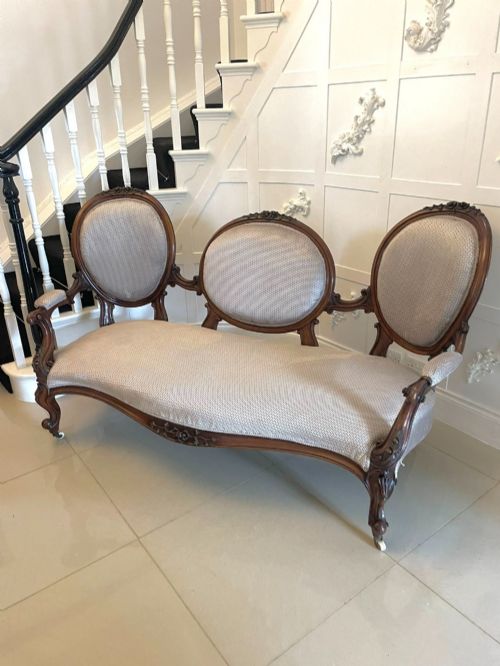


Rococo Walnut Couch
A rococo walnut couch brings curvaceous nineteenth-century and eighteenth-century seating into a room with rich timber frames and plush textile upholstery.
Rococo Walnut Couch
A rococo walnut couch covers a distinct range of upholstered seating including Victorian sofas, settee forms, chaise longues, and bergere three-seater sofas. These pieces draw heavily on Rococo Revival, Louis XV style, Italian rococo, and Queen Anne revival design vocabularies.
The pieces listed on this page span from eighteenth-century French and Italian examples through to Victorian interpretations of the 1850s, 1860s, and later turn-of-the-century variations. Settees and sofas dominate the selection, appearing alongside double-end settees and chaise longues.
Most examples you will encounter combine curvilinear timber frameworks with traditional upholstery, textile coverings, and occasionally cane panels. The aesthetic relies upon sweeping lines, carved details, and warm walnut timbers.
How they were made
Makers shaped solid walnut timbers to form the structural frames, often applying elaborate carved decoration such as cameo backs and scrolling motifs. Some frames show the natural grain of the wood, while others feature gold leaf or bleached finishes.
Upholstery forms an integral part of construction, utilising fabrics, velvet, linen, and antique textiles stretched over internal padding. Caning appears on specific variations like bergere seating, providing a lighter texture alongside the dense walnut structure.
Brass elements and detailed joinery secure the frames and upholstery, grounding the ornate woodwork with sturdy internal assembly. The combination of carved walnut and tactile fabric defines the physical presence of each couch.
Rococo Walnut Couch Retail Price Guide 2026
Typical asking prices for rococo walnut couch among the pieces listed under this phrase on Sellingantiques today, from the lower quarter to the upper quarter. They describe what is for sale here now, not the wider market.
Listings feature walnut frames paired with velvet, linen, cane, and gold leaf across Victorian and eighteenth-century periods.
What varies in quality
The depth and crispness of the carved walnut ornamentation separate standard production from finer examples. Sharp, well-defined floral or scroll carving requires skilled handwork, whereas softer detailing indicates simpler output.
The integration of the upholstery with the wooden frame determines the overall visual cohesion. Original or period-appropriate textiles like velvet, linen, and cane enhance the integrity of the piece more effectively than unsympathetic modern replacements.
Structural harmony in the curved framework, from the sweep of the backrest to the stance of the legs, dictates the success of the design. Proportion and balance remain crucial across both eighteenth-century origins and nineteenth-century revivals.
The Rococo Walnut Couch Glossary
- Rococo Revival
- A nineteenth-century design movement drawing inspiration from the flamboyant curves and asymmetrical ornamentation of the mid-eighteenth-century French Rococo style. It is particularly common in Victorian seating furniture.
- Bergere
- An enclosed upholstered armchair or sofa featuring wooden frames and cane panelling on the sides or back. This form appears in nineteenth-century interpretations on this page.
- Chaise Longue
- An elongated chair or sofa designed for reclining, featuring a backrest and partial armrests. Victorian examples often incorporate carved walnut framing.
- Cameo Back
- A sofa or chair back shaped to resemble a carved cameo, typically oval or cartouche-form with prominent moulded wooden borders. This feature defines several Victorian walnut settees.
- Double End Settee
- A sofa featuring raised, symmetrical scrolls at both ends rather than a conventional head and foot arrangement. It allows for reclining from either direction.
Rococo Walnut Couch: Frequently Asked Questions
What is a rococo walnut couch?
A rococo walnut couch is an upholstered seat featuring curving wooden frames made from walnut, spanning eighteenth-century European pieces and nineteenth-century revival styles. These items include settees, sofas, and chaise longues decorated with carved details.
They serve as decorative and functional seating in reception rooms and parlours, bringing historical character and soft upholstery to an interior space.
Where were these sofas used?
Historically, these settees and sofas were placed in formal drawing rooms, parlours, and salons where entertaining took place. Their decorative carved walnut frames and plush upholstery suited public domestic spaces.
Living with them today involves placing them in sitting rooms or studies where their historic textile coverings and curved timber profiles can be appreciated.
What is the difference between a settee and a chaise longue?
A settee is a wide, upholstered seat designed for multiple people to sit upright together, often featuring a uniform backrest and two armrests. A chaise longue is an elongated single-person seat built for reclining.
Both forms utilise carved walnut frames and fabric upholstery within the rococo style tradition, but serve distinct seating postures.