

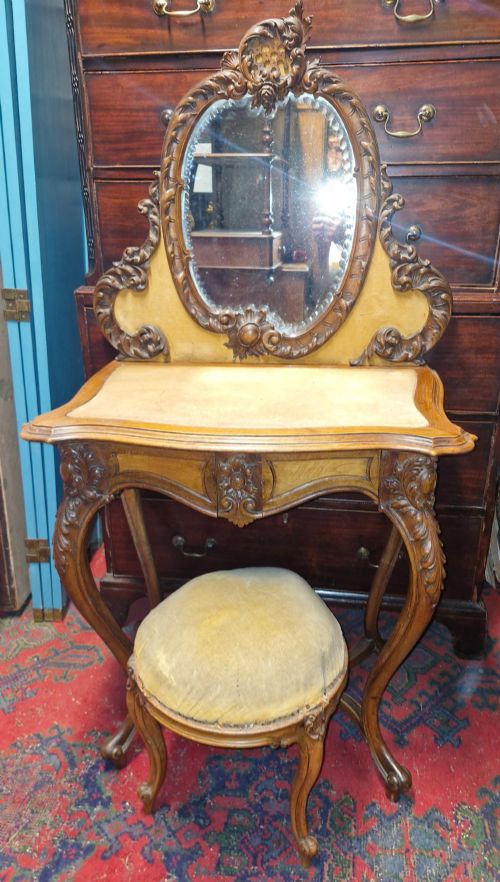


Rococo Revival Oval Mirror
These rococo revival oval mirror examples bring nineteenth-century flourish to a room, offering scrolling frames and classic proportions that collectors prize.
Rococo Revival Oval Mirror
When you search for a rococo revival oval mirror, you encounter ornate nineteenth-century furnishings designed to catch the light and expand a space. The listings and archives show these pieces span the Victorian era, c1870, c1880, and around 1900, capturing a sustained appetite for exuberant curves.
You meet several distinct forms on this page, dominated by wall mirrors alongside dressing table mirrors, swing mirrors, and even integrated mirror backs on credenzas. Frames take an oval shape, whether carved as a Florentine piece or paired with girandole sconces for flickering candlelight.
The majority of pieces embrace the Victorian rococo revival style, though related variants such as Edwardian Chippendale revival rococo appear in the archive. Origin and period dictate much of what arrives on the market, grounding each piece in nineteenth-century workshops.
How they were made
Maker's hands shaped these frames using timber cores of walnut, mahogany, and carved gilt wood, building the signature scrolls and asymmetrical motifs. Gesso and composition layers were applied over the wood base to create deep relief mouldings before final gilding.
Reflective surfaces consist of period mirror glass, often set into oval rabbets behind protective backings. Fabric occasionally accompanies dressing table components, while bronze elements emerge in French variants from around 1900.
Rococo Revival Oval Mirror Retail Price Guide 2026
Typical asking prices for rococo revival oval mirror among the pieces listed under this phrase on Sellingantiques today, from the lower quarter to the upper quarter. They describe what is for sale here now, not the wider market.
The site's records show materials spanning giltwood, walnut, mahogany, and fabric, with dates ranging across the Victorian era into 1900.
What varies in quality
The distinction between ordinary and exceptional frames lies in the depth and sharpness of the hand-carved detail within the giltwood or gesso ornament. Crisp, undercut foliage and scrolls indicate skilled nineteenth-century craftsmanship, whereas softer, shallower moulding suggests composition pressed into simpler forms.
Proportion and the integrity of the original mercury or silvered mirror glass also separate the grades. Pieces retaining their original gilding without heavy over-painting command greater appreciation among collectors.
The Rococo Revival Oval Mirror Glossary
- Giltwood
- Wood that has been coated with gold leaf or a gold-coloured metallic finish. This surface treatment gives nineteenth-century frames their characteristic warm brilliance.
- Gesso
- A plaster-like mixture applied to wooden frame bases to build up sculptural relief details. It provides a smooth ground for subsequent gilding.
- Girandole
- A branched wall mirror featuring candle sconces attached to the frame. The polished glass reflects the candlelight to brighten dark Victorian rooms.
- Florentine
- A regional style of Italian carving known for intricate, pierced ornamentation. These frames often feature rich leaf motifs surrounding the central glass.
- Composition
- A moulded mixture of whiting, resin, and glue pressed into shape. It allowed workshops to produce complex decorative scrolls more rapidly than hand carving.
Rococo Revival Oval Mirror: Frequently Asked Questions
How do I hang a heavy wall mirror safely?
Heavy nineteenth-century wall mirrors require secure fixings anchored directly into structural wall studs or masonry using appropriate brackets.
Wire alone is rarely sufficient for substantial giltwood frames, so professional hanging hardware distributed across two points ensures stability.
What is the difference between gesso and carved wood?
Carved wood involves cutting directly into the timber base to form the decorative relief of the frame. This method shows crisp tool marks and natural grain beneath the surface.
Gesso is a moulded paste applied over a simpler wooden core to create ornate scrolls. It feels smoother to the touch and can show fine craquelure with age.
How should I clean antique mirror glass?
Clean antique mirror glass gently with a soft cloth and a mild, ammonia-free solution applied to the cloth rather than directly to the glass.
Avoid spraying liquids near the edges where the backing may be degraded, as moisture can seep behind the silvering and cause permanent dark spots.
Can I place these mirrors in a bathroom?
High humidity and steam in bathrooms present significant risks to nineteenth-century giltwood, gesso, and original mirror silvering. Moisture causes the gesso to soften and accelerates the deterioration of the glass backing.
Dry living spaces, hallways, and bedrooms remain the best environments for preserving these pieces.