



River Mountain Painting
A river mountain painting captures the dramatic convergence of flowing water and rugged peaks, bringing open air and distant horizons directly to your wall.
River Mountain Painting
When you search for a river mountain painting, you encounter works spanning from the seventeenth century through to the early twentieth century, with a strong representation of nineteenth-century British, Scottish, and Welsh topography. These landscapes frequently depict specific waterways and peaks, such as the Conwy, Snowdonia, and Scottish glens, rendered by both named artists and continental schools.
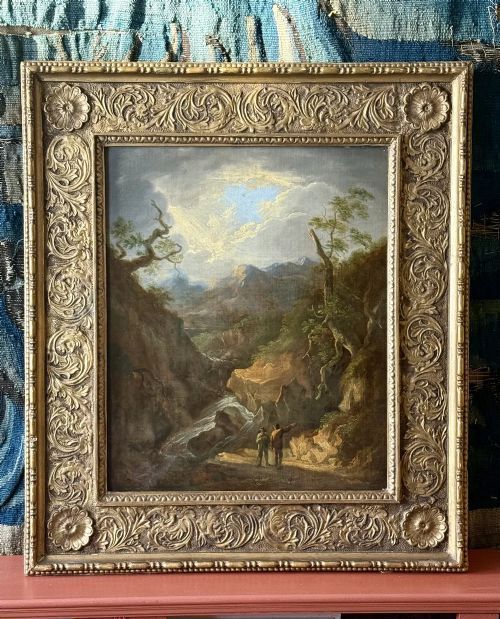
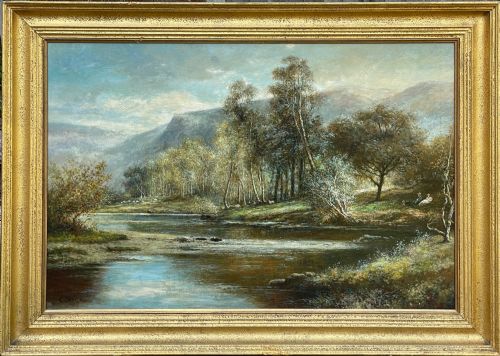
The dominant forms on this page are oil paintings on canvas and watercolours on paper, often housed in their original giltwood and gesso frames. Subjects range from pastoral river banks with figures and cottages to tumultuous waterfalls and steep mountain passes.
Materials and methods
Artists built these scenes using oil paint applied to canvas or watercolour pigments on paper, capturing light and atmosphere through layered brushwork and washes. Many of these works remain mounted in their original wood frames embellished with carved and moulded gilt gesso.
River Mountain Painting Retail Price Guide 2026
Typical asking prices for river mountain painting among the pieces listed under this phrase on Sellingantiques today, from the lower quarter to the upper quarter. They describe what is for sale here now, not the wider market.
Listings feature works executed in oil on canvas alongside watercolours on paper, originating from British, Scottish, Welsh, and continental schools.
Factors of quality
Quality in these landscapes rests upon the assurance of the artist's brush, the compositional balance between the water and the rising terrain, and the preservation of the canvas and pigment. Works bearing clear signatures and documented attributions to established nineteenth-century painters stand apart from unsigned continental or provincial school pieces.
Benjamin Barker of Bath·E Brown·William George Tennick·Thomas Spinks·Sidney Richard Percy·Walter J Watson·George Melvin Rennie·Noel Harry Leaver·William Henry Mander·Cornelius Pearson·A De Breanski·Robert John Hammond·Alfred de Breanski·Samuel Hart Turpin·James Poole·Henry Bright·Clarence Roe
The River Mountain Painting Glossary
- Giltwood
- Wood carved and coated with gold leaf or a gilt finish. This material forms the primary structure of many period picture frames.
- Gesso
- A plaster-like mixture applied to wooden frames before gilding. It provides a smooth surface for intricate mouldings.
- Oil on Canvas
- Pigment mixed with drying oil applied to a stretched cloth support. This medium allowed artists to build rich textures and deep tones.
- Watercolour Painting
- Pigments suspended in a water-soluble base applied to paper. This technique yields translucent washes often used for lighter landscape studies.
River Mountain Painting: Frequently Asked Questions
Are these paintings signed by the artists?
Many works on this page carry signatures or inscriptions from their period, while others remain attributed to regional or continental schools of the nineteenth century.
Documentation varies, with some pieces recording specific locations and dates directly on the canvas or reverse.
What periods do these landscapes represent?
The selection spans several centuries, drawing heavily from Victorian and nineteenth-century output alongside earlier seventeenth-century Dutch examples and early twentieth-century views.
Victorian landscape traditions dominate the selection, capturing British and Welsh topography in oil and watercolour.
Do the paintings come in original frames?
A number of the oil paintings retain their original giltwood and gesso frames, showing period craftsmanship that matches the age of the canvas.
These frames often feature decorative mouldings typical of nineteenth-century framing practices.
Where do these river and mountain scenes depict?
The geographical focus centres on British scenery, particularly Welsh rivers like the Conwy, Scottish glens, and Alpine streams in Switzerland.
Artists frequently recorded recognisable topography, pairing flowing waters with prominent peaks such as Snowdon.