

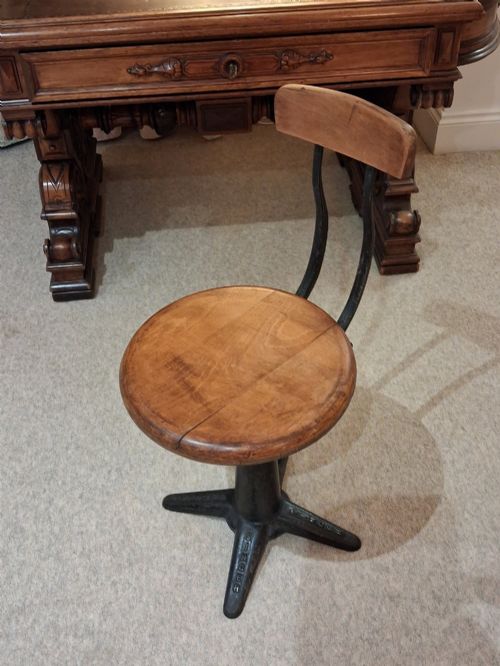


Revolving Wooden Stool
A revolving wooden stool brings functional movement and period character to a room.
Revolving Wooden Stool
When you search for a revolving wooden stool, you are looking at adjustable seating designed for musicians, workers and dressing rooms across the nineteenth and early twentieth centuries. These pieces combine a rotating top with a mechanical screw or pivot mechanism to alter the seat height.
The versions you are most likely to meet on this page span the Regency, Victorian and Edwardian periods, taking forms such as piano stools, music chairs, industrial machinist seats and dressing table stools. They arrive in various woods and heights, reflecting their original domestic or workshop functions.
Makers adapted the basic turning mechanism for specific tasks, producing everything from simple country swivel seats to elaborately carved walnut pedestal piano stools and industrial cast iron hybrids. Each piece shows how utility and mobility guided furniture design long before modern office chairs.
How they were made
Cabinet makers and workshops built these stools using dense hardwoods such as mahogany, walnut and rosewood, often pairing timber tops with iron and cast iron screw mechanisms. Turning lathes shaped the central pedestals and legs, while hand carving created the detailed foliage and grotto motifs found on Victorian examples.
Adjustment relied on threaded wooden spindles or central iron screws that allowed the seat to rise and fall as it turned. Upholstery was added to top surfaces using fabric or leather over stuffing, secured with tacks to cushion the user during long hours at a piano or workbench.
Revolving Wooden Stool Retail Price Guide 2026
Typical asking prices for revolving wooden stool among the pieces listed under this phrase on Sellingantiques today, from the lower quarter to the upper quarter. They describe what is for sale here now, not the wider market.
At least one nineteenth-century machinist clearly wanted a comfortable shift, resulting in a sewing stool that doubles as an adjustable swivel throne.
What varies in quality
The distinction between standard utility seating and exceptional work lies in the execution of the revolving mechanism and the depth of the timber carving. Superior examples feature smooth, stable thread action without excessive play in the screw, alongside finely figured mahogany or walnut.
Design ambition separates basic shop furniture from documented pieces by notable makers like Gillows, where proportions, timber selection and secondary woods meet a higher standard. Secondary elements, such as the crispness of turned legs and the integrity of joined frames, dictate the overall stature of the piece.
Gillows·Singer Sewing Machinist
The Revolving Wooden Stool Glossary
- Revolving
- A seat construction that turns fully on a central vertical axis. This rotation allows the user to change direction without moving the base.
- Rise and fall
- A mechanical action that adjusts the height of the seat. Turning the top raises or lowers the platform via an internal screw thread.
- Piano stool
- A seat designed specifically for keyboard players, often featuring height adjustment to suit different statures. They appear in circular tops and upholstered box forms.
- Grotto style
- A nineteenth-century design aesthetic mimicking natural shell and rock formations. Pieces in this style feature elaborate, rustic carving in hardwood.
- Pedestal base
- A single central support rising from three or four feet rather than four separate legs. This configuration provides stability beneath a swivelling top.
Revolving Wooden Stool: Frequently Asked Questions
What is a revolving wooden stool?
A revolving wooden stool is a movable seat with a top that turns on a central spindle or screw mechanism. These pieces were primarily made for practical tasks requiring height adjustment and rotation.
They appear in domestic and industrial forms from the nineteenth and early twentieth centuries, including piano stools, music chairs and workshop seating.
How do you adjust the height?
Height adjustment is achieved by turning the wooden seat top clockwise or anticlockwise to wind it up or down on a central screw thread. Iron and wooden mechanisms allow the seat to rise and fall.
Some industrial examples use a side lever or locking screw to fix the adjusted height in place.
Where were these stools used?
These stools served musicians at pianos, workers at industrial machines, and individuals at dressing tables. Their movable design suited environments where people needed to shift position or alter their elevation.
Domestic music rooms, parlours and workshops all utilised these versatile seating forms.
How do you date a revolving stool?
Dating relies on timber choices, stylistic details and the type of mechanical hardware used in the construction. Regency pieces often feature rosewood or mahogany with restrained lines, while Victorian examples frequently show heavier walnut carving or industrial cast iron.
Design motifs like grotto revival work or Edwardian simplicity help place pieces within specific decades.