

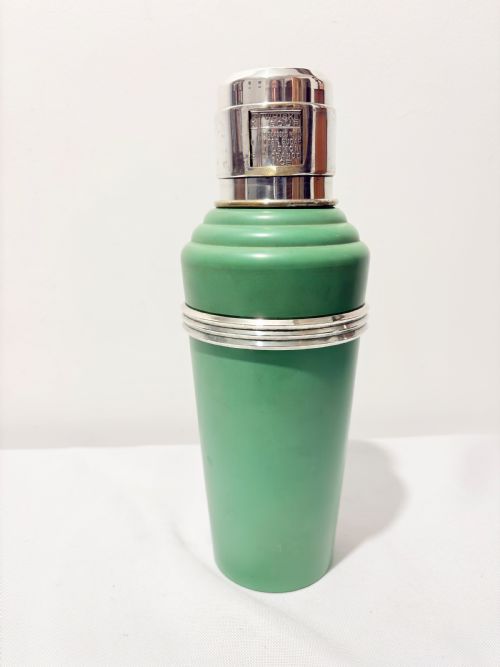


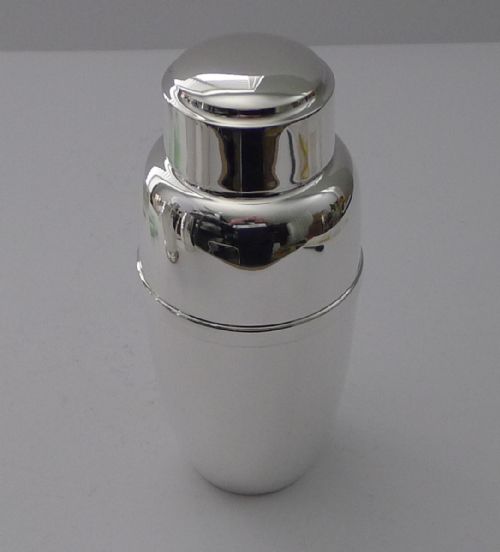


Retro Silver Cocktail Shaker
A retro silver cocktail shaker brings genuine mid-century style to the home bar.
Retro Silver Cocktail Shaker
A retro silver cocktail shaker represents a distinct era of design, spanning the 1920s through to the 1960s with a strong concentration of Art Deco forms. These barware items combine metal body construction with functional elements designed for mixing drinks.
The most common examples encountered here are silver plated vessels originating from English, French, Swiss, and German makers. Many incorporate practical additions such as integral lemon squeezers, glass bodies, or rolling mixer recipes.
Makers utilise styles ranging from strict Art Deco geometric lines to Italian Modernism and Mid-Century Modern aesthetics. Each piece functions as both a historical bar accessory and a display object for modern interiors.
Materials and construction methods
Makers relied heavily on silver plate, electroplated nickel silver, and base metal for the primary body, often pairing metal with glass, cork, and green Bakelite components. Enamel accents appear on specific decorative designs.
Construction techniques involved spinning or shaping metal and fitting specialised lids equipped with cork seals. Integral elements like lemon squeezers were cast and integrated directly into the upper assembly of the shaker.
Some vintage shakers feature a built-in cockerel motif, ready to crow over your evening martini.
Quality factors in vintage barware
Quality rests upon the weight of the metal, the integrity of the silver plating, and the crispness of the Art Deco or modernist detailing. Heavier metal bodies and solid construction separate standard production items from finer workshop pieces.
J. B. Chatterley & Sons·James Dixon & Sons·Asprey & Co·William Suckling·Hukin & Heath·C S Green & Co.·Gaskell & Chambers·Lutz & Weiss
The Retro Silver Cocktail Shaker Glossary
- Silver Plate
- A thin layer of silver bonded to a base metal core. This technique allowed manufacturers to produce lustrous vessels at a fraction of the cost of solid silver.
- Electroplated Nickel Silver
- Commonly abbreviated as EPNS, this material serves as a durable base for silver plating. It provides structural strength to the shaker body.
- Bakelite
- An early form of synthetic plastic utilised for heat-resistant handles and decorative knobs. Its green variant appears frequently on vintage barware.
- Art Deco
- A design style characterised by streamlined geometric shapes, sleek lines, and modern materials. It dominates the aesthetic of 1920s and 1930s cocktail shakers.
Retro Silver Cocktail Shaker: Frequently Asked Questions
How do I clean a silver plated cocktail shaker?
Wash the interior and exterior gently with warm soapy water and a soft cloth to protect the finish. Avoid abrasive scouring pads that can wear through the silver plate over time.
Dry the metal thoroughly immediately after washing to prevent water spots. For tarnish removal, use a specialised silver polish applied lightly by hand.
Are these vintage cocktail shakers still usable?
Most silver plated and glass shakers remain fully functional for mixing drinks today. Check that the cork seals and lids fit securely before use to prevent leaks.
Take care with older mechanisms like rolling recipes or integral squeezers. Hand washing preserves both the mechanical parts and the exterior plating.
How can I tell an Art Deco shaker apart from later styles?
Art Deco shakers from the 1920s and 1930s typically feature stepped geometric motifs, streamlined vertical lines, and Bakelite or enamel details. They reflect the industrial optimism of the interwar period.
Later pieces from the 1950s and 1960s often adopt cleaner, more minimalist Scandinavian or Italian Modernism lines. Form follows function more strictly in these postwar designs.
What does EPNS mean on a shaker?
EPNS stands for electroplated nickel silver, which serves as the metallic foundation for the silver coating. This mark indicates that a base metal alloy containing nickel was subjected to an electrical current to bond a thin layer of pure silver to its surface.
Manufacturers used this stamp widely across British barware production during the early twentieth century. It guarantees a sturdy metal core beneath the silver exterior.