




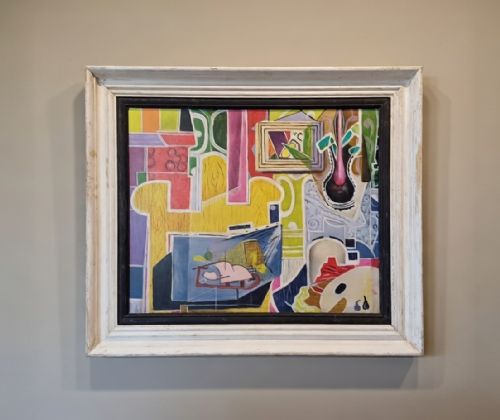
Retro Expressionist Canvas
These retro expressionist canvas works bring bold brushwork and mid-century character to a room, offering striking focal points for a modern interior.
Retro Expressionist Canvas
When you search for retro expressionist canvas, you are looking at mid-century paintings that use bold brushwork and non-naturalistic forms to convey emotion and atmosphere. The selection includes striking portraits, cityscapes, still lifes, and nude studies created during the 1920s, 1950s, and 1960s.
The versions you are most likely to meet on this page are oil paintings on canvas or board, often housed in wood frames. These pieces lean heavily into mid-century modern and expressionist aesthetics, capturing the experimental spirit of their respective decades.
From abstract interior scenes to figurative works by named artists, these canvases reflect the varied visual vocabulary of twentieth-century painting. Each piece brings a distinct sense of movement and texture directly to your walls.
How they were made
These works rely primarily on oil paint applied to canvas, board, or wood panels, allowing for rich colour blending and slow drying times. Artists built up heavy impasto textures in many of the abstract cityscapes and still lifes, giving the surfaces a tangible physical presence.
Support structures typically consist of wooden stretchers and wood frames designed to house the canvas securely. The combination of traditional oil media and robust wooden supports ensures these mid-century pieces retain their structural integrity over decades.
Retro Expressionist Canvas Retail Price Guide 2026
Typical asking prices for retro expressionist canvas among the pieces listed under this phrase on Sellingantiques today, from the lower quarter to the upper quarter. They describe what is for sale here now, not the wider market.
Some mid-century artists included vows of a very personal nature directly into the titles of their nude paintings.
What varies in quality
Quality in these paintings rests on the confidence of the brushwork and the artist's ability to command composition and colour harmony. Stronger works demonstrate a deliberate handling of paint, whether through thick impasto application or expressive figurative lines.
The depth of the artistic vision and the successful integration of frame and canvas distinguish the finest examples from simpler decorative works. Provenance and attribution to listed painters also elevate the standing of a particular piece within the mid-century corpus.
Joseph Biel·Tony Giles·Yetta Kane·William Ernst Burwell
The Retro Expressionist Canvas Glossary
- Impasto
- Paint applied thickly to a canvas, standing out in relief from the surface so that the brush or palette knife marks remain visible. This technique adds literal depth and texture to expressionist cityscapes.
- Oil paint
- A slow-drying paint made by mixing pigments with a drying oil, commonly linseed oil. It allows artists to work wet-in-wet and achieve rich, luminous colour depths.
- Canvas
- A closely woven fabric used as a surface for oil painting, typically stretched tightly over a wooden frame. It provides a flexible yet durable support for mid-century works.
- Mid-Century Modern
- A stylistic movement spanning roughly from the 1930s to the 1960s, characterised by clean lines, functional forms, and a forward-looking approach to abstract and expressionist art.
Retro Expressionist Canvas: Frequently Asked Questions
What is retro expressionist canvas?
It refers to mid-century paintings that combine expressionist brushwork with canvases from periods such as the 1950s and 1960s.
These artworks span abstracts, portraits, and cityscapes, all created using oil paint on canvas or board.
How should I hang these paintings?
These works suit prominent wall spaces where their bold textures and mid-century colour palettes can set the tone for a room.
Ensure they are kept away from direct sunlight and excessive moisture to protect the oil paint and wood frames.
How do I date an oil painting?
Dating relies on stylistic clues, stretcher construction, framing materials, and any artist signatures or dates inscribed on the canvas or board.
Mid-century works often feature specific modernist aesthetics or artist documentation that helps place them in the 1920s, 1950s, or 1960s.
What subjects are common in these works?
Common subjects include abstract cityscapes, still lifes with wine glasses and bottles, self-portraits, and nude studies.
Artists used these familiar genres to experiment with form, colour, and expressive impasto techniques.