





Religious Art Jewellery
Religious art jewellery brings devotional imagery into wearable form, spanning pendants and medals shaped by French makers.
Religious Art Jewellery
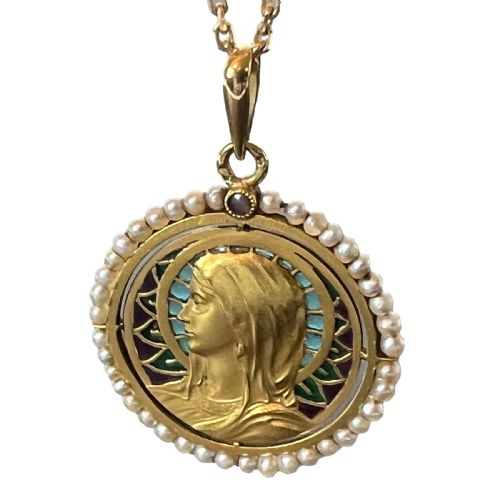
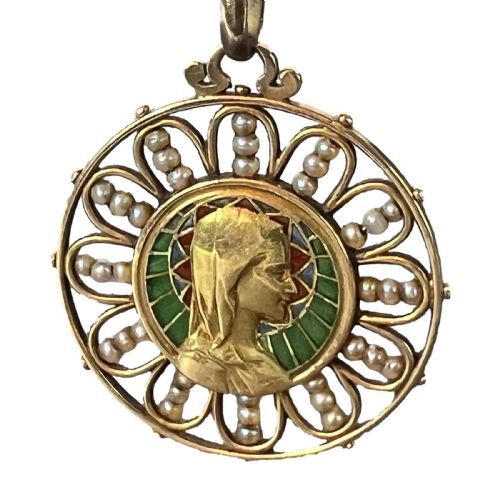
Religious art jewellery comprises pendants, charms, medals, and crosses that depict figures such as the Virgin Mary, Jesus Christ, and angels. The pieces belong to the periods spanning from 1890 through the Edwardian era up to 1950, capturing decades of devotional craft.
French origins dominate the selection, often taking the form of stamped or enamelled medals designed for suspension as pendants or charms. Buyers frequently encounter French pendant medals representing the Madonna and Child alongside standard religious imagery.
Materials and methods
Makers shaped these pieces predominantly from 18ct yellow gold, complemented by occasional silver components, white gold, and rose gold. Enamel work, specifically plique-a-jour, translucent vitreous enamel, and mother-of-pearl accents, brings colour and illumination to the metallic surfaces.
Techniques combine cast or pressed gold with delicate piercing and enamelling, allowing light to pass through the coloured glass sections of plique-a-jour pieces. Pearls and diamonds occasionally accent the gold and enamel frameworks.
Religious Art Jewellery Retail Price Guide 2026
Typical asking prices for religious art jewellery among the pieces listed under this phrase on Sellingantiques today, from the lower quarter to the upper quarter. They describe what is for sale here now, not the wider market.
A deer hunting horn sneaks into the religious art line-up alongside crosses and Virgins.
Quality factors
The sophistication of the enamel work dictates a piece's standing, with complex plique-a-jour designs requiring high technical precision. The clarity and preservation of translucent enamel cells separate standard stamped medals from finer artistic examples.
The reputation of the medallist or workshop influences quality, as signed French works by named designers carry distinct artistic merit. The intricacy of the metal piercing and the inclusion of pearls or diamonds further distinguish the level of execution.
Emile Monier·Paul Brandt·Emile Dropsy·Rasumny·Sellier·Ovide Yencesse·Omar Ramsden & Alwyn Carr·Arnault
The Religious Art Jewellery Glossary
- Plique-a-jour
- An enamelling technique where enamel is applied in cells without a backing, resembling miniature stained glass. This lets light shine directly through the translucent coloured areas.
- Medal
- A flat metal disc stamped or engraved with devotional imagery for personal wear. These items often feature suspension loops to hang from chains or charm bracelets.
- Vitreous enamel
- Glass fused to metal under high heat to create a durable coloured surface. It provides the smooth, glossy panels seen across many devotional pendants.
- Art Nouveau
- A decorative style characterised by flowing, organic lines popular around the turn of the twentieth century. This aesthetic heavily influences the framing of many period medals.
Religious Art Jewellery: Frequently Asked Questions
What periods do these pieces come from?
The pieces span from the late nineteenth century through the Edwardian period and the 1920s up to 1950. French works from the early nineteen hundreds dominate the selection.
Design traits shift across these decades, moving from ornate Art Nouveau motifs into cleaner Art Deco geometric lines.
How were these religious medals worn?
Devotional medals were typically suspended from chains as pendants or attached to charm bracelets. Many examples feature integrated loops specifically designed for hanging.
They served as personal items of faith, often kept close to the wearer's heart.
What materials are commonly used?
Yellow gold in 18ct purity forms the primary base for the majority of these pieces. Silver, white gold, and rose gold also appear alongside enamel and pearls.
Vitreous enamel and plique-a-jour add vibrant colour to the metallic religious scenes.
How do I identify French pieces?
French origin is frequently indicated by the names of notable medallists and artists stamped directly onto the metal. Subjects often feature specific Catholic iconography traditional to French devotion.
The distinct combination of 18K yellow gold and plique-a-jour enamel work frequently points to French manufacture from the early twentieth century.