


Regency Style Bedside Drawers
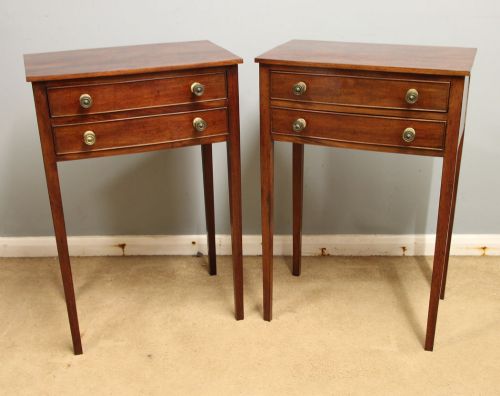
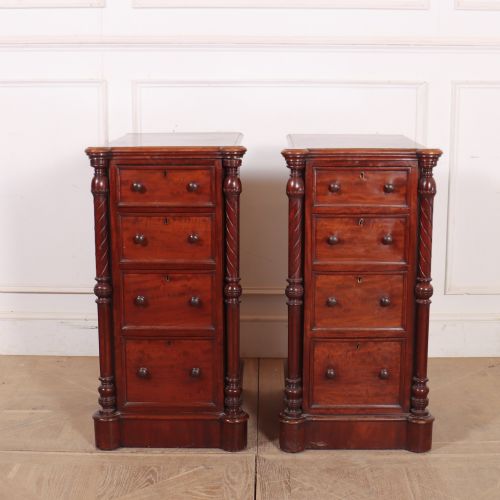
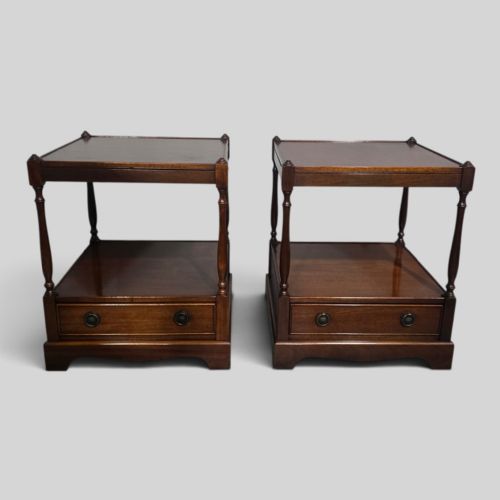
Regency style bedside drawers bring compact elegance to a bedroom, offering small-scale storage crafted in rich mahogany.
Regency Style Bedside Drawers
Regency style bedside drawers encompass compact chests, lamp tables and bedside cabinets designed to sit beside a bed. Most examples found on this page date from the nineteenth and early twentieth centuries, including Edwardian pieces and later revivals.
The selection ranges from neat pairs of mahogany bedside tables to bowfront cabinets and drop-leaf tables. These items provide practical surface space and drawer storage while maintaining classical proportions.
Makers drew on Georgian, William IV and Regency traditions, resulting in varied silhouettes from straightforward side tables to elaborate chests with leather tops and satinwood inlay.
How they were made
Cabinetmakers relied heavily on mahogany as the primary timber, sometimes pairing it with ebonised wood or adding delicate satinwood inlay for contrast. Brass fittings such as handles and castors provide functional metallic detail.
Surfaces occasionally feature inset leather tops, combining writing functionality with traditional woodworking. Construction methods span from nineteenth-century cabinet work to early twentieth-century revival production.
Mahogany is the dominant material across these listings, appearing alongside brass and leather details.
What varies in quality
Quality rests in the crispness of the timber selection and the subtlety of decorative details like satinwood inlay. Finer pieces demonstrate superior cabinet-making precision in the drawer construction and joinery.
The presence of matched pairs elevates an item, as does the integration of quality brass hardware and well-figured mahogany grain. Period authenticity and adherence to classical proportions distinguish the best examples.
The Regency Style Bedside Drawers Glossary
- Bowfront
- A convex, curved front to a chest of drawers or cabinet that softens the rectangular silhouette. This shape became popular during the Regency period.
- Drop-leaf table
- A table with hinged flaps on the sides that can be folded down to save space or raised to increase surface area. These offer adaptable utility in smaller rooms.
- Satinwood inlay
- A decorative technique where lighter contrasting wood is inserted into recesses in the mahogany surface. It creates geometric or floral patterns.
- Ebonised wood
- Timber treated to resemble ebony, providing dark, contrasting details against the warmer tones of mahogany. This finish was favoured for accentuating mouldings and feet.
Regency Style Bedside Drawers: Frequently Asked Questions
What periods do these bedside drawers come from?
The pieces span from the nineteenth century through the Edwardian era up to the 1930s. They include original nineteenth-century items alongside revival pieces made in the early twentieth century.
This mix reflects enduring classical tastes rather than a single production era.
Are pairs common for these tables?
Many of the listings feature matched pairs designed to flank a bed symmetrically. Finding a matching pair from earlier periods adds convenience for bedroom placement.
Single tables also appear for more eclectic interior arrangements.
What materials are typically used?
Mahogany serves as the principal wood across nearly all pieces, complemented by brass handles and occasional leather top inserts. Detail work sometimes incorporates satinwood inlay or ebonised wood.
These materials ensure a traditional dark wood finish.
How do I distinguish between styles?
Styles range from strict Regency and Irish Regency to Georgian, Victorian, and later revivals like Sheraton Revival and William IV. The silhouettes vary from simple side tables to bowfront cabinets.
Examining the proportions and decorative motifs helps identify the specific design influence.