

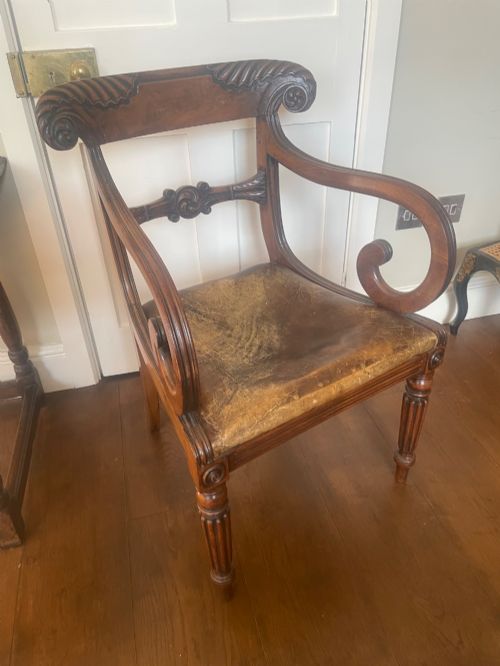
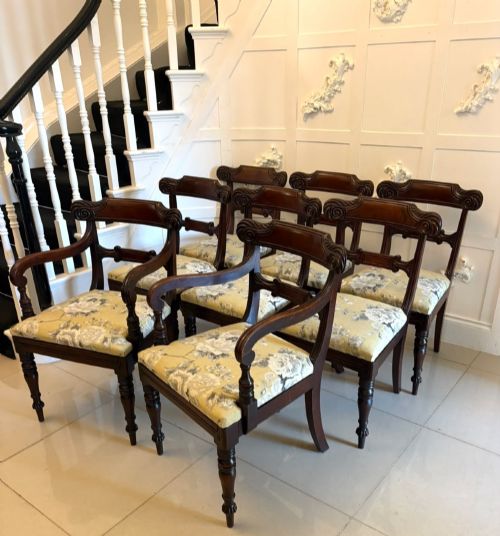
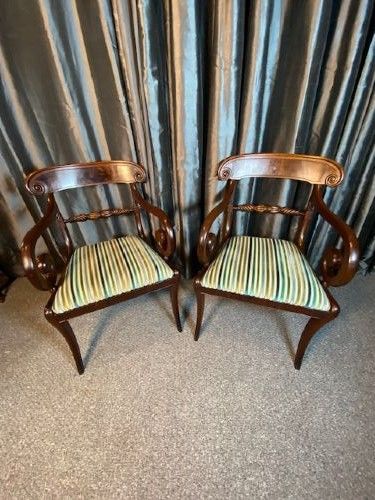
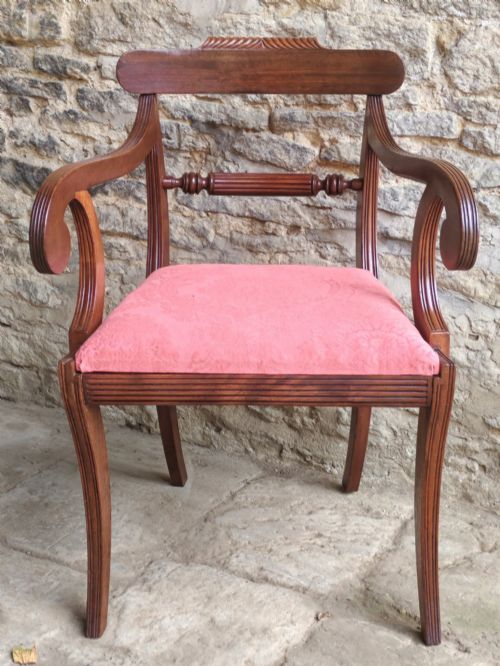

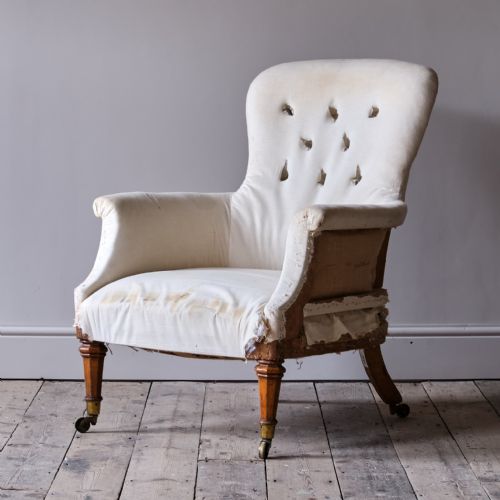
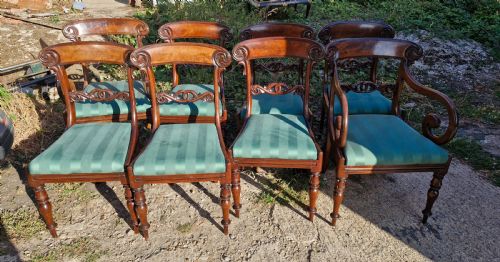
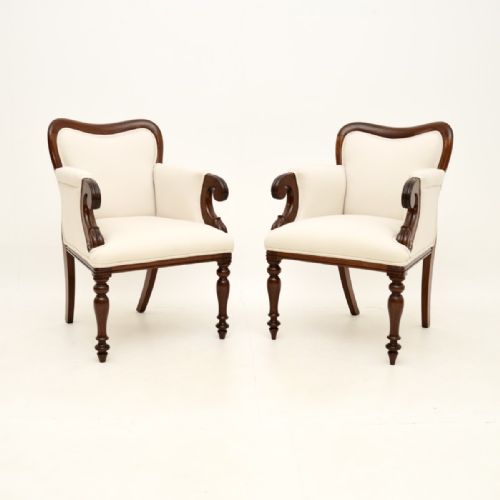
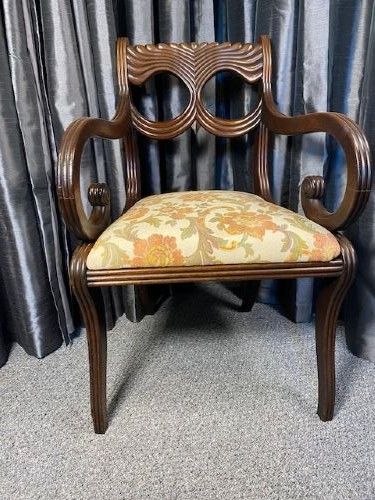
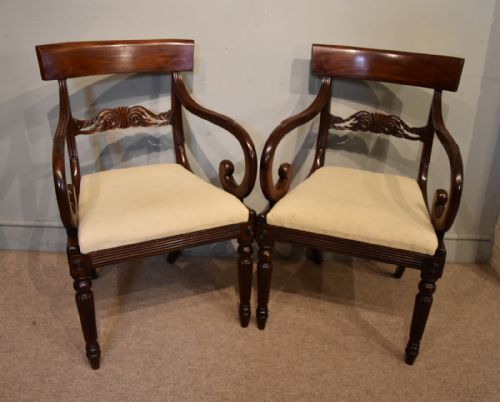


Regency Mahogany Scroll Armchair
A regency mahogany scroll armchair brings architectural line and figured timber to a room, offering robust comfort rooted in early nineteenth-century design.
Regency Mahogany Scroll Armchair
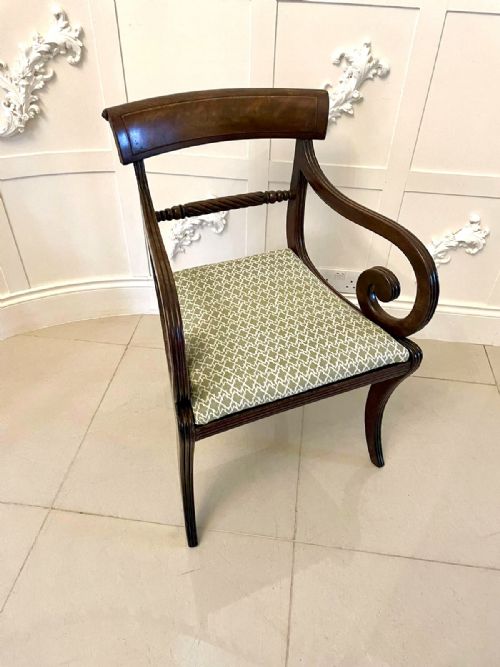
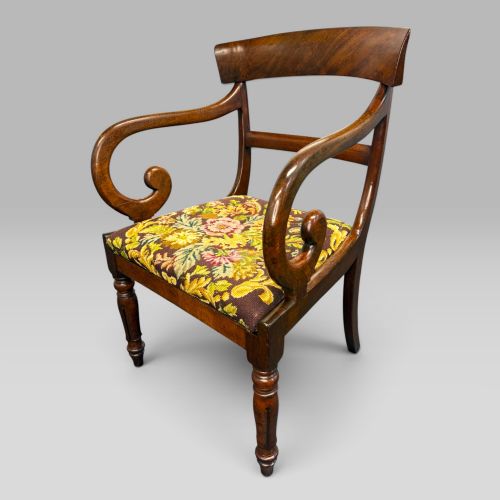
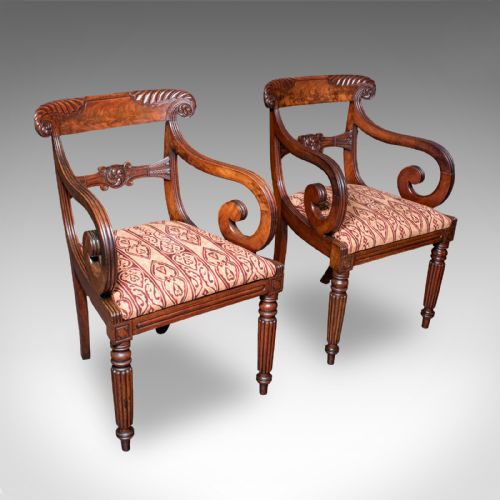
A regency mahogany scroll armchair is a seating form defined by sweeping arm supports and dense tropical timber, emerging from the Regency, Late Georgian, and William IV periods. These pieces serve primarily as library, desk, or carver chairs within a dining or reception setting, often appearing as pairs or within larger sets of chairs.
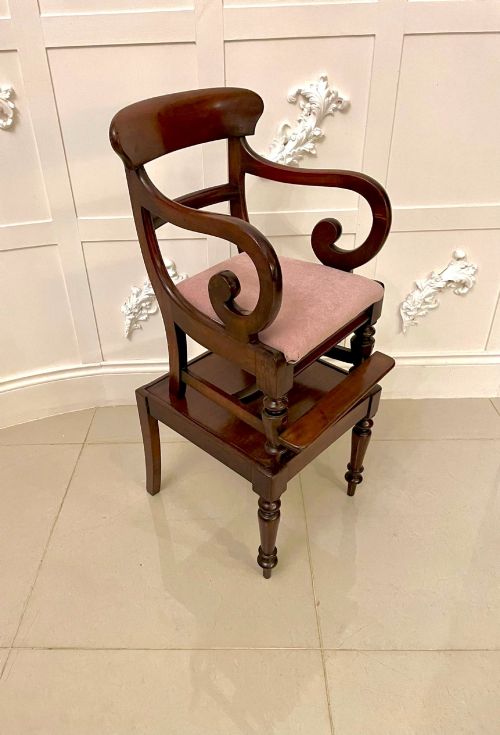
The varieties on this page span standard elbow chairs to specialised forms such as metamorphic library steps, reclining models, and compact children's versions. Buyers will encounter both simple domestic seating and grander library carvers featuring sabre legs or ebonised details.
Origins trace directly to English cabinet makers working through the early nineteenth century, utilising native and imported hardwoods. The silhouettes reflect classical revival influences translated into practical domestic furniture.
Materials and construction methods
Makers built these frames using solid mahogany, prized for its deep grain and structural stability, frequently complemented by brass hardware and turned wooden components. Seats utilised traditional drop-in or upholstered pads finished in fabric, leather, velvet, or needlepoint.
Structural integrity relied on joined framing and carved scrollwork integrated directly into the arm supports or crest rails. Secondary details such as ebonised highlights added visual contrast to the polished timber.
Regency Mahogany Scroll Armchair Retail Price Guide 2026
Typical asking prices for regency mahogany scroll armchair among the pieces listed under this phrase on Sellingantiques today, from the lower quarter to the upper quarter. They describe what is for sale here now, not the wider market.
One remarkably clever maker decided a library chair ought to transform into a set of steps whenever a book sat out of reach.
Assessing quality in early nineteenth-century seating
Quality rests upon the crispness of the timber carving and the architectural proportion of the scroll arms relative to the wider frame. Heavier, larger carvers and specialised forms like sliding library chairs demonstrate higher ambition from the maker.
The choice of figured mahogany and the retention of original brass elements or sophisticated upholstery treatments distinguish standard domestic seating from finer library and desk variants.
James Mein Kelso
The Regency Mahogany Scroll Armchair Glossary
- Carver
- An armchair designed with open elbows, traditionally placed at the head of a dining table or used as a desk seat.
- Bergere
- An enclosed upholstered armchair with wooden framing and a cane or fabric back, prevalent in nineteenth-century interiors.
- Sabre leg
- A sharply curved, outwardly tapering chair leg inspired by classical Greek and Roman klismos furniture.
- Metamorphic
- Convertible furniture designed to transform into an alternative functional object, such as an armchair folding out into library steps.
- Ebonised
- Wood treated with a dark stain or finish to imitate ebony, utilised for contrast on classical revival frames.
Regency Mahogany Scroll Armchair: Frequently Asked Questions
How do I identify a Regency period armchair?
Look for classical proportions, reeded or sabre legs, and characteristic scroll arm terminals executed in solid mahogany. These design cues separate early nineteenth-century pieces from later Victorian reproductions.
Examine the construction underneath for period joinery methods and timber oxidation consistent with the Regency and William IV eras.
Were these chairs used at desks or dining tables?
They served both functions depending on the specific form, with lighter carvers placed around dining tables and sturdier models fitted with casters for library or desk use. Many examples on this page are explicitly designated as desk or library chairs.
Their substantial timber frames provided the durability required for daily work and dining in formal nineteenth-century interiors.
What is the difference between a Regency and a William IV armchair?
Regency chairs generally display lighter, sharper classical lines with elegant scrollwork and sabre legs. William IV examples tend toward heavier, more robust proportions with bolder scroll arms and darker timber surfaces.
Both styles overlap significantly in the early nineteenth century, sharing a reliance on solid mahogany and upholstered seating.
How do I care for nineteenth-century mahogany furniture?
Keep wooden frames away from direct heat sources and strong sunlight to prevent the mahogany from drying out or splitting. Dust regularly with a dry cloth and occasionally feed the timber with appropriate wax polish.
Protect upholstered elements such as leather, velvet, or fabric by avoiding moisture and maintaining stable room humidity.