

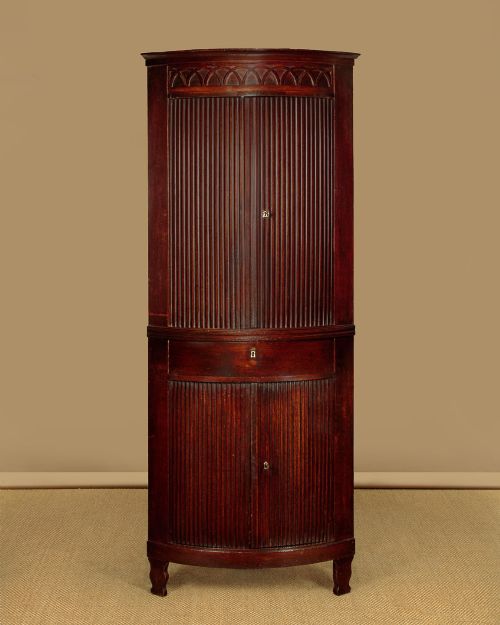
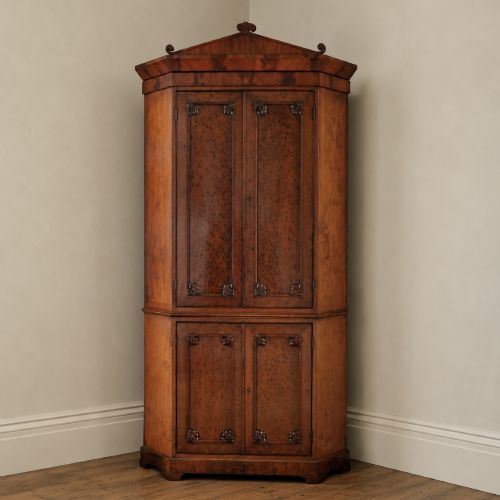
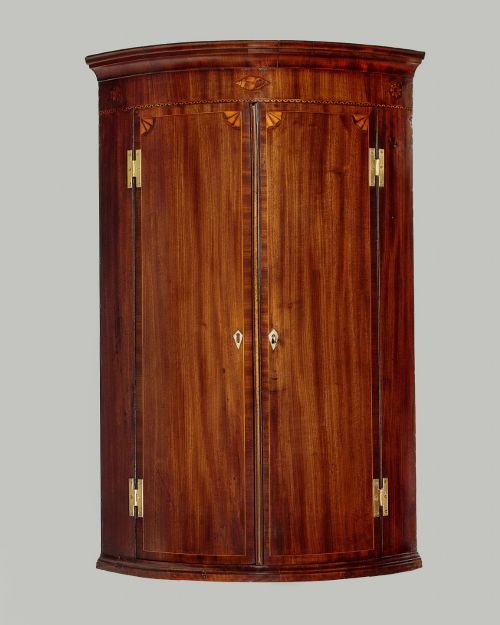


Regency Mahogany Corner Cupboard
A regency mahogany corner cupboard turns wasted angles into stately storage, bringing warmth and clean architectural lines to a room.
Regency Mahogany Corner Cupboard
A regency mahogany corner cupboard is a specialised cabinet designed to fit neatly into the ninety-degree junction of two walls, making clever use of otherwise idle space. The pieces you encounter most often on this page take the form of wall-hanging units or tall floor-standing cupboards, both engineered to display or conceal contents while hugging the room's perimeter.
The evidence spans several eras including the Georgian, Regency, William IV, and Edwardian periods, with the Regency era providing the strongest anchor for the style. You will find variations ranging from small medicine cabinets to double-height and full-height floor-standing cupboards, alongside related forms such as wall cabinets and whatnots.
Makers and cabinetmakers of these periods utilised native and exotic woods to construct forms that could be hung at eye level or stood firmly on the floor. Whether you select a bow-fronted hanging cabinet or a substantial country house cupboard, each version shares the fundamental purpose of organising a corner with elegance.
How They Were Made
The primary material underpinning these pieces is mahogany, frequently enriched by flame mahogany, plum pudding mahogany, and satinwood inlay to create striking grain patterns and contrasting borders. Cabinetmakers selected these dense hardwoods for their stability and rich colour, which deepened with age and polishing.
Construction techniques relied on sturdy joinery to support heavy timber doors, often fitted with glass panes divided by delicate astragal bars. Brass hardware, bone escutcheons, and working keys complete the functional assembly of these architectural cabinets.
Regency Mahogany Corner Cupboard Retail Price Guide 2026
Typical asking prices for regency mahogany corner cupboard among the pieces listed under this phrase on Sellingantiques today, from the lower quarter to the upper quarter. They describe what is for sale here now, not the wider market.
The documented periods span the Georgian, Regency, William IV, and Edwardian eras.
What Varies in Quality
The distinction between ordinary and exceptional examples rests upon the choice of timber veneer and the precision of the cabinet work. Pieces featuring highly figured flame mahogany or intricate satinwood inlay command attention for their visual depth, whereas plain mahogany surfaces present a more austere character.
Proportion and glazing also dictate standing within the range, particularly where hand-formed astragal bars structure the glass doors. Finer execution shows in the crispness of the mouldings and the harmonious integration of brass fittings rather than sheer scale.
The Regency Mahogany Corner Cupboard Glossary
- Astragal
- A moulding profile used to divide glass panes within a door. These narrow wooden bars create a grid pattern that lightens the visual weight of the cupboard door.
- Bow front
- A convex curved front facade that projects outward in a smooth arc. This curved design softens the rigid angles of a room.
- Flame mahogany
- A veneer cut from the fork of the mahogany tree where the branch meets the trunk. The resulting grain mimics flickering flames with dramatic movement and iridescence.
- Etagere
- An open shelving unit used for displaying decorative objects. Some variants incorporate small cupboards within their tiered structure.
Regency Mahogany Corner Cupboard: Frequently Asked Questions
How do I hang a wall cabinet safely?
Hanging a heavy mahogany cabinet requires locating solid wall studs or using heavy-duty fixings suited to your wall type. Because these pieces are densely constructed from hardwood, ensuring the mounting brackets anchor securely into the structure is essential for safe support.
Distributing the weight evenly once the cabinet is mounted prevents undue strain on the historic joints. Professional installation is often recommended for larger glazed wall units.
What is the difference between hanging and floor-standing models?
Hanging models attach directly to the wall at a chosen height, freeing up floor space beneath them. They suit smaller rooms or hallways where a bulky base would obstruct movement.
Floor-standing versions offer greater storage capacity, often extending from the baseboard to shoulder height or above as double-height cupboards. They anchor a room visually and provide substantial interior shelving.
How should I care for mahogany surfaces?
Maintain the wood by dusting regularly with a soft, dry cloth to prevent abrasive particles from accumulating. Apply a quality natural beeswax periodically to nourish the grain and preserve the deep lustre without building up heavy chemical layers.
Keep the cupboard away from direct sunlight and strong heat sources such as radiators. Rapid temperature fluctuations can cause the dense hardwoods and veneers to warp or split over time.
Can I use a corner cupboard in a modern interior?
A traditional mahogany cabinet adds architectural interest and warm organic texture to contemporary rooms. The dark timber contrasts sharply against pale modern walls, creating a deliberate focal point in an unused corner.
Beyond aesthetics, they provide practical enclosed storage for glassware, books, or everyday items. Their compact triangular footprint makes them adaptable to awkward spaces in modern apartments.
How do I identify a Regency period piece?
Regency pieces typically date from the early nineteenth century and often feature restrained classical lines inspired by ancient Roman and Greek design. Look for balanced proportions, clean mahogany surfaces, and subtle brass accents rather than heavy carving.
Details like bow fronts, astragal glazed doors, and satinwood inlay frequently accompany this style. Comparing the construction methods to known examples from the era helps confirm the period.